

• Advertise
  • About us
  • Terms and Conditions
  • Contact us
Saturday, September 26, 2026
Australian Times News
  • News
    • Weather
    • Sport
    • Technology
    • Business & Finance
      • Currency Zone
    • Lotto Results
      • The Lott
  • Lifestyle
    • Entertainment
    • Horoscopes
    • Health & Wellness
    • Recipes
  • Travel
  • Expat Life
  • Move to Australia
No Result
View All Result
  • News
    • Weather
    • Sport
    • Technology
    • Business & Finance
      • Currency Zone
    • Lotto Results
      • The Lott
  • Lifestyle
    • Entertainment
    • Horoscopes
    • Health & Wellness
    • Recipes
  • Travel
  • Expat Life
  • Move to Australia
No Result
View All Result
Australian Times News
No Result
View All Result
Home News

How plastic cutlery can be recycled into home-insulating foam

NZ researchers find a way to turn single-use knives and forks into a useful plastic foam that insulates buildings.

Mike Simpson by Mike Simpson
18-09-2021 09:54
in News
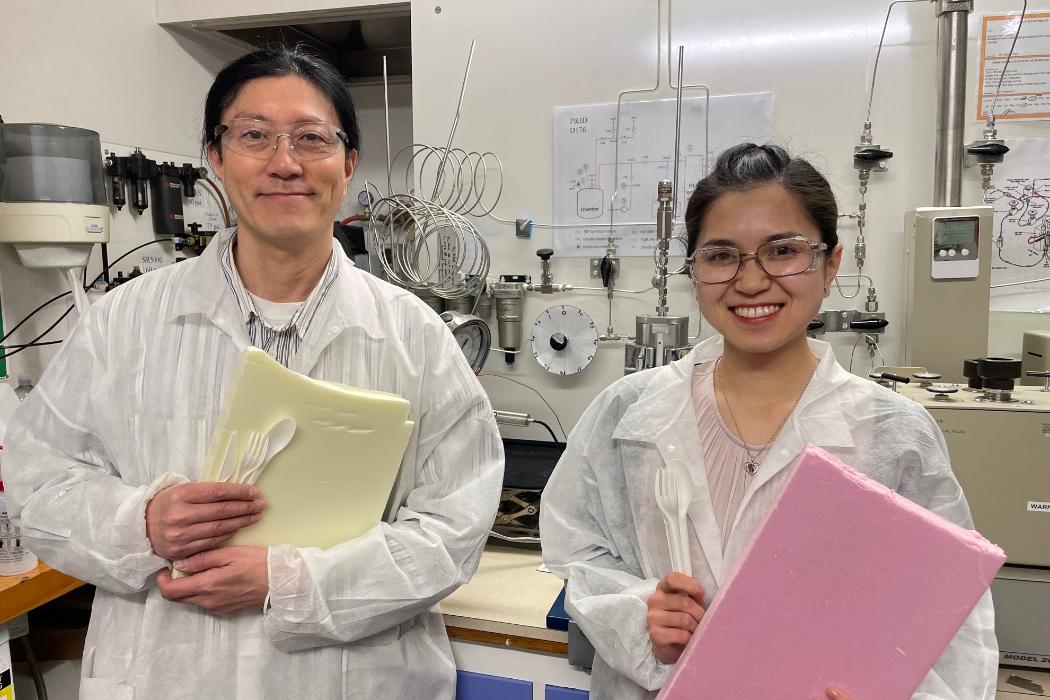
University of Canterbury academic, Dr Heon Park, and co-author and Engineering PhD student, Lilian Lin, with examples of the materials they're studying. Photo credit: University of Canterbury

University of Canterbury academic, Dr Heon Park, and co-author and Engineering PhD student, Lilian Lin, with examples of the materials they're studying. Photo credit: University of Canterbury

Biodegradable plastics are supposed to be good for the environment. But, rather paradoxically, because they are designed to degrade quickly, they can’t be recycled.

Offering a potential solution and a way of recycling the material, New Zealand researchers have found that compostable plastic can be turned into a foam that functions as building insulation.

University of Canterbury academic Dr Heon Park – along with co-authors Chemical and Process Engineering PhD student Lilian Lin and BE(Hons) graduate Young Lee – have developed a method to convert single-use plastic knives, spoons and forks into a foam that can be turned into insulation for walls or flotation devices. This cutlery is made from PLA.

An explanation of polylactic acid

Polylactic acid (PLA) is a plastic made of fermented starch from corn or sugar cane. It is designed to break down harmlessly, but if PLA enters the environment it doesn’t always break down as intended.

Dr Park studies biodegradable foams and the synthesis and processing of biodegradable plastics as part of his many fields of research.

How did the NZ researchers do it?


The researchers placed the cutlery, which was previously thought to be ‘non-foamable’ plastic, into a chamber filled with carbon dioxide. As pressure increased, the gas dissolved into the plastic. When they suddenly released the pressure in the chamber, the carbon dioxide expanded within the plastic, creating foaming.

Dr Park says the process is like opening a can of soda and releasing the carbonation.

AlsoRead...

How supporting Australia’s Care Workforce could strengthen care in the community

How supporting Australia’s Care Workforce could strengthen care in the community

10 September 2026
What HR Must Champion Next, According to Energy Collective Co

The Future of Work Is Changing: What HR must champion next, according to Energy Collective Co

28 August 2026

“By tweaking the temperature and pressure, there is a window where we can make good foams,” he says. “It’s not that every temperature or every pressure works. We found what temperature [and] pressure is the best to make those non-foamable plastics into foams.”

Each time plastic is recycled, it loses a bit of strength. Foams are an ideal material because strength is not important in many applications.

“Whenever we recycle, we degrade the plastics each time,” explains Park. “Let’s say we have a biodegradable spoon. If we use it and we recycle it back into another spoon, it may break in your mouth.”

Alleviate global pollution problems

The ideal structure of a foam depends on its final use. Bulky foams, which have large or plentiful air pockets, are good for buoys. The researchers found, contrary to what was previously thought, lower chamber pressures led to bulky foams.

Making biodegradable plastics recyclable could alleviate some of the global pollution issue. While biodegradable material eventually breaks down in nature, it is even better for the environment if plastics can be repurposed.

Biodegradable and recyclable plastics can be used more than once, but are also less of an environmental threat if they end up in oceans or landfills. The team believes this process could be implemented on a large scale.

“We can expand foaming applications to a lot of plastics, not just this plastic,” says Dr Park.

Tags: environmentNew ZealandPlastic pollutionScientific research
DMCA.com Protection Status

SUBSCRIBE to our NEWSLETTER

[mc4wp_form id=”2384248″]

Don't Miss

How supporting Australia’s Care Workforce could strengthen care in the community

by Pauline Torongo
10 September 2026
How supporting Australia’s Care Workforce could strengthen care in the community
News

Australian care funding faces growing scrutiny after a 2025 ANAO report found NDIS losses from fraud, non-compliance, and payment errors...

Read moreDetails

The Future of Work Is Changing: What HR must champion next, according to Energy Collective Co

by Pauline Torongo
28 August 2026
What HR Must Champion Next, According to Energy Collective Co
Business & Finance

Energy Collective Co examines the root causes of performance by considering how work is designed, how leadership is enacted and...

Read moreDetails

From Empathy Burnout to Body-Led Recovery: What Heidi Jane of Intuition Co. learned by living through what she teaches

by Pauline Torongo
25 August 2026
What Heidi Jane of Intuition Co. learned by living through what she teaches
Lifestyle

Recognising emotional exhaustion is only the first step. While supportive habits such as rest, time in nature, hydration, and reduced...

Read moreDetails

Why Smarter Fleet Management Is For All Modern Business Options

by Fazila Olla-Logday
29 July 2026
Smarter Fleet Management
Motoring

Operating a business that relies on vehicles is harder than ever.

Read moreDetails

Animal Communication Goes Beyond What Science Can Currently Measure: Zoologist and Spiritual teacher Artemis, the heart whisperer on what the textbooks don’t teach

by Australian Times
7 July 2026
Animal Communication Goes Beyond What Science Can Currently Measure
Lifestyle

Animal communication classes and formal training can be valuable, providing tools, structure, and guidance.

Read moreDetails

Managing Aussie Share Portfolios Abroad: Tips for Growth

by Fazila Olla-Logday
2 July 2026
Managing Aussie Share Portfolios Abroad: Tips for Growth
at

Unlock the secrets to optimizing your Aussie share portfolios abroad. Discover essential tips for growth and navigate the global market...

Read moreDetails

The New Meaning of Luxury: Lessons from Entrepreneur Chloe Hardy

by Pauline Torongo
2 July 2026
The New Meaning of Luxury: Lessons from Entrepreneur Chloe Hardy
Business & Finance

Chloe Hardy, the founder and CEO of Dupes & Co established an Australian-made beauty brand focused on affordability and product...

Read moreDetails
Load More

Copyright © Blue Sky Publications Ltd. All Rights Reserved.
australiantimes.co.uk is a division of Blue Sky Publications Ltd. Reproduction without permission prohibited. DMCA.com Protection Status

  • About us
  • Write for Us
  • Advertise
  • Contact us
  • T&Cs, Privacy and GDPR
No Result
View All Result
  • News
    • Weather
    • Sport
    • Technology
    • Business & Finance
      • Currency Zone
    • Lotto Results
      • The Lott
  • Lifestyle
    • Entertainment
    • Horoscopes
    • Health & Wellness
    • Recipes
  • Travel
  • Expat Life
  • Move to Australia

Copyright © Blue Sky Publications Ltd. All Rights Reserved.
australiantimes.co.uk is a division of Blue Sky Publications Ltd. Reproduction without permission prohibited. DMCA.com Protection Status

No Result
View All Result
  • News
    • Weather
    • Sport
    • Technology
    • Business & Finance
      • Currency Zone
    • Lotto Results
      • The Lott
  • Lifestyle
    • Entertainment
    • Horoscopes
    • Health & Wellness
    • Recipes
  • Travel
  • Expat Life
  • Move to Australia

Copyright © Blue Sky Publications Ltd. All Rights Reserved.
australiantimes.co.uk is a division of Blue Sky Publications Ltd. Reproduction without permission prohibited. DMCA.com Protection Status







