

• Advertise
  • About us
  • Terms and Conditions
  • Contact us
Saturday, December 6, 2025
Australian Times News
  • News
    • Weather
    • Sport
    • Technology
    • Business & Finance
      • Currency Zone
    • Lotto Results
      • The Lott
  • Lifestyle
    • Entertainment
    • Horoscopes
    • Health & Wellness
    • Recipes
  • Travel
  • Expat Life
  • Move to Australia
No Result
View All Result
  • News
    • Weather
    • Sport
    • Technology
    • Business & Finance
      • Currency Zone
    • Lotto Results
      • The Lott
  • Lifestyle
    • Entertainment
    • Horoscopes
    • Health & Wellness
    • Recipes
  • Travel
  • Expat Life
  • Move to Australia
No Result
View All Result
Australian Times News
No Result
View All Result
Home News

Coastal landfills risk leaking long-banned toxic chemicals into the ocean

Legacy pollutants like PCBs are chemical contaminants that take a long time to break down in the environment and often still cause harm to humans and wildlife many decades after they are banned.

The Conversation by The Conversation
17-07-2021 06:15
in News
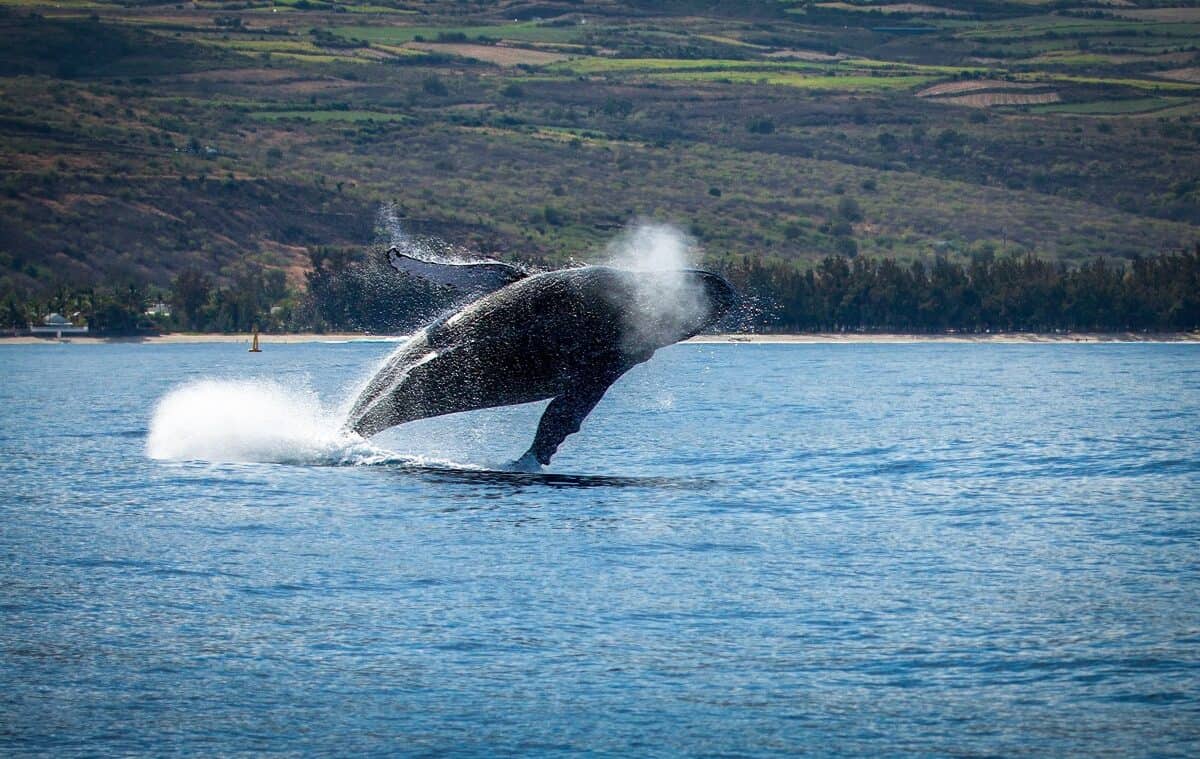
Photo by Rémi Boudousquié on Unsplash

Photo by Rémi Boudousquié on Unsplash

Alex Ford, University of Portsmouth and Kate Spencer, Queen Mary University of London

Five years ago, a killer whale called Lulu washed up on the shores of Scotland. She was thought to be over 20 years old, though autopsies revealed she had never had any offspring. Tissues recovered from Lulu suggested she was one of the most PCB-contaminated animals on the planet. She came from the UK’s only resident killer whales, a group of eight, none of which had ever had young and are now considered infertile from pollution.

Legacy pollutants like PCBs are chemical contaminants that take a long time to break down in the environment and often still cause harm to humans and wildlife many decades after they are banned. Many legacy pollutants have been buried in landfills out of our sight and therefore out of our minds. PCBs or polychlorinated biphenols were used in electrical components and many other materials between the 1930s and 1970s, before being phased out around the world after concerns about their toxicity and ability to accumulate through the food chain. In total, over a million tonnes were produced. A third of this has already been released to the environment, but up to two-thirds is still locked up in either old landfill or storage sites or materials.
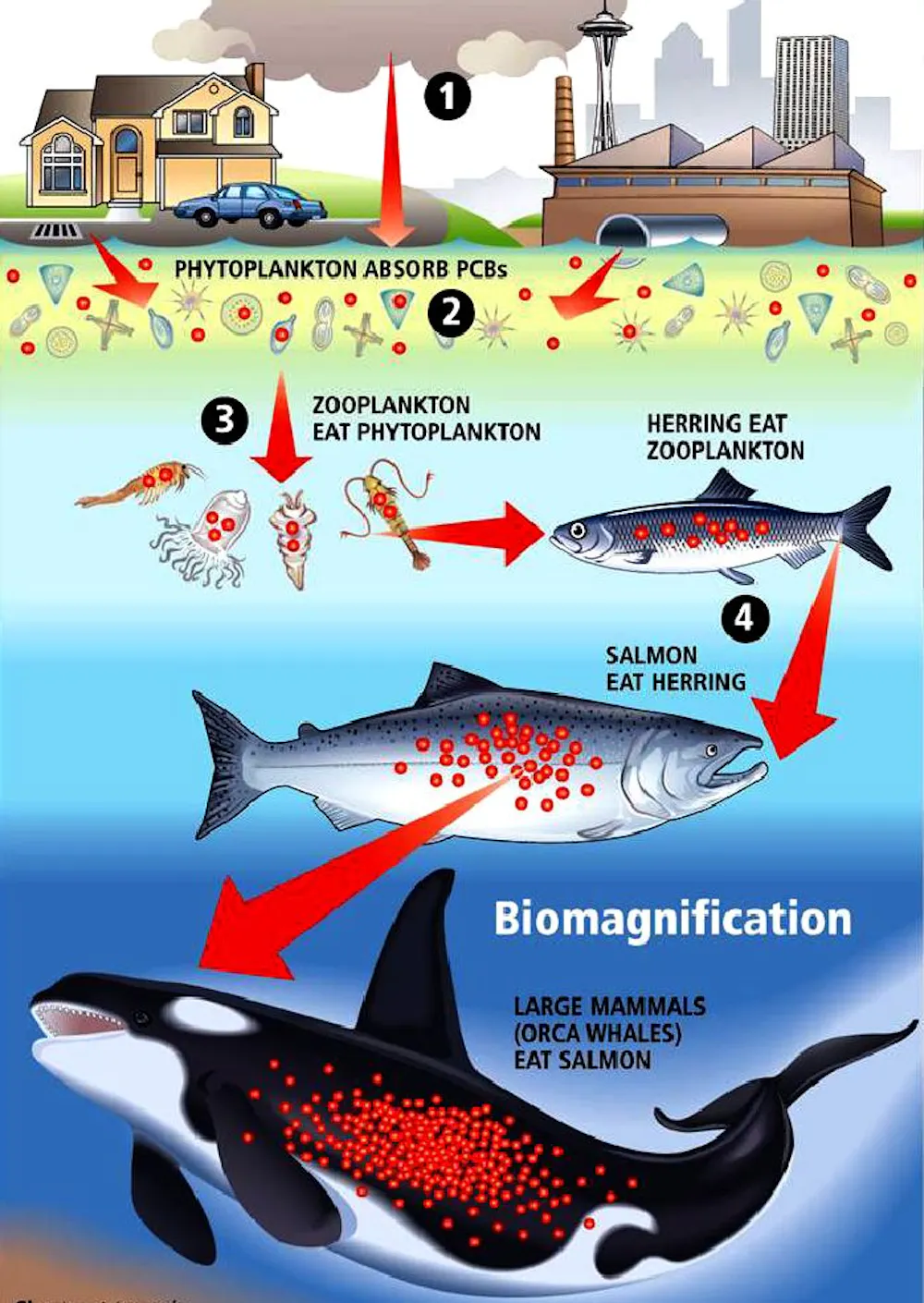
Diagram of PCBs passing through bigger and bigger animals
PCBs accumulate further up the food chain, meaning apex predators like killer whales can become very contaminated. blue-growth.org, CC BY-SA

While some studies have indicated that PCBs released into the environment are in decline, many marine mammals have concentrations way above safe thresholds for their immune system and fertility. This has led some scientists to predict dramatic declines and extinction of some killer whale populations in the next 30 to 50 years. PCB levels in killer whales appear very much dependent on the geographical populations and their diets, with seal-eaters accumulating more pollutants than the fish eaters or the whales with mixed diets.

If the scientists are correct in their predictions, then some marine mammals are at a critical juncture in their survival. The last thing they or future generations need is a second wave of legacy contaminants released from landfills.

The second wave

Historic landfills – those built before the introduction of stringent environmental regulation – are a ticking time bomb, containing millions of tonnes of hazardous, industrial, commercial, domestic and in some cases low-level radioactive and military wastes. Depending on the age of the landfill, they can contain substances that are now banned, such as PCBs and asbestos, and materials that are only just starting to cause concern, such as plastics. In addition, these sites predate legal requirements to record the waste they received or to engineer for pollution control.

In Europe alone there are almost 1 million historic landfill sites and of these, around 10,000 are situated on coasts at risk of climate change, sea-level rise, flooding or erosion with the potential to release their contaminant load directly to the marine environment.


AlsoRead...

Ryan: Building real freedom through e-commerce

Ryan: Building real freedom through e-commerce

27 November 2025
Design Australia Group: Redefining Drafting as the engine of housing growth

Design Australia Group: Redefining Drafting as the engine of housing growth

26 November 2025

There have already been examples of catastrophic flooding and erosion of historic landfills, for example, in Texas, following Hurricane Harvey and in New Zealand, where flooding washed out the disused Fox River landfill releasing waste over hundreds of kilometres of coastline. Such extreme weather events are predicted to increase in frequency under climate change scenarios and in England alone up to 79 coastal landfills could erode by 2055 if sea defences are not maintained and across the UK more than 1,700 are at risk of flooding.
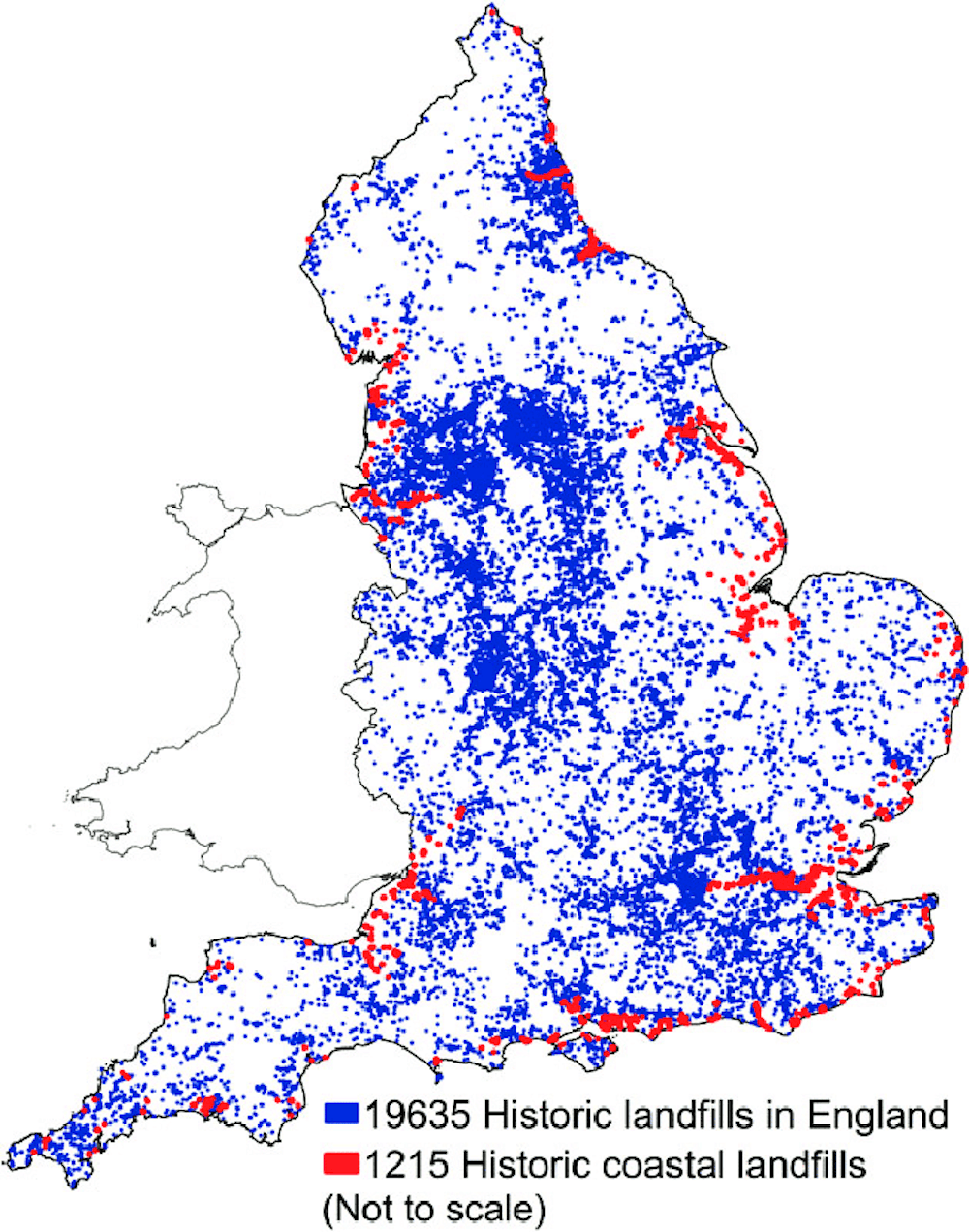
Map of england with dots representing historic and coastal historic landfills
Historic landfill sites in England. ‘Coastal’ includes sites on estuaries and other areas subject to tides. Brand et al 2017, CC BY-SA

None of the options are cheap

The presence of waste can constrain decisions on how to manage the coasts, for instance, by forcing continued maintenance of hard sea defences or “hold the line” policies rather than more sustainable alternatives such as managed retreat or the restoration of coastlines to benefit ecosystems and communities.

However, none of these options are cheap. Authorities looked at one UK south coast landfill and estimated it would cost £200 million to hold the line or £1 billion to relocate the waste, while the restoration of Port Sunlight, Merseyside, cost more than £3 million. Given the potential number of coastal landfills at risk in the UK alone, projections for continued sea-level rise and increased frequency and severity of coastal flooding and erosion it is evident that the UK alone is looking at an issue that will cost billions to address.

This is a long-term societal problem that will cause significant problems for future generations if we ignore it today. That’s why there is a need for national strategies and funding, and the issue can’t be allowed to fall foul of governmental short-termism. Internationally, there need to be coordinated efforts to accept this will be an issue not just for some countries, but all, due to the global importance of healthy oceans.

Alex Ford, Professor of Biology, University of Portsmouth and Kate Spencer, Professor of Environmental Geochemistry, Queen Mary University of London

This article is republished from The Conversation under a Creative Commons license. Read the original article.


Tags: SB001
DMCA.com Protection Status

SUBSCRIBE to our NEWSLETTER

[mc4wp_form id=”2384248″]

Don't Miss

The evolution of Aesthetic Surgery through the lens of Dr Kourosh Tavakoli

by Pauline Torongo
4 December 2025
The evolution of Aesthetic Surgery through the lens of Dr. Kourosh Tavakoli
Health & Wellness

As global interest in Australian cosmetic surgery continues to grow, the combination of regulation, research and emerging digital tools is...

Read moreDetails

Ryan: Building real freedom through e-commerce

by Pauline Torongo
27 November 2025
Ryan: Building real freedom through e-commerce
Business & Finance

Ryan’s greatest achievement isn’t any single business or revenue milestone — it’s the ecosystem he’s built through the Change community.

Read moreDetails

Design Australia Group: Redefining Drafting as the engine of housing growth

by Pauline Torongo
26 November 2025
Design Australia Group: Redefining Drafting as the engine of housing growth
Business & Finance

Australia is under pressure to build homes faster, but design bottlenecks slow progress. Design Australia Group is fixing this by...

Read moreDetails

Louis Guy Detata builds Global Trading Empires through autonomous systems and disciplined leadership

by Pauline Torongo
25 November 2025
Louis Guy Detata builds Global Trading Empires through autonomous systems and disciplined leadership
Business & Finance

The path from investment banking to leading a global trading platform has taught Louis Detata that sustainable success requires more...

Read moreDetails

Burning Eucalyptus Wood: Tips, Advantages, Disadvantages & Alternatives

by Fazila Olla-Logday
20 November 2025
Image Supplied
Enviroment

Learn about burning eucalyptus wood for stoves and fireplaces. Discover benefits, drawbacks, harvesting tips, and better alternative firewood options for...

Read moreDetails

Everything Parents Need to Know About Baby Soft Play and Why It’s a Game Changer

by Fazila Olla-Logday
11 November 2025
Everything Parents Need to Know About Baby Soft Play
Health & Wellness

Baby soft play is a fun, safe, and educational way for little ones to explore and grow. Discover the benefits...

Read moreDetails

WOMAD Sets Up a New Camp in Wiltshire – Australian festival fans take note!

by Kris Griffiths
11 November 2025
Kumbia Boruka brought their reggae and dancehall flavour to the Taste the World Stage at WOMAD 2024 - Credit - Mike Massaro
Entertainment

With its 2026 edition moving to Neston Park in England, WOMAD offers Aussie music lovers a chance to reconnect with global...

Read moreDetails
Load More

Copyright © Blue Sky Publications Ltd. All Rights Reserved.
australiantimes.co.uk is a division of Blue Sky Publications Ltd. Reproduction without permission prohibited. DMCA.com Protection Status

  • About us
  • Write for Us
  • Advertise
  • Contact us
  • T&Cs, Privacy and GDPR
No Result
View All Result
  • News
    • Weather
    • Sport
    • Technology
    • Business & Finance
      • Currency Zone
    • Lotto Results
      • The Lott
  • Lifestyle
    • Entertainment
    • Horoscopes
    • Health & Wellness
    • Recipes
  • Travel
  • Expat Life
  • Move to Australia

Copyright © Blue Sky Publications Ltd. All Rights Reserved.
australiantimes.co.uk is a division of Blue Sky Publications Ltd. Reproduction without permission prohibited. DMCA.com Protection Status

No Result
View All Result
  • News
    • Weather
    • Sport
    • Technology
    • Business & Finance
      • Currency Zone
    • Lotto Results
      • The Lott
  • Lifestyle
    • Entertainment
    • Horoscopes
    • Health & Wellness
    • Recipes
  • Travel
  • Expat Life
  • Move to Australia

Copyright © Blue Sky Publications Ltd. All Rights Reserved.
australiantimes.co.uk is a division of Blue Sky Publications Ltd. Reproduction without permission prohibited. DMCA.com Protection Status





