


• Advertise
  • About us
  • Terms and Conditions
  • Contact us
Monday, March 23, 2026
Australian Times News
  • News
    • Weather
    • Sport
    • Technology
    • Business & Finance
      • Currency Zone
    • Lotto Results
      • The Lott
  • Lifestyle
    • Entertainment
    • Horoscopes
    • Health & Wellness
    • Recipes
  • Travel
  • Expat Life
  • Move to Australia
No Result
View All Result
  • News
    • Weather
    • Sport
    • Technology
    • Business & Finance
      • Currency Zone
    • Lotto Results
      • The Lott
  • Lifestyle
    • Entertainment
    • Horoscopes
    • Health & Wellness
    • Recipes
  • Travel
  • Expat Life
  • Move to Australia
No Result
View All Result
Australian Times News
No Result
View All Result
Home News

Third-largest diamond found in June, then a bigger one days later. What’s behind the monster gem boom?

A mega diamond of a staggering 1,174 carats was recently recovered from the Karowe mine in Botswana, making it one of the largest natural diamonds ever recovered.

The Conversation by The Conversation
12-07-2021 01:39
in News
Photo by Ramiz Culfa on Unsplash

Photo by Ramiz Culfa on Unsplash

Jodie Bradby, Australian National University and Nigel Marks, Curtin University

A mega diamond of a staggering 1,174 carats was recently recovered from the Karowe mine in Botswana, making it one of the largest natural diamonds ever recovered.

More remarkably, the stone was found alongside several other similar diamonds weighing 471, 218 and 159 carats — suggesting the original diamond could have had a weight of more than 2,000 carats when it first formed.

The latest discovery is hot on the heels of another mega diamond of more than 1,000 carats which was recovered from the Jwaneng mine, also in Botswana, only a few weeks ago.

Why are we seeing a sudden rush in the recovery of these mammoth gems?
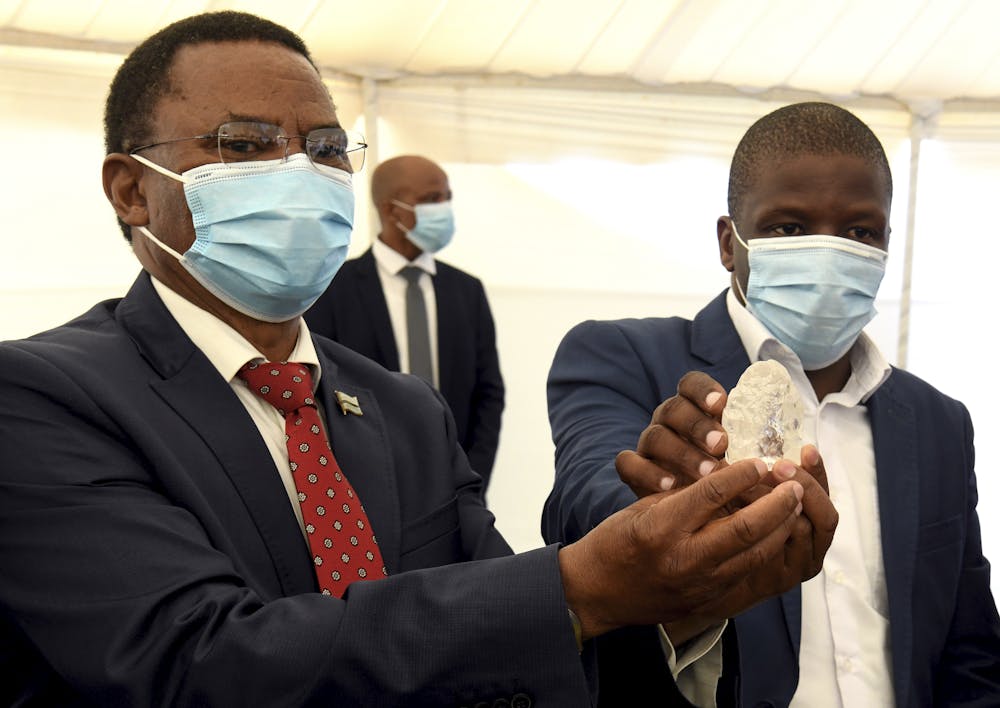
Botswana Vice President Slumber Tsogwane, on the left, holds the 1098 carat diamond unearthed in Botswana in June. This one has now been replaced by a larger one. EPA

Are diamonds really ‘rare’ as they’re said to be?

In 2020, global diamond production amounted to 111 million carats or just over 20 tonnes of diamond. However, a small proportion of this production is of high-quality gemstones. The vast majority of diamonds are small, at less than one carat.

Australia’s Argyle mine, famous for its pink diamonds (and once the world’s largest diamond mine by volume) ceased its operations late last year since it was no longer economically viable. This is because most of the diamonds extracted were small, and therefore only useful for industrial applications.


AlsoRead...

Design Without Compromise: Where Gutter Protection Meets Modern Architecture

Design Without Compromise: Where Gutter Protection Meets Modern Architecture

20 March 2026
The Rise of This Lead Generation Workshop Across Australia

The Rise of This Lead Generation Workshop Across Australia

13 February 2026

These small diamonds are so common that a diamond-tipped scribe tool can be purchased for less than the price of a tank of petrol.

Large gemstone-quality diamonds, on the other hand, are extremely rare. To understand why, we need to look at how diamonds are formed, as well as how they are mined.


How are natural diamonds formed?

Natural diamonds are billions of years old. They’re formed deep in the Earth where temperatures and pressures are high enough to squash carbon atoms into a dense, crystalline structure.

Some scientists have suggested there are vast quantities of diamonds hundreds of kilometres deep. But as the deepest hole ever drilled is about 12km, we will never be able to mine these deep-earth diamonds.

So we have to make do with the relatively tiny fraction that make it to the surface. Diamonds near the ground’s surface are typically thought to have hitched a ride via a deep-source volcanic eruption.

These violent events need to be fast enough to deliver the diamonds to the surface and, at the same time, the diamonds can’t be exposed to extreme heat, shock or oxygen. It’s a narrow Goldilocks scenario.

Most diamonds are found within igneous rocks called Kimberlite. Kimberlite “pipes” are carrot-shaped columns of rock, often just tens of metres across, at the very top of deep-source volcanoes.

But only a small percentage of all known Kimberlite deposits contain diamonds. And only a handful of these are rich enough with diamonds to warrant being mined.

The ideal conditions are very difficult to find. Only particular regions of a continent can host diamonds as the crust has to be thick enough to have hosted a deep volcanic event. It also needs to be stable and ancient — characteristics which are common in parts of Australia and Africa.

Moreover, despite its reputation for being indestructible, diamond is a brittle material. This is a property that must be taken into account when polishing diamonds into gems. At regular atmospheric pressures, diamond is not even the most stable arrangement of carbon atoms.

A crushing task

Large natural diamonds that manage to survive the tortuous path to the surface often get destroyed by the very process of us finding them. In most diamond mines, ore is blasted with explosives and then crushed into fragments to search for diamonds.

But new technologies are allowing mines to process ore with the aid of X-ray ore-sorting technology. This is specifically targeted for “mega diamond recovery”.

Although the diamond world is notoriously secretive about specifics, we do know the latest diamond from the Karowe mine was recovered using these newer techniques. And it’s likely more of these mega stones will be discovered in the future.

Advances in diamond mining techniques, coupled with the inherent rarity of mega diamonds, is a boon for Botswana, where diamonds constitute a significant portion of the country’s GDP.

Diamonds in the lab

Diamonds are getting bigger in the laboratory too. For decades, artificial diamonds were manufactured using high-pressure equipment that mimics the extreme physical conditions deep in the earth.

Now, new technology employing low-pressure conditions and carefully controlled chemistry can make perfect diamond discs as large as a dinner plate.

This chemical approach is being used commercially to manufacture gem-quality stones for jewellery. But making diamonds in this way requires patience. To grow one millimetre of diamond takes the best part of a day, meaning mining will likely play a key role in the diamond industry for some time.


Jodie Bradby, Professor of Physics, Australian National University and Nigel Marks, Associate Professor of Physics, Curtin University

This article is republished from The Conversation under a Creative Commons license. Read the original article.


Tags: SB001
DMCA.com Protection Status

SUBSCRIBE to our NEWSLETTER

[mc4wp_form id=”2384248″]

Don't Miss

Design Without Compromise: Where Gutter Protection Meets Modern Architecture

by Fazila Olla-Logday
20 March 2026
Design Without Compromise: Where Gutter Protection Meets Modern Architecture
Business & Finance

Design without compromise by integrating gutter protection seamlessly into modern architecture. Discover how innovative gutter systems enhance your home’s aesthetics...

Read moreDetails

How WageSafe Secured Australia’s Most Reputable Retail Business Among Its Premium Clients

by Fazila Olla-Logday
12 March 2026
How WageSafe Secured Australia’s Most Reputable Retail Business Among Its Premium Clients
at

Learn how WageSafe helps businesses stay compliant with payroll and wage regulations through reliable monitoring, risk management, and expert support—protecting...

Read moreDetails

Zakeke AI Agent Studio Removes the E-Commerce Content Bottleneck With Outputs in Seconds

by Fazila Olla-Logday
3 March 2026
Zakeke AI Agent Studio Removes the E-Commerce Content Bottleneck With Outputs in Seconds
at

Zakeke AI Agent Studio removes the e-commerce content bottleneck by generating product content and visuals in seconds, enabling brands to...

Read moreDetails

Empire Traveller launches to give Small and Medium Businesses Enterprise-Level Travel rates

by Pauline Torongo
20 February 2026
Empire Traveller launches to give Small and Medium Businesses Enterprise-Level Travel rates
Travel

Empire Traveller suggests the travel sector may be entering a more inclusive phase — one where advantage is shaped less...

Read moreDetails

Is Feng Shui Master Xu Really A Modern Genius?

by Fazila Olla-Logday
19 February 2026
Is Feng Shui Master Xu Really A Modern Genius?
at

Is Feng Shui Master Xu truly a modern genius, or simply a master of timeless wisdom? Blending ancient Feng Shui...

Read moreDetails

The Rise of This Lead Generation Workshop Across Australia

by Pauline Torongo
13 February 2026
The Rise of This Lead Generation Workshop Across Australia
Business & Finance

“Where U?”, is a two-day in-person lead generation workshop that teaches Australian business owners how to build their own acquisition...

Read moreDetails

Lyca Mobile Australia’s Customer-First Overhaul Pays Off with Finder Award Win

by Fazila Olla-Logday
2 February 2026
Lyca Mobile Australia's Customer-First Overhaul Pays Off with Finder Award Win
Technology

Lyca Mobile Australia’s customer-first overhaul has earned a Finder Award, recognising its improved value, service, and stronger focus on Australian...

Read moreDetails
Load More

Copyright © Blue Sky Publications Ltd. All Rights Reserved.
australiantimes.co.uk is a division of Blue Sky Publications Ltd. Reproduction without permission prohibited. DMCA.com Protection Status

  • About us
  • Write for Us
  • Advertise
  • Contact us
  • T&Cs, Privacy and GDPR
No Result
View All Result
  • News
    • Weather
    • Sport
    • Technology
    • Business & Finance
      • Currency Zone
    • Lotto Results
      • The Lott
  • Lifestyle
    • Entertainment
    • Horoscopes
    • Health & Wellness
    • Recipes
  • Travel
  • Expat Life
  • Move to Australia

Copyright © Blue Sky Publications Ltd. All Rights Reserved.
australiantimes.co.uk is a division of Blue Sky Publications Ltd. Reproduction without permission prohibited. DMCA.com Protection Status

No Result
View All Result
  • News
    • Weather
    • Sport
    • Technology
    • Business & Finance
      • Currency Zone
    • Lotto Results
      • The Lott
  • Lifestyle
    • Entertainment
    • Horoscopes
    • Health & Wellness
    • Recipes
  • Travel
  • Expat Life
  • Move to Australia

Copyright © Blue Sky Publications Ltd. All Rights Reserved.
australiantimes.co.uk is a division of Blue Sky Publications Ltd. Reproduction without permission prohibited. DMCA.com Protection Status





