

• Advertise
  • About us
  • Terms and Conditions
  • Contact us
Saturday, December 6, 2025
Australian Times News
  • News
    • Weather
    • Sport
    • Technology
    • Business & Finance
      • Currency Zone
    • Lotto Results
      • The Lott
  • Lifestyle
    • Entertainment
    • Horoscopes
    • Health & Wellness
    • Recipes
  • Travel
  • Expat Life
  • Move to Australia
No Result
View All Result
  • News
    • Weather
    • Sport
    • Technology
    • Business & Finance
      • Currency Zone
    • Lotto Results
      • The Lott
  • Lifestyle
    • Entertainment
    • Horoscopes
    • Health & Wellness
    • Recipes
  • Travel
  • Expat Life
  • Move to Australia
No Result
View All Result
Australian Times News
No Result
View All Result
Home News

NASA is returning to Venus to learn how it became a hot poisonous wasteland – and whether the planet was ever habitable in the past

NASA is finally headed back to Venus. On June 2, 2021, NASA Administrator Bill Nelson announced that the agency had selected two winners of its latest Discovery class spacecraft mission competition, and both are headed to the second planet from the Sun.

The Conversation by The Conversation
17-06-2021 06:27
in News
Photo by Brian McGowan on Unsplash

Photo by Brian McGowan on Unsplash

Paul K. Byrne, North Carolina State University

NASA is finally headed back to Venus. On June 2, 2021, NASA Administrator Bill Nelson announced that the agency had selected two winners of its latest Discovery class spacecraft mission competition, and both are headed to the second planet from the Sun.

I’m a planetary scientist and a self-confessed Venus evangelist, and here’s why I’m so excited that humanity is going back to Venus.

This is the first time since the Magellan mission in 1989 that NASA has committed to sending spacecraft to study the shrouded planet just next door. With the data these two Venus missions – called VERITAS and DAVINCI+ – will collect, planetary scientists can start tackling one of the biggest mysteries in the solar system: Why is Venus, a planet almost the same size, density and age of Earth, so very different from the world humanity calls home?

Venus divided in half with green–yellow clouds on the left and an artists impression of what it might have looked like with oceans, clouds and life on the right.
Venus might once have been covered in oceans and clouds and could have supported life. NASA/JPL-Caltech/Ames

An Earth gone wrong?

Venus is a rocky planet about the same size as Earth, but despite these similarities, it is a brutal place. Although only a little closer to the Sun than Earth, a runaway greenhouse effect means that it’s extremely hot at the surface – about 870 F (465 C), roughly the temperature of a self-cleaning oven. The pressure at the surface is a crushing 90 times the pressure at sea level on Earth. And to top it off, there are sulfuric acid clouds covering the entire planet that corrode anything passing through them.

But perhaps the most fascinating aspect of Venus is that it may have once looked a lot like Earth. Recent climate models suggest that in the past the planet could have had liquid water oceans and a mild climate. It may have been habitable for as long as 3 billion years before succumbing to some sort of climate catastrophe that triggered the runaway greenhouse. The goal of these two new missions to Venus is to try to determine if Venus really was Earth’s twin, why it changed and whether, in general, large rocky planets become habitable oases like Earth… or scorched wastelands like Venus.

A square satellite with two long solar panels above a tan–colored Venus.
The VERITAS mission will send a craft carrying a powerful radar system into orbit above Venus. NASA/JPL–Caltech

Fresh eyes on Venus

What might come as a surprise is that in the 1960s and 1970s Venus was the central focus of space exploration like Mars is today. The U.S. and Soviet Union sent more than 30 spacecraft in total to the second planet from the Sun. But since 1989, only two missions have gone to Venus, and both were focused on studying the atmosphere – the European Space Agency’s Venus Express and Japan’s Akatsuki.


AlsoRead...

Ryan: Building real freedom through e-commerce

Ryan: Building real freedom through e-commerce

27 November 2025
Design Australia Group: Redefining Drafting as the engine of housing growth

Design Australia Group: Redefining Drafting as the engine of housing growth

26 November 2025

In contrast, the VERITAS and DAVINCI+ missions will take a holistic view by exploring the geological and climatological history of Venus as a whole, in two very different but complementary ways.

The thick, global layer of sulfuric acid clouds covering Venus make it almost impossible to see the surface with normal cameras. That’s why the VERITAS orbiter – short for “Venus Emissivity, Radio Science, InSAR, Topography, and Spectroscopy” – will carry a powerful radar system. This radar can peer through the clouds and gather images and topographic data up to 10 times higher-resolution than any previous mission to Venus. This will allow scientists to look for clues about Venus’ earlier climate that may be preserved in rock formations on the surface and might also answer whether the planet is geologically active today. And, finally, this exciting mission will use a special, infrared camera to peer through the atmosphere at very specific wavelengths to take the first global measurements of what Venus’ rocks are made of – something scientists know very little about.

A circular probe with sampling equipment on it falling towards Venus.
The DAVINCI+ probe will fall through the Venus atmosphere collecting samples and snapping photos before it ultimately collides with the Alpha Regio region. NASA GSFC visualization by CI Labs Michael Lentz and others

VERITAS’ stablemate is DAVINCI+, or “Deep Atmosphere Venus Investigation of Noble gases, Chemistry and Imaging.” The DAVINCI+ mission also involves an orbiter, but the real star of the show will be the meter-wide atmospheric probe. The probe will drop into Venus’ atmosphere and free-fall through the thick clouds for about an hour before reaching the surface.

On the way down, it will take samples of the atmosphere, specifically measuring a variety of gases including argon, krypton and xenon. Different climate histories for Venus would lead to different ratios of these noble gases in the atmosphere – and so by analyzing these ratios, scientists will be able to work out how much water the planet formed with, and even how much water it has lost over the past 4.5 billion years.

But that’s not all the probe will do. Just before impacting crash landing into an area called Alpha Regio that has some of the oldest rocks on the planet, the probe will take infrared images of the surface as it comes into view through the gloom of the lower atmosphere. Those images will be the first ever taken from above the surface but below the cloud deck, showing planetary scientists Venus as never before.
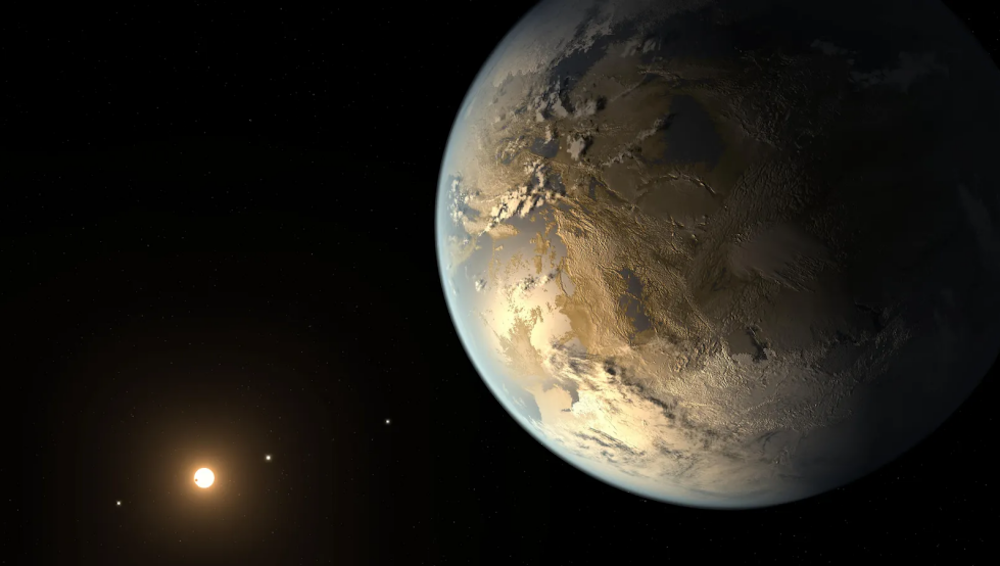
An artists impression of an exoplanet around a different star.
Studying Venus can offer valuable insight into how other rocky, potentially habitable planets in the galaxy – like Kepler-186f, seen here in an artist’s rendition – might evolve. NASA Ames/SETI Institute/JPL-Caltech

Now is the time to go back to Venus

I have argued before for returning to Venus, so to say I’m enthusiastic about these missions is an understatement. Venus may hold the key to understanding the past – and possibly the future – of Earth. As astronomers discover more and more Earth-size worlds around other stars, they need to understand whether the outcome we see on Earth – blue skies, water oceans and even a thriving biosphere – is the norm, or if the hellish, barren wastelands of Venus are the rule.

Several decades of sustained Mars exploration have shown that each mission answers earlier questions and also raises new ones. I don’t know what surprises VERITAS and DAVINCI+, scheduled to launch in the late 2020s, will uncover at Venus, but I do know they’ll discover aspects of the planet that no one had ever imagined. Scientists and mission teams across the world have worked hard to realize a “Decade of Venus,” and it’s starting to pay off. In fact, only a week after NASA’s announcement, the European Space Agency declared its plans for a Venus mission, too. With these new missions, it’s my guess – my hope – that we’re at the start of a new, golden age of Venus exploration.

Paul K. Byrne, Associate Professor of Planetary Science, North Carolina State University

This article is republished from The Conversation under a Creative Commons license. Read the original article.


Tags: SB001
DMCA.com Protection Status

SUBSCRIBE to our NEWSLETTER

[mc4wp_form id=”2384248″]

Don't Miss

The evolution of Aesthetic Surgery through the lens of Dr Kourosh Tavakoli

by Pauline Torongo
4 December 2025
The evolution of Aesthetic Surgery through the lens of Dr. Kourosh Tavakoli
Health & Wellness

As global interest in Australian cosmetic surgery continues to grow, the combination of regulation, research and emerging digital tools is...

Read moreDetails

Ryan: Building real freedom through e-commerce

by Pauline Torongo
27 November 2025
Ryan: Building real freedom through e-commerce
Business & Finance

Ryan’s greatest achievement isn’t any single business or revenue milestone — it’s the ecosystem he’s built through the Change community.

Read moreDetails

Design Australia Group: Redefining Drafting as the engine of housing growth

by Pauline Torongo
26 November 2025
Design Australia Group: Redefining Drafting as the engine of housing growth
Business & Finance

Australia is under pressure to build homes faster, but design bottlenecks slow progress. Design Australia Group is fixing this by...

Read moreDetails

Louis Guy Detata builds Global Trading Empires through autonomous systems and disciplined leadership

by Pauline Torongo
25 November 2025
Louis Guy Detata builds Global Trading Empires through autonomous systems and disciplined leadership
Business & Finance

The path from investment banking to leading a global trading platform has taught Louis Detata that sustainable success requires more...

Read moreDetails

Burning Eucalyptus Wood: Tips, Advantages, Disadvantages & Alternatives

by Fazila Olla-Logday
20 November 2025
Image Supplied
Enviroment

Learn about burning eucalyptus wood for stoves and fireplaces. Discover benefits, drawbacks, harvesting tips, and better alternative firewood options for...

Read moreDetails

Everything Parents Need to Know About Baby Soft Play and Why It’s a Game Changer

by Fazila Olla-Logday
11 November 2025
Everything Parents Need to Know About Baby Soft Play
Health & Wellness

Baby soft play is a fun, safe, and educational way for little ones to explore and grow. Discover the benefits...

Read moreDetails

WOMAD Sets Up a New Camp in Wiltshire – Australian festival fans take note!

by Kris Griffiths
11 November 2025
Kumbia Boruka brought their reggae and dancehall flavour to the Taste the World Stage at WOMAD 2024 - Credit - Mike Massaro
Entertainment

With its 2026 edition moving to Neston Park in England, WOMAD offers Aussie music lovers a chance to reconnect with global...

Read moreDetails
Load More

Copyright © Blue Sky Publications Ltd. All Rights Reserved.
australiantimes.co.uk is a division of Blue Sky Publications Ltd. Reproduction without permission prohibited. DMCA.com Protection Status

  • About us
  • Write for Us
  • Advertise
  • Contact us
  • T&Cs, Privacy and GDPR
No Result
View All Result
  • News
    • Weather
    • Sport
    • Technology
    • Business & Finance
      • Currency Zone
    • Lotto Results
      • The Lott
  • Lifestyle
    • Entertainment
    • Horoscopes
    • Health & Wellness
    • Recipes
  • Travel
  • Expat Life
  • Move to Australia

Copyright © Blue Sky Publications Ltd. All Rights Reserved.
australiantimes.co.uk is a division of Blue Sky Publications Ltd. Reproduction without permission prohibited. DMCA.com Protection Status

No Result
View All Result
  • News
    • Weather
    • Sport
    • Technology
    • Business & Finance
      • Currency Zone
    • Lotto Results
      • The Lott
  • Lifestyle
    • Entertainment
    • Horoscopes
    • Health & Wellness
    • Recipes
  • Travel
  • Expat Life
  • Move to Australia

Copyright © Blue Sky Publications Ltd. All Rights Reserved.
australiantimes.co.uk is a division of Blue Sky Publications Ltd. Reproduction without permission prohibited. DMCA.com Protection Status





