



Peter Thomas, University of Hertfordshire
United Airlines has announced it will purchase up to 50 Boom Overture supersonic jets for commercial use by 2029, heralding the return of supersonic passenger flights nearly 20 years after the Concorde was decommissioned.
Supersonic planes halve the time it takes to fly from New York to London, from seven hours down to 3.5 hours, but such airliners were abandoned following Concorde’s final flight in 2003. Concorde had become financially unworkable after a high-profile crash in 2000, combined with excessive ticket prices, high fuel consumption, and increasingly high maintenance costs.
If Boom’s supersonic aircraft is to succeed, it will depend on overcoming these issues that derailed Concorde. So can it be done?
Breaking the sound barrier
Supersonic flights are so called because they travel faster than the speed of sound. To do this, the aircraft must break through the sound barrier, which requires an efficient aerodynamic design to reduce drag, and considerable thrust from powerful engines to overcome the turbulence caused by shock waves. https://www.youtube.com/embed/JO4_VHM69oI?wmode=transparent&start=0 Breaking the sound barrier produces a loud sonic boom.
Breaking the sound barrier also requires engines which burn through lots of jet fuel – one of Concorde’s key drawbacks and something that’s only become more contentious in recent years. You’d therefore expect Boom, which is in the prototype stage of developing the Overture, to concentrate its designs on increasing fuel efficiency.
The Colorado-based company is likely to choose between a turbojet and turbofan engine. A turbojet produces all of its thrust from its exhaust gas when it is moving at faster speeds. A turbofan engine, meanwhile, derives most of its thrust from the amount of the air it accelerates with its fan blades. The amount of this air defines the engine’s “bypass ratio”.


Higher bypass ratio turbofan engines are more fuel efficient than turbojets. Their lower exhaust speed makes them quieter, but they tend to be larger, resulting in higher drag at supersonic speeds. This drag penalty has outweighed the efficiency of turbofans for prolonged supersonic flight in the past.
A good compromise might be a low bypass turbofan with an afterburner, which injects additional fuel to significantly increase the available thrust, and is commonly used on military jets. Such an engine was used in early production versions of another supersonic passenger jet, the Russian Tupelov Tu-144, but was too inefficient because it needed to keep firing its afterburners to maintain supersonic cruise.
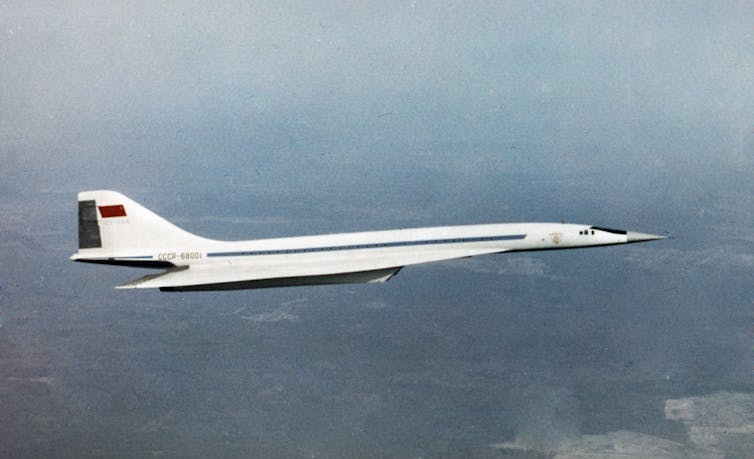
The Tu-144’s afterburner also contributed to a very noisy cabin, humming loudly at 90 decibels – roughly the sound generated by a hairdryer – which exceeds regulatory safety limits. The Concorde’s turbojets, meanwhile, only needed afterburners at take-off and to break through the sound barrier, improving its fuel economy and lowering cabin noise while supercruising.
Supersonic jet noise
Due to the noise they generate, supersonic jets aren’t allowed to fly over land. But these restrictions could be lifted with refined aerodynamic design. For example, research by Nasa on its X-59 QueSST programme hopes to produce optimised airframe shapes which could significantly reduce overland sonic booms to a much quieter “thud” – coming in at 75 decibels rather than the Concorde’s 105 decibel boom.
Getting the aerodynamics right could also open up the possibility of using modern, lightweight composite materials to enable better thrust-to-weight ratios – perhaps eliminating the need for afterburners at take-off.
Substantial developments in computational fluid dynamics software and other simulation programmes since the 1970s will be crucial in evaluating these designs and getting them certified to Boom’s tight production deadlines.
Sustainable aviation fuel
Boom is also promoting its aircraft’s green credentials. Part of the United deal involves collaborative development in establishing a reliable supply of sustainable aviation fuel. This will ultimately benefit other aircraft in United’s fleet and the industry at large, which currently produces around 2.8% of all global CO₂ emissions from fossil fuel combustion.
Sustainable aviation fuels include biofuels and synthetic kerosine that are manufactured using renewable and sustainable materials. An impressive 80% reduction in lifecycle CO₂ emissions is often quoted. The key word here though is “lifecycle”; it doesn’t necessarily mean less harmful emissions from the engine.
These sustainable fuels are compatible with conventional jet fuel, which means no changes to airport fuelling infrastructure or engine design will be needed for them to be introduced – a critical factor in their uptake. But these fuels are very expensive, because the raw materials needed to make them aren’t available at scale. The total amount of sustainable aviation fuel currently being used amounts to just 0.1% of the total fuel spent in the air. Projections estimate this needs to reach somewhere between 1.4% and 3.7% before such fuels become economically viable.
A return to supersonic flights?
Boom will be optimistic that it can overcome fuel efficiency challenges by the time its aircraft begins carrying fare-paying passengers in 2029. Those fares look set to be high, with Boom anticipating a £3,500 price tag per seat. In 1996, British Airways charged around £5,350 – £8,800 in today’s prices – for round-trip tickets from New York to London.
This means that, like Concorde before it, the Boom Overture looks aimed at the luxury market – beyond the reach of even business class passengers. It is likely to be frequented only by those who currently travel via private jet, who may be enticed by Boom’s claims to be a sustainable aircraft manufacturer.
So, while supersonic passenger jets may return to our skies by the end of the decade, the closest most of us will get to experiencing them will be when they unleash their characteristic sonic booms above our heads.
Peter Thomas, Senior Lecturer in Aerospace Engineering, University of Hertfordshire
This article is republished from The Conversation under a Creative Commons license. Read the original article.








