• Advertise
  • About us
  • Terms and Conditions
  • Contact us
Saturday, December 6, 2025
Australian Times News
  • News
    • Weather
    • Sport
    • Technology
    • Business & Finance
      • Currency Zone
    • Lotto Results
      • The Lott
  • Lifestyle
    • Entertainment
    • Horoscopes
    • Health & Wellness
    • Recipes
  • Travel
  • Expat Life
  • Move to Australia
No Result
View All Result
  • News
    • Weather
    • Sport
    • Technology
    • Business & Finance
      • Currency Zone
    • Lotto Results
      • The Lott
  • Lifestyle
    • Entertainment
    • Horoscopes
    • Health & Wellness
    • Recipes
  • Travel
  • Expat Life
  • Move to Australia
No Result
View All Result
Australian Times News
No Result
View All Result
Home News

From smallpox to polio, vaccine rollouts have always had doubters. But they work in the end

The first modern vaccine was the smallpox vaccine which English country general practitioner Edward Jenner developed from cowpox at the end of the 18th century.

The Conversation by The Conversation
08-06-2021 09:17
in News
Photo by JC Gellidon on Unsplash

Photo by JC Gellidon on Unsplash

David Isaacs, University of Sydney

In 2019, before COVID-19, the World Health Organization (WHO) identified vaccine hesitancy as one of the top ten greatest threats to global health.

Every year, vaccination saves around 4-5 million lives, although a further 1.5 million lives could be saved annually with improved global vaccine coverage.
CDC

Now, we are seeing a new round of vaccine hesitancy in some corners as the COVID vaccine is rolled out. But that’s nothing new. Anti-vaccination movements have existed for as long as vaccination.


From cowpox came the smallpox vaccine

The first modern vaccine was the smallpox vaccine which English country general practitioner Edward Jenner developed from cowpox at the end of the 18th century.

Smallpox was known as the “most terrible of all the ministers of death”, so Jenner’s smallpox vaccine was rapidly adopted around the world. However, some were scared or sceptical.

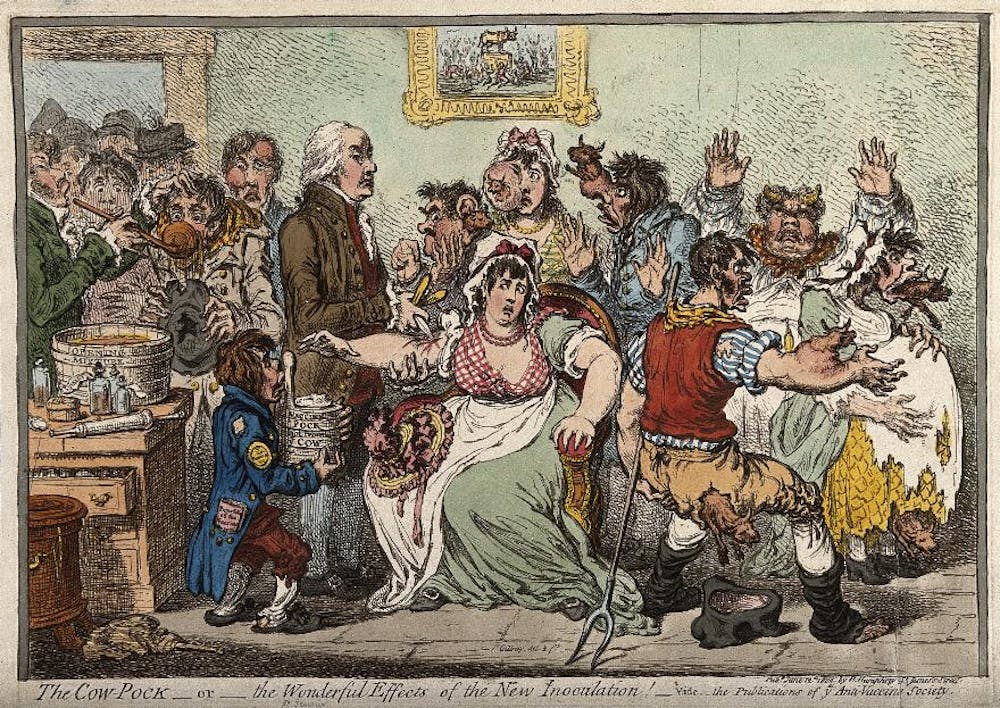
English satirist James Gillray famously depicted cows emerging from the bodies of terrified people being given cowpox vaccine, as seen below.


AlsoRead...

Ryan: Building real freedom through e-commerce

Ryan: Building real freedom through e-commerce

27 November 2025
Design Australia Group: Redefining Drafting as the engine of housing growth

Design Australia Group: Redefining Drafting as the engine of housing growth

26 November 2025
Edward Jenner vaccinating patients in the Smallpox and Inoculation Hospital at St. Pancras: the patients develop features of cows. Coloured etching by J. Gillray, 1802. Wellcome Collection., CC BY-NC-ND

In 1853, concerned by pockets of poor uptake of smallpox vaccine, the British parliament introduced the Vaccination Act, making infant smallpox vaccination compulsory. Mandatory vaccination fomented opposition, something we should remember if considering making a modern vaccine mandatory.

In 1885, over 80,000 vaccine dissenters marched through Leicester carrying banners, a child’s coffin and an effigy of Jenner. Dissent spread to the US and Canada. Eventually, the success of Jenner’s smallpox vaccine silenced the anti-smallpox vaccination movement.

Nevertheless, in 1950, over 50 million people worldwide caught smallpox, most in Africa and India. About 10 million died, and it took an extraordinary WHO campaign, in which Australian virologist Frank Fenner played a key role, to eliminate smallpox from the world forever. That was achieved in 1978.

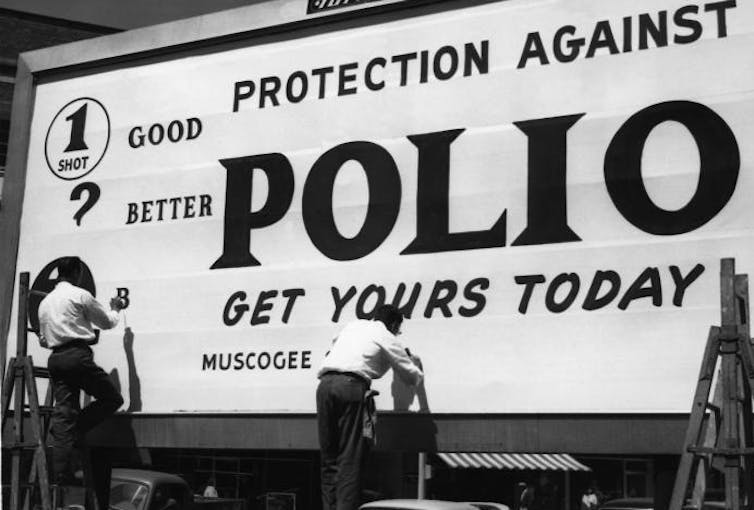
Polio, the silent killer

In the first half of the 20th century, as smallpox began to disappear, polio (infantile paralysis) was the disease most feared in resource-rich countries.

Philip Roth’s novel Nemesis describes the terror of polio, the silent killer, sweeping through Newark, New Jersey, in 1944 killing or paralysing its victims. It is easy to draw parallels with COVID-19.

America was desperate for a polio vaccine. Two Jewish virologists whose families fled the pogroms in Europe, Albert Sabin and Jonas Salk, competed to develop the first polio vaccine.

Salk’s vaccine, made from killed polio viruses, was ready for a large clinical trial in 1954. Families were desperate for their children to be enrolled; children who did so called themselves Polio Pioneers.

Even before the results of the trial were made public, vaccine companies were asked to tender to mass produce the Salk vaccine. Five companies applied, four major pharmaceutical firms and one Californian family firm called Cutter Laboratories. The whole country held its breath and tuned their radios as the trial results were announced.

The press release showed protection against the virus. Reporters cried, “It works, it works”, church bells pealed, sirens blared. Vaccine production began and the vaccine was launched triumphantly in 1955.

The Cutter Incident

But within two weeks disaster struck. Children who received the Cutter vaccine (but not the vaccines made by the four other companies) started to develop paralysis.

Cutter Laboratories had failed to kill the poliovirus incorporated in its vaccine. Of 200,000 children given the Cutter vaccine, 40,000 developed polio, 200 were paralysed and 10 died.

Although the polio vaccination program stalled due to the “Cutter Incident”, the fear of catching polio was so great the public was soon reassured the other vaccines had not caused polio.

Universal polio vaccination resumed with excellent uptake.

This historic 1962 image depicted an aerial view of a long line of people awaiting their polio vaccination. The line was so long, it surrounded a city auditorium in San Antonio, Texas.
This historic 1962 image depicted an aerial view of a long line of people awaiting their polio vaccination. The line was so long, it surrounded a city auditorium in San Antonio, Texas. CDC/Mr. Stafford Smith

What are the lessons from history for COVID-19 vaccination?

Firstly, the public will tolerate risk of harm from a vaccine if their fear of the disease exceeds their fear of the vaccine.

The immediate response of many countries to news of rare but serious cases of blood clotting occurring in people given the AstraZeneca COVID-19 vaccine was to suspend use of the vaccine, at least for younger adults.

In public health, the precautionary principle means acting to prevent harm. Arguably, this is an example of inappropriate use of the precautionary principle (which, in public health, means acting to prevent harm). Perhaps there was not sufficient consideration of the possibility that suspending vaccine delivery was a disproportionate response which would alarm the public and increase vaccine hesitancy.

Although the risk of blood clotting with the AstraZeneca vaccine is extremely low, at times when there is almost no COVID-19 circulating (as sometimes happens in Australia and New Zealand) the risk of dying from blood clotting due to the vaccine is slightly higher than dying from COVID-19.

In Australia, a concentration on individual risk at a single point in time ignores the benefits to the community of widespread vaccine uptake.

This historic image depicts a gathering of people in Columbus, Georgia, who were awaiting their polio vaccination, during the earlier days of the National Polio Immunization Program.
This historic image depicts a gathering of people in Columbus, Georgia, who were awaiting their polio vaccination, during the earlier days of the National Polio Immunization Program. CDC/Charles N. Farmer

And as soon as COVID-19 incidence rises, the risk of dying from COVID-19 massively outweighs any slight vaccine risk.

Indeed, COVID-19 itself is far more likely to cause blood clots than the vaccine. However, contravening autonomy by making vaccination mandatory threatens civil liberties and should only be considered in extreme circumstances.

Complacency, inconvenient access to vaccines, and lack of confidence are key factors in vaccine hesitancy.

However, trusted health workers in communities can build public confidence in vaccines and combat hesitancy.

Open and honest communication about vaccine safety is important, but messaging also needs to put vaccine risk in perspective.

History tells us the public can tolerate risk of harm from vaccines when the severity of the disease warrants the risk.


David Isaacs, Professor of Pediatric Infectious Diseases, University of Sydney

This article is republished from The Conversation under a Creative Commons license. Read the original article.


Tags: SB001
DMCA.com Protection Status

SUBSCRIBE to our NEWSLETTER

[mc4wp_form id=”2384248″]

Don't Miss

The evolution of Aesthetic Surgery through the lens of Dr Kourosh Tavakoli

by Pauline Torongo
4 December 2025
The evolution of Aesthetic Surgery through the lens of Dr. Kourosh Tavakoli
Health & Wellness

As global interest in Australian cosmetic surgery continues to grow, the combination of regulation, research and emerging digital tools is...

Read moreDetails

Ryan: Building real freedom through e-commerce

by Pauline Torongo
27 November 2025
Ryan: Building real freedom through e-commerce
Business & Finance

Ryan’s greatest achievement isn’t any single business or revenue milestone — it’s the ecosystem he’s built through the Change community.

Read moreDetails

Design Australia Group: Redefining Drafting as the engine of housing growth

by Pauline Torongo
26 November 2025
Design Australia Group: Redefining Drafting as the engine of housing growth
Business & Finance

Australia is under pressure to build homes faster, but design bottlenecks slow progress. Design Australia Group is fixing this by...

Read moreDetails

Louis Guy Detata builds Global Trading Empires through autonomous systems and disciplined leadership

by Pauline Torongo
25 November 2025
Louis Guy Detata builds Global Trading Empires through autonomous systems and disciplined leadership
Business & Finance

The path from investment banking to leading a global trading platform has taught Louis Detata that sustainable success requires more...

Read moreDetails

Burning Eucalyptus Wood: Tips, Advantages, Disadvantages & Alternatives

by Fazila Olla-Logday
20 November 2025
Image Supplied
Enviroment

Learn about burning eucalyptus wood for stoves and fireplaces. Discover benefits, drawbacks, harvesting tips, and better alternative firewood options for...

Read moreDetails

Everything Parents Need to Know About Baby Soft Play and Why It’s a Game Changer

by Fazila Olla-Logday
11 November 2025
Everything Parents Need to Know About Baby Soft Play
Health & Wellness

Baby soft play is a fun, safe, and educational way for little ones to explore and grow. Discover the benefits...

Read moreDetails

WOMAD Sets Up a New Camp in Wiltshire – Australian festival fans take note!

by Kris Griffiths
11 November 2025
Kumbia Boruka brought their reggae and dancehall flavour to the Taste the World Stage at WOMAD 2024 - Credit - Mike Massaro
Entertainment

With its 2026 edition moving to Neston Park in England, WOMAD offers Aussie music lovers a chance to reconnect with global...

Read moreDetails
Load More

Copyright © Blue Sky Publications Ltd. All Rights Reserved.
australiantimes.co.uk is a division of Blue Sky Publications Ltd. Reproduction without permission prohibited. DMCA.com Protection Status

  • About us
  • Write for Us
  • Advertise
  • Contact us
  • T&Cs, Privacy and GDPR
No Result
View All Result
  • News
    • Weather
    • Sport
    • Technology
    • Business & Finance
      • Currency Zone
    • Lotto Results
      • The Lott
  • Lifestyle
    • Entertainment
    • Horoscopes
    • Health & Wellness
    • Recipes
  • Travel
  • Expat Life
  • Move to Australia

Copyright © Blue Sky Publications Ltd. All Rights Reserved.
australiantimes.co.uk is a division of Blue Sky Publications Ltd. Reproduction without permission prohibited. DMCA.com Protection Status

No Result
View All Result
  • News
    • Weather
    • Sport
    • Technology
    • Business & Finance
      • Currency Zone
    • Lotto Results
      • The Lott
  • Lifestyle
    • Entertainment
    • Horoscopes
    • Health & Wellness
    • Recipes
  • Travel
  • Expat Life
  • Move to Australia

Copyright © Blue Sky Publications Ltd. All Rights Reserved.
australiantimes.co.uk is a division of Blue Sky Publications Ltd. Reproduction without permission prohibited. DMCA.com Protection Status