


Annie Curtis, RCSI University of Medicine and Health Sciences
When microorganisms – such as bacteria or viruses – infect us, our immune system jumps into action. It’s highly trained to sense and eliminate infections and clear up any damage caused by them.
It’s typically assumed our immune systems work the exact same way regardless of whether an infection occurs during the day or at night. But research spanning over half a century now shows our bodies actually respond differently at day and night. The reason for this is our body clock, and the fact that each cell in the body, including our immune cells, can tell what time of day it is.
Our body clock has evolved over millions of years to help us survive. Every cell in the body has a collection of proteins that indicate the time depending on their levels. Knowing whether it’s day or night means our body can adjust its functions and behaviours (such as when we want to eat) to the correct time.
Our body clock does this by generating 24 hour rhythms (also termed circadian rhythms) in how cells function. For example, our body clock ensures that we only produce melatonin as night falls, as this chemical makes us tired – signalling it’s time for sleep.
Our immune system is composed of many different types of immune cells that are continually patrolling the body looking for evidence of infection or damage. But it is our body clock that determines where those cells are located at particular times of the day.
Broadly speaking, our immune cells migrate into tissues during the day and then circulate around the body at night. This circadian rhythm of immune cells may have evolved so that immune cells are directly located in tissues at a time when we are more likely to be infected, primed for attack.


At night, our immune cells circulate around the body and stop off at our lymph nodes. Here, they build up memory of what was encountered during the day – including any infections. This ensures they can respond better to the infection the next time they encounter it.
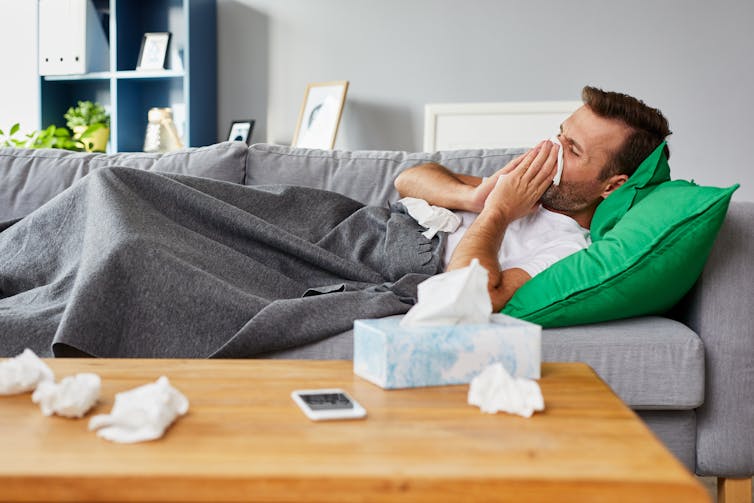
Given the body clock’s control over our immune system, it’s hardly surprising to learn that some research has shown that the time we’re infected with a virus – such as influenza or hepatitis – can impact how sick we become. The exact timing is likely to differ depending on the virus in question.
Other research has also shown that the time we take our medicines can affect how well they work – but again, this depends on the drug in question. For example, since we make cholesterol when we sleep, taking a short-acting statin (a cholesterol-lowering drug) just before bedtime provides the most benefit. It’s also been shown that time of day impacts how well certain types of immune cells work.
Body clocks and vaccines
There’s also an increasing body of evidence showing vaccines – which create an immune “memory” of a particular pathogen – are impacted by our body clock, and the time of day that a vaccine is administered.
For example, a 2016 randomised trial of over 250 adults aged 65 and older showed having the influenza vaccine in the morning (between 9am and 11am) resulted in a greater antibody response compared to those vaccinated in the afternoon (between 3pm and 5pm).
More recently, people in the mid-twenties who were immunised with the BCG (tuberculosis) vaccine between 8am and 9am had an enhanced immune response compared to those vaccinated between noon and 1pm. So for certain vaccines, there’s evidence that early morning vaccination may provide a more robust response.
One reason for seeing improved immune response to vaccines in the morning may be due to the way our body clock controls sleep. In fact, studies have found that sufficient sleep after vaccination for hepatitis A improves the immune response by increasing the number of vaccine-specific immune cells which provide long term immunity compared to those who had restricted sleep following vaccination.
It’s still not fully understood why sleep improves vaccine response, but it might be because of how our body clock directly controls immune cell function and location during sleep. So for example, it sends the immune cells to our lymph nodes while we sleep to learn about what infections were encountered during the day, and to build a “memory” of this.
Of course this raises the question of how this might all relate to the current pandemic and worldwide vaccination programmes. How our immune body clock works might be important in terms of whether we develop COVID-19. Intriguingly, the receptor which allows the COVID virus, SARS-CoV-2, to gain entry into our cells is under control of our body clock.
In fact, there are higher levels of this receptor on the cells which line our airways at distinct times of day. This could mean we’re more likely to get COVID-19 at certain times of the day, but further research will be needed to determine whether this is the case.
Whether the time of day we’re vaccinated against COVID-19 impacts immune response remains to be answered. Given the high effectiveness of many COVID-19 vaccines (with both Pfizer and Moderna reporting over 90% efficacy) and the urgency with which we need to vaccinate, people should be vaccinated at whatever time of day is possible for them.
But current and future vaccines which do not have such high efficacy rates – such as the flu vaccine – or if they’re used in people with poorer immune response (such as older adults), using a more precise “timed” approach may ensure better immune response.
Annie Curtis, Senior Lecturer, Medicine and Health Sciences, RCSI University of Medicine and Health Sciences
This article is republished from The Conversation under a Creative Commons license. Read the original article.







