



Karen Levy, University of Washington
Kill every human on the planet.
This is the first assignment I give students in my public health classes, filled with do-gooders passionate about saving the world. Their homework is to play a game called Plague, in which they pretend to be pathogens bent on infecting everyone on the globe before humans can develop a cure or a vaccine.
Why this assignment? Because as a professor of infectious disease epidemiology, I aim to teach students to think like pathogens so they can learn how to control them.
With COVID-19, thinking like a pathogen leads to an inevitable conclusion: Getting the vaccine out to everyone in the world as quickly as possible is not just an ethical imperative, but also a selfish one.
Passing on genetic material a key goal
While many wealthy countries soon will offer vaccines to their entire populations, people in poorer countries might have to wait years for their shots. About half of U.S. residents are now at least partially vaccinated. Many other countries have yet to reach 1% vaccination coverage.
In the interim, SARS-CoV-2 will take advantage of this opening.


In reality, pathogens don’t actually want to kill all of their human hosts, because they would eventually have nowhere to live. Their goal is to pass on their genetic material to the next generation. They will do what they can to answer their evolutionary call.
A virus to-do list
Of course, viruses and bacteria don’t have brains so they don’t “think,” per se. But like all life forms, these particular living creatures are trying to maximize their chances of reproducing and having their offspring survive and reproduce.
As a single virus particle, you have two key items on the to-do list. First, you need a place to propagate. You need to reproduce yourself in large numbers, to increase the chances that one of your kids will do the right thing and provide you with some grandchildren. As a virus you are very good at this bit. No need to visit Tinder and find the perfect match, as you reproduce asexually. Instead you use the cellular machinery of your host – the human you infect – to reproduce yourself.
Second, you need a way to get from your current host to the next host that you will infect, otherwise known as transmission. For that you need both a portal of exit – the way to get out of your current host – and a portal of entry – the way to get into your next host. You need a susceptible host. And you need a way to travel to your next host.
Susceptible hosts? That was easy for SARS-CoV-2 when it first came on the scene. Because it was a novel pathogen, the entire global population was susceptible. No humans had full immunity to this particular virus from previous exposure, because it didn’t exist in human populations before 2019. Now, with each person who gets exposed or vaccinated, the number of susceptible hosts dwindles.
For a portal of exit, SARS-CoV-2 has a few options – mostly exhalation through breathing, but also through pooping and expelling other bodily fluids. For a portal of entry it has inhalation – the new host breathes it in – and to a lesser extent ingestion – the new host consumes it orally.
This means that transmission of this virus is relatively easy, involving an activity that people of all ages do all day: breathing. Other viruses require more specific activities or conditions, such as sexual intercourse or needle-sharing for HIV, or being bitten by a particular species of mosquito for Zika.

SARS-CoV-2 is one smart virus
SARS-CoV-2 has had a lot of things playing in its favor, aside from having a global population naïve to it. Several other characteristics make it particularly successful.
First, while it does kill, it can also cause mild or asymptomatic infections in others. When pathogens kill most of their hosts, they are not so successful in spreading, because humans change their behavior in response to the perceived threat of the disease.
Ebola is a perfect example. College students would have been more likely to cancel their spring break plans to Florida in 2020 if they had expected that it might cause them to bleed out of their eyeballs, as happens in some people infected with the Ebola virus.
SARS-CoV-2 also has a long incubation period – the time between its infection of a new host and the start of the host’s symptoms. Yet it can be transmitted during the time before symptoms occur, which allows it to spread unnoticed.
More transmission, more new variants
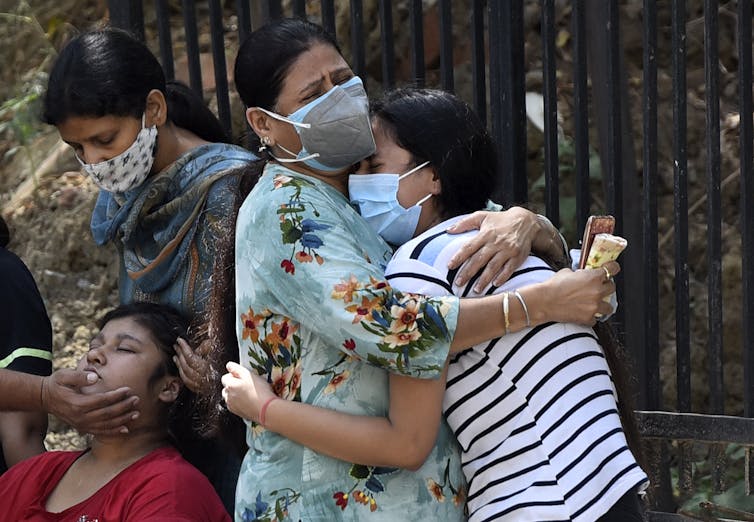
If you’re thinking like the SARS-CoV-2 pathogen now, you’re furiously searching for a way around current vaccine formulations. The more cases you cause, the more chances you have for new variants that can break through the vaccines. You don’t care whether these cases occur in Montana or Mumbai. This is why no human is safe from the pandemic until transmission is controlled everywhere.
Thinking like a pathogen requires thinking over an evolutionary time scale, which for a virus is very short, sometimes the course of a single human infection. SARS-CoV-2 and other viruses have astonishing powers to adapt to changing conditions.
One of their survival strategies is the built-in mistakes in their reproduction machinery that cause mutations. Occasionally, a mutation occurs that improves the ability of a virus to survive and spread.
This leads to new variants, like those we have seen emerge recently. So far, available vaccines appear effective against the variants. But new variants may reduce vaccine effectiveness, or lead to a need for booster shots. The increased transmissibility of the new variants has already likely made chances of reaching herd immunity through vaccination out of reach.
We watch in horror as the virus ravages India, and to some it may seem like a distant threat. But every new case offers another opportunity for a new variant to emerge and spread worldwide.
To outsmart the virus, we need shots in arms everywhere
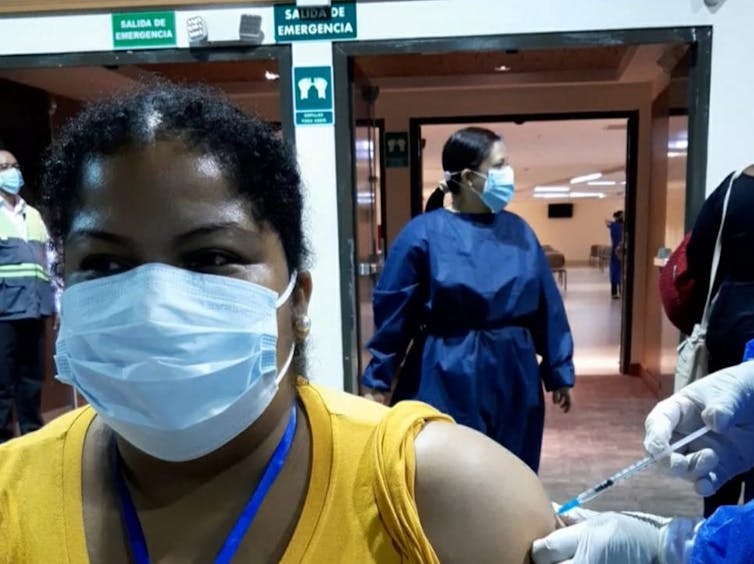
That is why global access to vaccines is not only a moral imperative but also the only way to outsmart the virus. The U.S. can do a lot right now to ensure global access to vaccines even as we step up vaccination here.
The U.S. has already made substantial commitments to COVAX, a global collaboration to accelerate the development and manufacture of COVID-19 vaccines and guarantee equitable distribution.
The U.S. could channel additional funds now and pressure other countries to do the same. Funding commitments to COVAX may be hollow without a concurrent plan to quickly distribute the vaccine stockpile the U.S. has amassed as we raced to buy up the first available doses.
In addition to vaccination, the U.S. and other well-resourced countries can help increase the availability of testing in all countries. These countries can also provide technical and logistics assistance to improve vaccine rollout efforts and work to coordinate and improve global genomic surveillance so new variants are quickly identified.
[Get facts about coronavirus and the latest research. Sign up for The Conversation’s newsletter.]
If this all seems expensive, think of the crushing economic costs of going back into lockdown. This is no time to be cheap.
To avoid jeopardizing the effectiveness of the millions of shots going into arms in rich countries, we must get shots into the arms of people in all countries.
Karen Levy, Associate Professor of Environmental & Occupational Health Sciences, University of Washington
This article is republished from The Conversation under a Creative Commons license. Read the original article.







