

• Advertise
  • About us
  • Terms and Conditions
  • Contact us
Thursday, May 14, 2026
Australian Times News
  • News
    • Weather
    • Sport
    • Technology
    • Business & Finance
      • Currency Zone
    • Lotto Results
      • The Lott
  • Lifestyle
    • Entertainment
    • Horoscopes
    • Health & Wellness
    • Recipes
  • Travel
  • Expat Life
  • Move to Australia
No Result
View All Result
  • News
    • Weather
    • Sport
    • Technology
    • Business & Finance
      • Currency Zone
    • Lotto Results
      • The Lott
  • Lifestyle
    • Entertainment
    • Horoscopes
    • Health & Wellness
    • Recipes
  • Travel
  • Expat Life
  • Move to Australia
No Result
View All Result
Australian Times News
No Result
View All Result
Home News

What would happen to the climate if we reforested the entire tropics?

Trees and forests have become increasingly important in plans to tackle the climate emergency, yet our work shows that once you factor in how the soil, oceans and other parts of the Earth system would respond, tree planting is not as potent a solution as it may first seem.

The Conversation by The Conversation
29-05-2021 01:55
in News
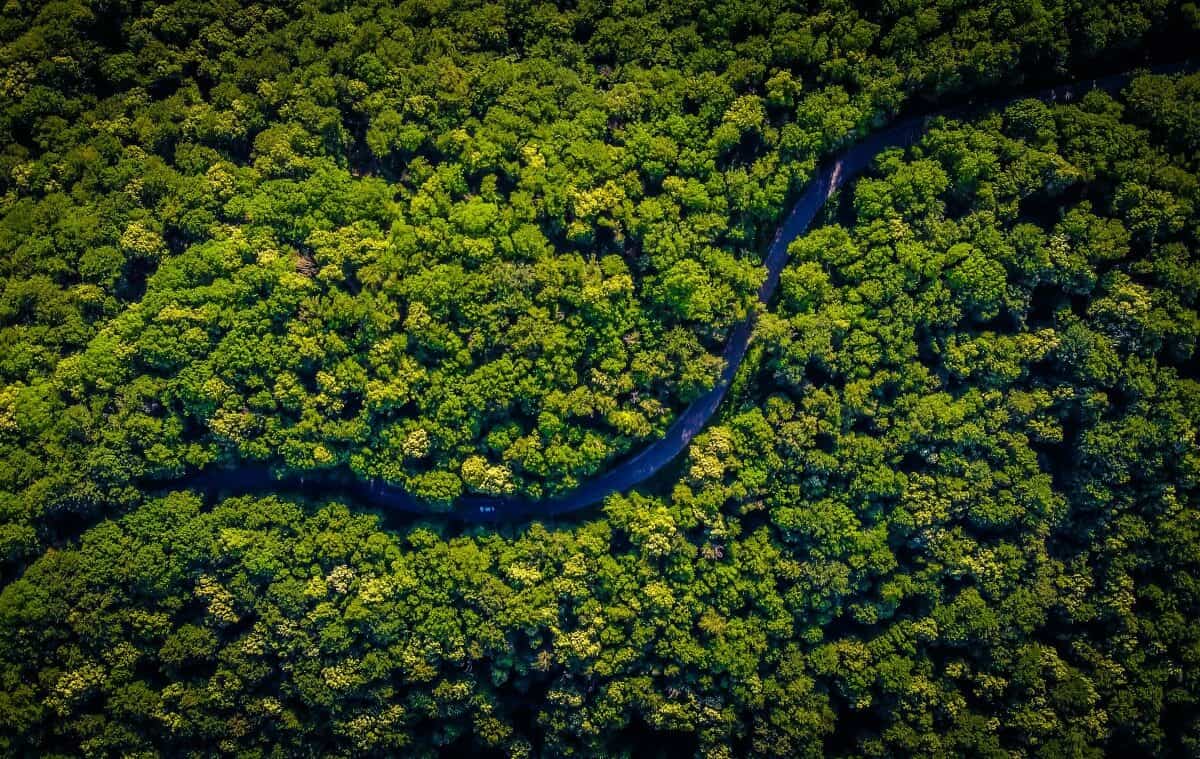
Photo by Vlad Hilitanu on Unsplash

Photo by Vlad Hilitanu on Unsplash

Simon Lewis, UCL; Alexander Koch, University of Hong Kong, and Chris Brierley, UCL

What would happen if every single patch of farmland in the tropics, from Brazil through Congo, India and Indonesia, was abandoned overnight and left to turn back into forests? That’s the question we investigated in our new research. Trees and forests have become increasingly important in plans to tackle the climate emergency, yet our work shows that once you factor in how the soil, oceans and other parts of the Earth system would respond, tree planting is not as potent a solution as it may first seem.

Of course, abandoning agriculture in the tropics cannot be a solution to climate change. This was a hypothetical and idealised experiment, but one that helps us to explore how the global carbon cycle might respond to forest restoration and tree planting on a vast scale. And targeting the tropics shows maximum impact as trees grow fast there.

To investigate the question, we used the UK Met Office’s climate change model – a computer simulation of the Earth as a system in which the oceans, land and climate interact and affect each other. We simulated two futures. First, a scenario where the world takes serious action to limit warming to less than 2℃. The second scenario was identical, except all farming across the tropics was stopped and the original vegetation, mostly forests, would recover.

The difference between the two scenarios shows that the new tropical trees would store an extra 124 billion tonnes of carbon by the year 2100, or around 13 years’ worth of today’s rate of fossil fuel emissions. All this extra carbon would have been taken from the atmosphere through photosynthesis. However, carbon in the atmosphere – which matters for climate change – would drop by only 18 billion tonnes, just two years’ worth of emissions. What explains the huge difference?
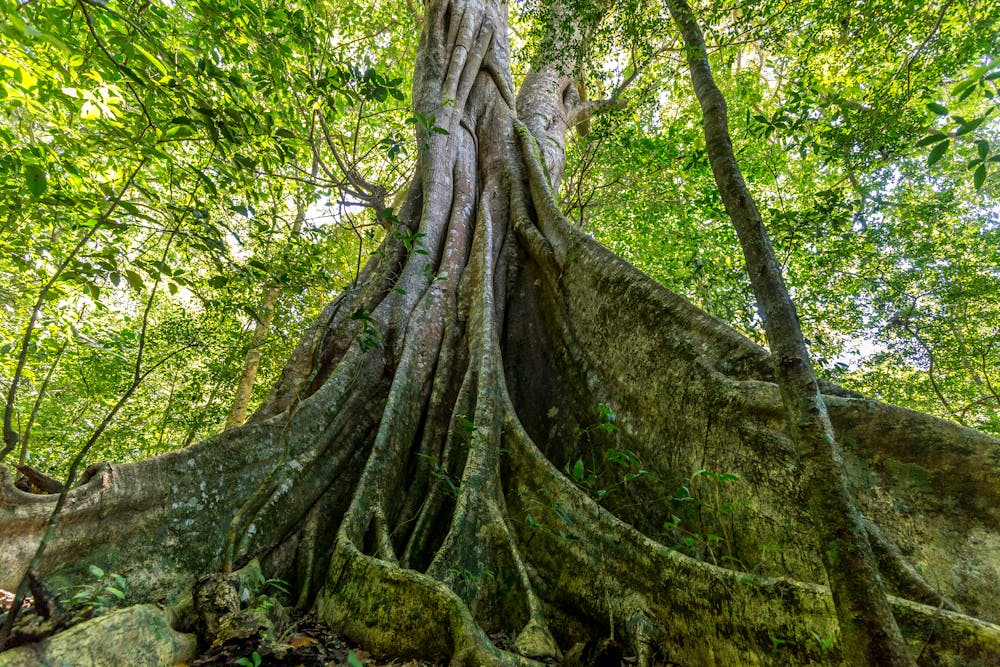
Large tree root in tropical forest
Reforesting the tropics would mean more carbon stored in trees, but less absorbed in soil. Serge Goujon/shutterstock

The reason is that other parts of the Earth system counteract the effect of the new tree growth. If the tropics were reforested, our model predicts that the oceans, soil and vegetation would absorb less carbon dioxide. By the end of the century, tropical trees would take up an extra 124 billion tonnes of carbon (or 124 gigatonnes, Gt), but tropical soils would take up 83 Gt less carbon, as the turnover of dead plants is much slower in forests compared with grasses and crops that die annually, meaning lower carbon inputs in forest soils and lower carbon storage.

Lower carbon dioxide levels in the atmosphere would also affect vegetation and soils elsewhere in the world. Less carbon dioxide in the atmosphere would mean plant growth slows. And just as in the tropics, less carbon would be taken up by soils.


AlsoRead...

Svitla Systems

Svitla Systems acquires Australia’s Kiandra IT to expand Global Engineering Footprint and Accelerate AI-Driven delivery

11 May 2026
How Clevero is helping Australian Service Businesses compete with Enterprises on a Fraction of the Budget

How Clevero is helping Australian Service Businesses compete with Enterprises on a Fraction of the Budget

28 April 2026

There would be one other major change to the Earth system. The oceans slow climate change by removing carbon dioxide from the atmosphere: as CO₂ levels increase some of the extra carbon dioxide dissolves into the seawater. And in our model, the oceans would take up less carbon since the new tropical trees would lower atmospheric CO₂.

To recap: we started with new trees in the tropics taking 124 Gt of carbon out of the atmosphere. Avoiding deforestation adds a further 10 Gt. But once you subtract the carbon no longer stored in tropical forest soils (83 Gt), in soils and vegetation elsewhere (18 Gt), and in the oceans (15 Gt), you aren’t left with much.
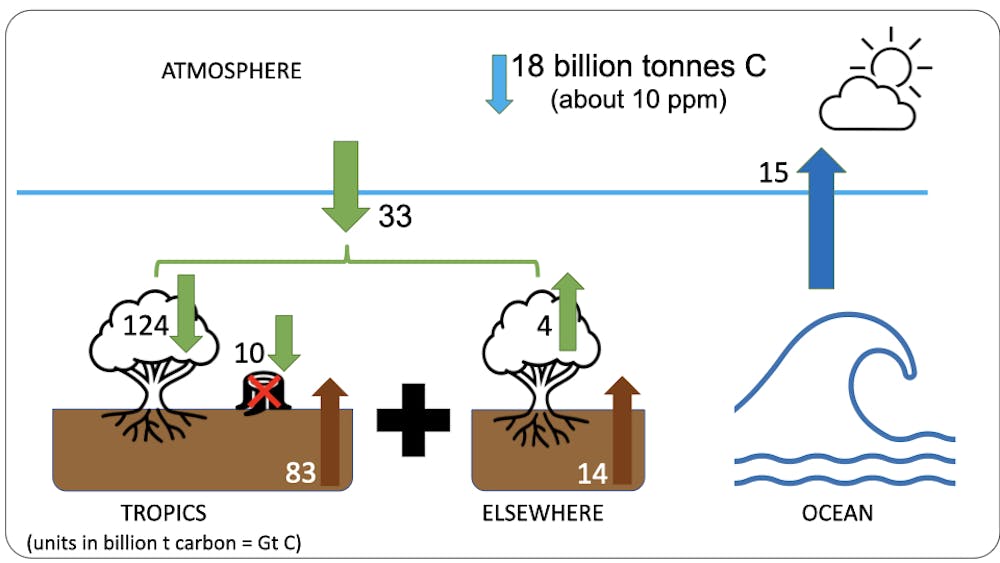
Chart showing flows of carbon in and out of the atmosphere.
How the full tropical reforestation scenario adds up. Lewis, Koch, Brierley, Author provided

Remarkably, reforesting the tropics – after accounting for soil, vegetation, and ocean responses – results in only 18 Gt of carbon taken from the atmosphere. This is an 86% reduction from our initial extra carbon in tropical trees. This 18 Gt equates to just ten parts per million reduction in atmospheric carbon dioxide.

The Earth system works against us

What we found in our hypothetical scenario is the reverse of what is happening today. When carbon dioxide is released from burning fossil fuels, a little less than half of those emissions remain in the atmosphere and contribute to climate change. The rest are absorbed by the oceans, soil and vegetation. This has been a great free subsidy from nature.

But here is the catch: just as the amount of carbon absorbed in the land and ocean increases as we pump more carbon dioxide into the atmosphere, the reverse happens when we take it out of the atmosphere. The Earth system starts to work against us when we plant trees or use other methods of removing atmospheric CO₂.

These results are sobering. Even something as radical as reforesting the entire tropics – far beyond any plausible real-world policy outcome – would have less influence on the climate than you might think. But these results also highlight that the best way to avoid dangerous global heating is by not releasing fossil carbon into the atmosphere in the first place.

Simon Lewis, Professor of Global Change Science at University of Leeds and, UCL; Alexander Koch, Postdoctoral Research Associate, Earth Sciences, University of Hong Kong, and Chris Brierley, Associate Professor of Geography, UCL

This article is republished from The Conversation under a Creative Commons license. Read the original article.


Tags: SB001
DMCA.com Protection Status

SUBSCRIBE to our NEWSLETTER

[mc4wp_form id=”2384248″]

Don't Miss

Svitla Systems acquires Australia’s Kiandra IT to expand Global Engineering Footprint and Accelerate AI-Driven delivery

by Pauline Torongo
11 May 2026
Svitla Systems
Business & Finance

Acquisition marks Svitla’s entry into the Australian market and strengthens capabilities in low-code, Microsoft technologies, and enterprise software engineering.

Read moreDetails

Residential Healthcare Practices: Revolution or Evolution?

by Pauline Torongo
11 May 2026
Residential Healthcare Practices: Revolution or Evolution?
Lifestyle

President Bill Lutz’s "revolution" was born from his background in fine dining, which instilled a disciplined, customer-focused approach.

Read moreDetails

Medicana Health Group launches HPV vaccination campaign to support cervical cancer prevention

by Pauline Torongo
28 April 2026
Medicana Health Group launches HPV vaccination campaign to support cervical cancer prevention
Health & Wellness

The Türkiye-based healthcare group has introduced a new awareness campaign focused on HPV vaccination, regular check-ups and early detection, with...

Read moreDetails

How Clevero is helping Australian Service Businesses compete with Enterprises on a Fraction of the Budget

by Pauline Torongo
28 April 2026
How Clevero is helping Australian Service Businesses compete with Enterprises on a Fraction of the Budget
Business & Finance

By consolidating CRM, scheduling, workflow automation, invoicing, reporting, and client communications into a single platform, Clevero gives smaller operators the...

Read moreDetails

How CJAM Group is building 1,100 homes across Southeast Queensland

by Pauline Torongo
24 March 2026
How CJAM Group is building 1,100 homes across Southeast Queensland
Lifestyle

The CJAM Group founder is quietly building a 1,100+ home pipeline, with projects in Hervey Bay and Toowoomba, using a...

Read moreDetails

Design Without Compromise: Where Gutter Protection Meets Modern Architecture

by Fazila Olla-Logday
20 March 2026
Design Without Compromise: Where Gutter Protection Meets Modern Architecture
Business & Finance

Design without compromise by integrating gutter protection seamlessly into modern architecture. Discover how innovative gutter systems enhance your home’s aesthetics...

Read moreDetails

How WageSafe Secured Australia’s Most Reputable Retail Business Among Its Premium Clients

by Fazila Olla-Logday
12 March 2026
How WageSafe Secured Australia’s Most Reputable Retail Business Among Its Premium Clients
at

Learn how WageSafe helps businesses stay compliant with payroll and wage regulations through reliable monitoring, risk management, and expert support—protecting...

Read moreDetails
Load More

Copyright © Blue Sky Publications Ltd. All Rights Reserved.
australiantimes.co.uk is a division of Blue Sky Publications Ltd. Reproduction without permission prohibited. DMCA.com Protection Status

  • About us
  • Write for Us
  • Advertise
  • Contact us
  • T&Cs, Privacy and GDPR
No Result
View All Result
  • News
    • Weather
    • Sport
    • Technology
    • Business & Finance
      • Currency Zone
    • Lotto Results
      • The Lott
  • Lifestyle
    • Entertainment
    • Horoscopes
    • Health & Wellness
    • Recipes
  • Travel
  • Expat Life
  • Move to Australia

Copyright © Blue Sky Publications Ltd. All Rights Reserved.
australiantimes.co.uk is a division of Blue Sky Publications Ltd. Reproduction without permission prohibited. DMCA.com Protection Status

No Result
View All Result
  • News
    • Weather
    • Sport
    • Technology
    • Business & Finance
      • Currency Zone
    • Lotto Results
      • The Lott
  • Lifestyle
    • Entertainment
    • Horoscopes
    • Health & Wellness
    • Recipes
  • Travel
  • Expat Life
  • Move to Australia

Copyright © Blue Sky Publications Ltd. All Rights Reserved.
australiantimes.co.uk is a division of Blue Sky Publications Ltd. Reproduction without permission prohibited. DMCA.com Protection Status





