


Sanjay Mishra, Vanderbilt University
Takeaways:
- Vaccines can be great at preventing you from getting sick, while at the same time not necessarily stopping you from getting infected or spreading the germ.
- Preliminary evidence seems to suggest the COVID-19 vaccines make it less likely someone who’s vaccinated will transmit the coronavirus, but the proof is not yet ironclad.
- Unvaccinated people should still be diligent about mask-wearing, physical distancing and other precautions against the coronavirus.
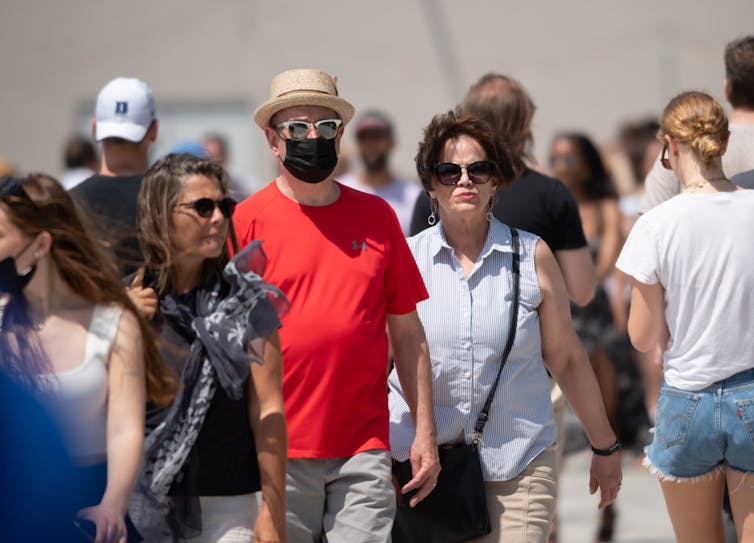
When the U.S. Centers for Disease Control and Prevention changed its guidelines about mask-wearing on May 13, 2021, plenty of Americans were left a little confused. Now anyone who is fully vaccinated can participate in indoor and outdoor activities, large or small, without wearing a mask or physical distancing.
Anthony Fauci, chief medical adviser to President Biden, said the new guideline is “based on the evolution of the science” and “serves as an incentive” for the almost two-thirds of Americans who are not yet fully vaccinated to go ahead and get the shot.
But some people cannot be vaccinated because of underlying conditions. Others with weakened immune systems, from cancer or medical treatments, may not be fully protected by their vaccinations. Children aged 12 to 15 became eligible for the Pfizer-BioNTech vaccine only on May 10, 2021. And no COVID-19 vaccines are yet authorized for the nearly 50 million children in the U.S. younger than 12.
As restrictions are lifted and people start to leave their masks at home, some people worry: Can you catch COVID-19 from someone who’s vaccinated?
Vaccines don’t always prevent infection
Researchers had hoped to design safe COVID-19 vaccines that would prevent at least half of the people vaccinated from getting COVID-19 symptoms.


Fortunately, the vaccines have vastly outperformed expectations. For example, in 6.5 million residents of Israel, aged 16 years and older, the Pfizer–BioNTech mRNA COVID-19 vaccine was found to be 95.3% effective after both shots. Within two months, among the 4.7 million fully vaccinated, the detectable infections fell by 30-fold. Similarly in California and Texas, only 0.05% of fully vaccinated health care workers tested positive for COVID-19.
Vaccine developers often hope that, in addition to preventing illness, their vaccines will achieve “sterilizing immunity,” where the vaccination blocks the germ from even being able to get into the body at all. This sterilizing immunity means someone who’s vaccinated will neither catch the virus nor transmit it further. For a vaccine to be effective, though, it doesn’t need to prevent the germ from infecting an immunized person.
The Salk inactivated polio vaccine, for instance, does not completely stop polio virus from growing in the human gut. But it is extremely effective at preventing the crippling disease because it triggers antibodies that block the virus from infecting the brain and spinal cord. Good vaccines provide effective and durable training for the body’s immune system, so when it actually encounters the disease-causing pathogen, it’s ready to mount an optimum response.
When it comes to COVID-19, immunologists are still figuring out what they call the “correlates of protection,” factors that predict just how protected someone is against the coronavirus. Researchers believe that an optimum amount of “neutralizing antibodies,” the type that not only bind the virus but also prevent it from infecting, are sufficient to fend off repeat infections. Scientists are also still assessing the durability of immunity that the COVID-19 vaccines are providing and where in the body it’s working.
Can a vaccinated person spread coronavirus?
Immunologists expect vaccines that protect against viral illnesses to also reduce transmission of the virus after vaccination. But it’s actually tricky to figure out for sure if vaccinated people are not spreading the germ.
COVID-19 poses a particular challenge because people with asymptomatic and pre-symptomatic infections can spread the disease – and insufficient contact tracing and testing mean those without symptoms are rarely detected. Some scientists estimate that the number of asymptomatic COVID-19 infections in the overall population could be 3 to 20 times higher than the number of confirmed cases. Research suggests that undocumented cases of COVID-19 in people who either were asymptomatic or experienced very mild disease could be responsible for up to 86% of all infections, though other studies contradict the high estimates.
In one study, the CDC tested volunteer health care personnel and other front-line workers at eight U.S. locations for SARS-CoV-2 infections weekly for three months, regardless of symptoms or vaccination status. The researchers found that fully immunized participants were 25 times less likely to test positive for COVID-19 than were those who were unvaccinated. Findings like this imply that if vaccinated people are so well protected from getting infected at all, they are also unlikely to spread the virus. But without contact tracing to track transmission in a larger population, it’s impossible to know if the assumption is true.
What we know for sure is that if someone does get sick with COVID-19 after vaccination, in what is called a “breakthrough infection,” symptoms will be milder. Studies have found that people who tested positive for COVID-19 after getting just their first vaccine dose had lower levels of virus in their bodies than unvaccinated people who tested positive. The researchers believe the decreased viral load hints that vaccinated people who do contract the virus will be less infectious because they will have much less virus that could be spread to others.
A preprint study which has not yet been peer-reviewed suggests that the Moderna mRNA COVID-19 vaccine can produce coronavirus-fighting antibodies in the oral and nasal fluid. Since that’s where SARS-CoV-2 makes its entry, antibodies in the mouth and nose should block the virus from getting into the body, effectively providing “sterilizing immunity.” This would also mean vaccinated people probably wouldn’t spread the virus through respiratory droplets.
These bits of evidence are promising. But without more studies, scientists cannot yet conclude that COVID-19 vaccines really do protect against all transmission. Studies attempting to directly answer this question through contact tracing are just beginning: Researchers will track COVID-19 infections among vaccinated and unvaccinated volunteers and their close contacts.

Protection and prevention go hand in hand
Vaccines help slow down the spread of an infectious disease by breaking the chain of infection. Those who are infected eventually have fewer and fewer unprotected people to pass the virus on to. This is how a vaccine increases herd immunity – susceptible and not-yet-immunized people are surrounded by a “herd” of people who have become immune, thanks to vaccination or previous infection. But studies suggest that, for a combination of biological and social reasons, vaccination alone is unlikely to achieve herd immunity against COVID-19 and fully contain the coronavirus.
In fact, vaccination alone can take a long time to eradicate any disease. Even diseases that are nearly “eliminated” – such as chickenpox, measles and pertussis – can resurface with waning immunity and declining vaccine rates.
The recent outbreak of infections among the vaccinated New York Yankees shows that vaccinated people not only can still get infected, they might also transmit the coronavirus to close contacts. Highly tested groups, such as professional sports teams, spotlight the fact that mild, asymptomatic infections among the vaccinated in the general population might actually be more frequent than reported. A similar outbreak in airport workers in Singapore shows that, even among the fully vaccinated, new and more infectious variants can spread fast.
The CDC’s relaxed guidelines on masking are meant to reassure vaccinated people that they are safe from serious illness. And they are. But the picture is less clear-cut for the unvaccinated who interact with them. Until near herd immunity against COVID-19 is achieved, and clear evidence accumulates that vaccinated people do not spread the virus, I and many epidemiologists believe it is better to avoid situations where there are chances to get infected. Vaccination coupled with continued masking and social distancing is still an effective way to stay safer.
Sanjay Mishra, Project Coordinator & Staff Scientist, Vanderbilt University Medical Center, Vanderbilt University
This article is republished from The Conversation under a Creative Commons license. Read the original article.







