


Philip Zylstra, University of Wollongong; Grant Wardell-Johnson, Curtin University; James Watson, The University of Queensland, and Michelle Ward, The University of Queensland
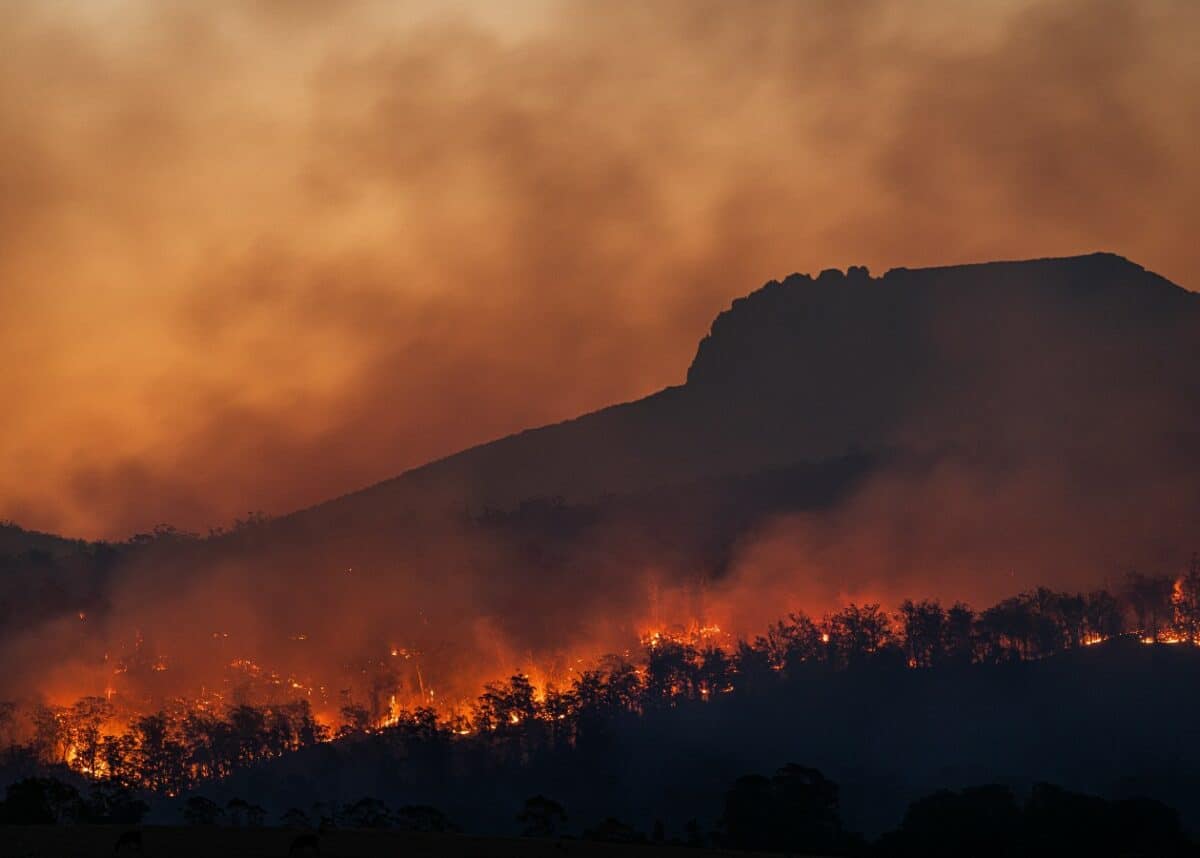
The Black Summer bushfires burned far more temperate forest than any other fire season recorded in Australia. The disaster was clearly a climate change event; however, other human activities also had consequences.
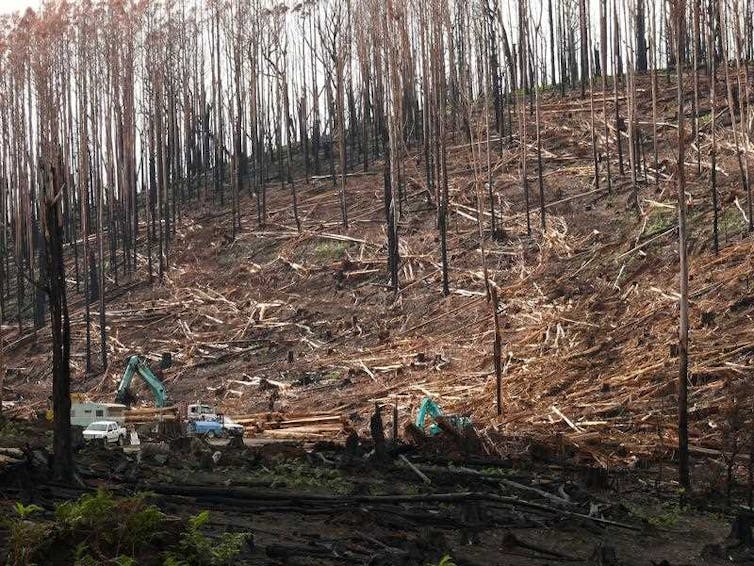
Taking timber from forests dramatically changes their structure, making them more vulnerable to bushfires. And, crucially for the Black Summer bushfires, logged forests are more likely to burn out of control.
Naturally, the drivers of the fires were widely debated during and after the disaster. Research published earlier this month, for example, claimed native forest logging did not make the fires worse.
We believe these findings are too narrowly focused and in fact, misleading. They overlook a vast body of evidence that crown fire – the most extreme type of bushfire behaviour, in which tree canopies burn – is more likely in logged native forests.
Crown fires vs scorch
The Black Summer fires occurred in the 2019-20 bushfire season and burned vast swathes of Australia’s southeast. In some cases, fire spread through forests with no recorded fire, including some of the last remnants of ancient Gondwanan rainforests.
Tragically, the fires directly killed 33 people, while an estimated 417 died due to the effects of smoke inhalation. A possible three billion vertebrate animals perished and the risk of species extinctions dramatically increased.


Much of the forest that burned during Black Summer experienced crown fires. These fires burn through the canopies of trees, as well as the undergrowth. They are the most extreme form of fire behaviour and are virtually impossible to control.
Crown fires pulse with such intense heat they can form thunderstorms which generate lightning and destructive winds. This sends burning bark streamers tens of kilometres ahead of the fire, spreading it further. The Black Summer bushfires included at least 18 such storms.
Various forest industry reports have recognised logging makes bushfires harder to control.
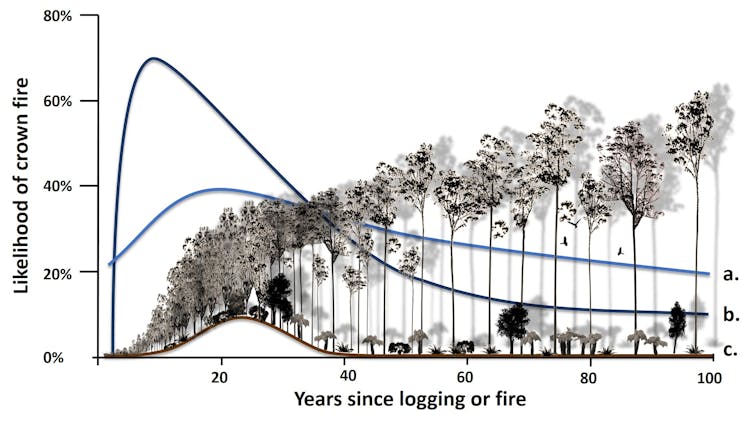
And to our knowledge, every empirical analysis so far shows logging eucalypt forests makes them far more likely to experience crown fire. The studies include:
- A 2009 paper suggesting changes in forest structure and moisture make severe fire more likely in logging regrowth compared to undisturbed forest
- 2012 research concluding the probability of crown fires was higher in recently logged areas than in areas logged decades before
- A 2013 study that showed the likelihood of crown fire halved as forests aged after a certain point
- 2014 findings that crown fire in the Black Saturday fires likely peaked in regrowth and fell in mature forests
- 2018 research into the 2003 Australian Alps fires, which found the same increase in the likelihood of crown fire during regrowth as was measured following logging.
The findings of these studies are represented in the image below. The lines a, b and c refer to the 2013, 2014 and 2018 studies respectively.
Crown fires take lives
The presence of crown fire is a key consideration in fire supression, because crown fires are very hard to control.
However, the study released last week – which argued that logging did not worsen the Black Summer fires – focused on crown “scorch”. Crown scorch is very different to crown fire. It is not a measure of how difficult it is to contain the fire, because even quite small flames can scorch a drought-stressed canopy.
Forestry studies tend to focus more on crown scorch, which damages timber and is far more common than crown fires.
But the question of whether logging made crown scorch worse is not relevant to whether a fire was uncontrollable, and thus was able to destroy homes and lives.
Importantly, when the study said logging had a very small influence on scorch, this was referring to the average scorch over the whole fire area, not just places that had been logged. That’s like asking how a drought in the small town of Mudgee affects the national rainfall total: it may not play a large role overall, but it’s pretty important to Mudgee.
The study examined trees in previously logged areas, or areas that had been logged and burned by fires of any source. It found they were as likely to scorch on the mildest bushfire days as trees in undisturbed forests on bad days. These results simply add to the body of evidence that logging increases fire damage.
Managing forests for all
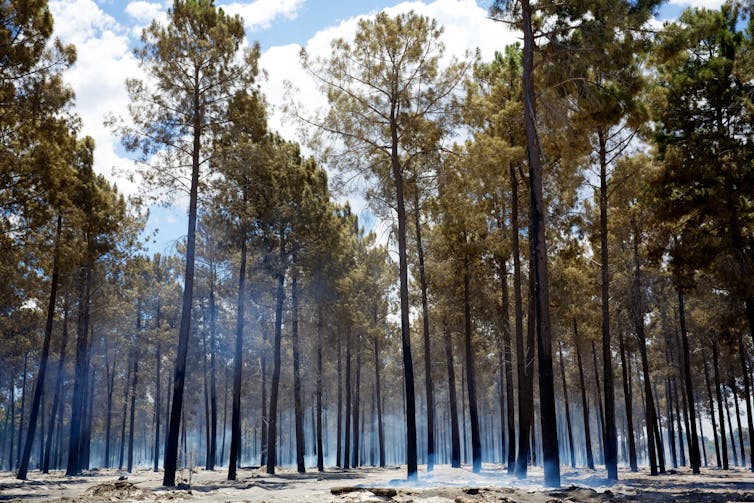
Research shows forests became dramatically less likely to burn when they mature after a few decades. Mature forests are also less likely to carry fire into the tree tops.
For example during the Black Saturday fires in 2009, the Kilmore East fire north of Melbourne consumed all before it as a crown fire. Then it reached the old, unlogged mountain ash forests on Mount Disappointment and dropped to the ground, spreading as a slow surface fire.
The trees were scorched. But they were too tall to ignite, and instead blocked the high winds and slowed the fire down. Meanwhile, logged ash forests drove flames high into the canopy.
Despite decades of opportunity to show otherwise, the only story for eucalypt forests remains this: logging increases the impact of bushfires. This fact should inform forest management decisions on how to reduce future fire risk.
We need timber, but it must be produced in ways that don’t endanger human lives or the environment.
Philip Zylstra, Adjunct Associate Professor at Curtin University, Honorary Fellow at University of Wollongong, University of Wollongong; Grant Wardell-Johnson, Associate Professor, Environmental Biology, Curtin University; James Watson, Professor, The University of Queensland, and Michelle Ward, PhD Candidate, The University of Queensland
This article is republished from The Conversation under a Creative Commons license. Read the original article.







