

• Advertise
  • About us
  • Terms and Conditions
  • Contact us
Saturday, December 6, 2025
Australian Times News
  • News
    • Weather
    • Sport
    • Technology
    • Business & Finance
      • Currency Zone
    • Lotto Results
      • The Lott
  • Lifestyle
    • Entertainment
    • Horoscopes
    • Health & Wellness
    • Recipes
  • Travel
  • Expat Life
  • Move to Australia
No Result
View All Result
  • News
    • Weather
    • Sport
    • Technology
    • Business & Finance
      • Currency Zone
    • Lotto Results
      • The Lott
  • Lifestyle
    • Entertainment
    • Horoscopes
    • Health & Wellness
    • Recipes
  • Travel
  • Expat Life
  • Move to Australia
No Result
View All Result
Australian Times News
No Result
View All Result
Home News

Intense training – why F1 is one of the most physically and mentally demanding sports on the planet

Imagine driving a car at speeds approaching 112 mph for around two hours, while at the same time having to negotiate twisting circuits and finding ways to overtake opponents. This is what a Formula 1 (F1) driver will experience when they race around the streets of Monaco.

The Conversation by The Conversation
22-05-2021 06:07
in News
Photo by Alex Gorbi on Unsplash

Photo by Alex Gorbi on Unsplash

Dan Gordon, Anglia Ruskin University

Imagine driving a car at speeds approaching 112 mph for around two hours, while at the same time having to negotiate twisting circuits and finding ways to overtake opponents. This is what a Formula 1 (F1) driver will experience when they race around the streets of Monaco. It might sound thrilling and exciting, but now imagine doing this with your heart beating close to its maximum for the whole race.
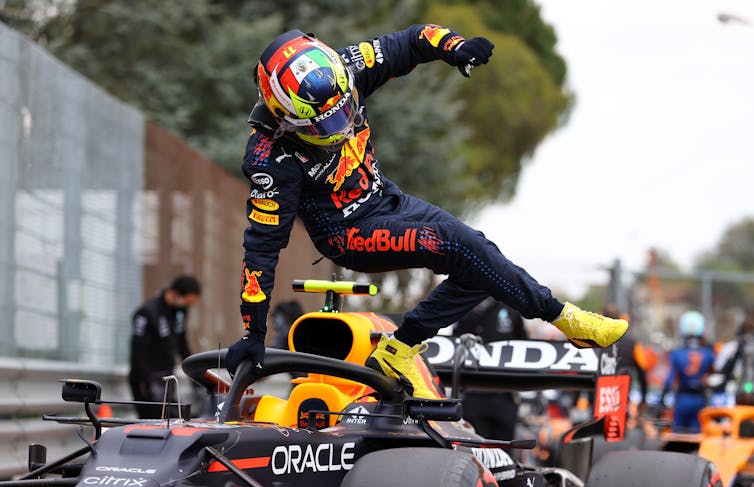
Being an Formula 1 driver is harder than it looks. ALEJANDRO GARCIA/EPA

Research shows that heart rates can average 182 beats per minute over the course of a race while experiencing cardiorespiratory responses and energy costs which are similar to that seen in elite marathon runners and soccer players.

Quite simply this is not just about driving, this is one of the most physically and mentally demanding sports on the planet.

Physical demands

Drivers experience such extreme physical demands for two reasons. First, the car generates an enormous amount of heat from the engine so the driver experiences temperatures in their cockpit of around 50C (122F). They are also wearing specialist race suits that are designed to protect them from fire but also end up preventing them from keeping cool. Not surprising, then, that a driver can lose close to 5% of their body weight through sweat during a race, potentially leading to hyperthermia.

Second, there are the dreaded G-forces. During a race a driver is exposed to up to five times gravity pushing down on them, making it harder to breathe, pump blood around their body and move their arms and legs. Oh, and to top it all off, they are sitting in a position which means that the feet are raised up in line with the chest.

So not only must they be exceptional drivers but clearly, they must be exceptionally fit.

AlsoRead...

Ryan: Building real freedom through e-commerce

Ryan: Building real freedom through e-commerce

27 November 2025
Design Australia Group: Redefining Drafting as the engine of housing growth

Design Australia Group: Redefining Drafting as the engine of housing growth

26 November 2025

Complex training

Drivers train to develop their cardiorespiratory fitness. Just as the physical responses are similar to those in marathon runners so is the training they undertake.

To cope with the high temperatures and G-forces, both of which reduce the amount of blood that goes to the skin for cooling, drivers must train to make their heart and cardiovascular systems stronger and more efficient. Training is driver specific but will involve long periods of exercising to help increase heart size and capillary density in the muscles, both of which are needed to get oxygen to the working muscles.

However, the high energy demands and amount of work being done by the cardiovascular system mean that the muscles will start to use energy from sources other than the oxygen dependent ones. Trough this anaerobic respiration (without oxygen), a small amount of energy is released by the breakdown of food substances in the absence of oxygen. These alternate sources provide energy but at a cost. They lead to local muscular fatigue and so make it harder to control the car.

But it is not just about the cardiorespiratory fitness, there are those G-forces which act across the whole body that need to be trained for. To do this, drivers undertake strength training.

Strength training will be used to increase the size of the muscle fibres but also the speed at which the muscles can be recruited. This is not like training to be a weight-lifter though, this is about trying to stop the muscle becoming tired as the race goes on, increasing the speed the muscles contract and making them more efficient. An F1 driver needs strength to keep the car on the road.
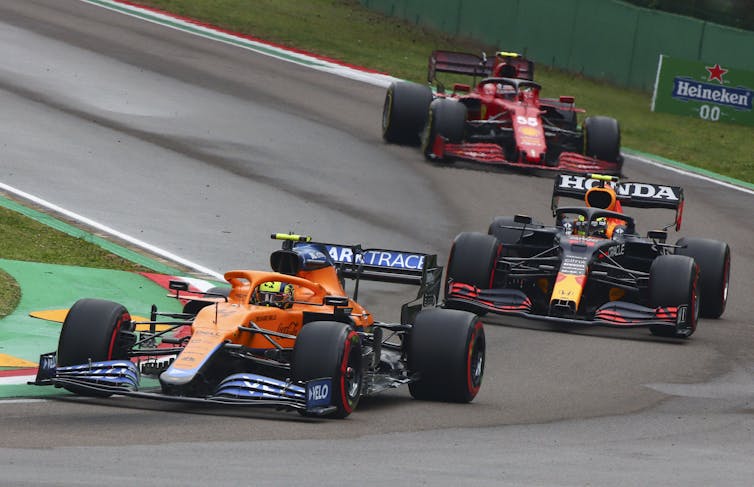
Three Formular 1 cars race.
It takes a lot of strength to keep the car on the road, as well as to overtake. Davide Gennari/EPA

One area of the body that has to be strengthened are the muscles of the neck. With the G-forces pushing on the body it becomes harder for drivers to hold their heads upright. So, drivers adopt a form of training called isometrics where the muscles are working against a resistance, but do not change length.

Imagine trying to push as hard as you can against a wall. The wall doesn’t move but you feel the muscles working. This is an isometric exercise. So, to develop the neck muscles drivers will perhaps use resistance bands like you see in the gym but attached to their head or special helmets which have weight added to them while trying to keep their head in a fixed position.

In addition, all drivers will need to work on their core strength, again using a combination of conventional strength training and isometrics to help them maintain their body position in the cockpit whilst working against the G-forces.

This is a physically demanding sport that requires the drivers to train like Olympic athletes throughout the season while also having to do all of the work with the car and race. It might, to the casual onlooker, seem like an easy sport with cars just going round and round a track but hopefully now you realise that it takes a lot of work to be able to do, making F1 one of the toughest sports in the world.

Dan Gordon, Associate Professor: Cardiorespiratory Exercise Physiology, Anglia Ruskin University

This article is republished from The Conversation under a Creative Commons license. Read the original article.


Tags: SB001
DMCA.com Protection Status

SUBSCRIBE to our NEWSLETTER

[mc4wp_form id=”2384248″]

Don't Miss

The evolution of Aesthetic Surgery through the lens of Dr Kourosh Tavakoli

by Pauline Torongo
4 December 2025
The evolution of Aesthetic Surgery through the lens of Dr. Kourosh Tavakoli
Health & Wellness

As global interest in Australian cosmetic surgery continues to grow, the combination of regulation, research and emerging digital tools is...

Read moreDetails

Ryan: Building real freedom through e-commerce

by Pauline Torongo
27 November 2025
Ryan: Building real freedom through e-commerce
Business & Finance

Ryan’s greatest achievement isn’t any single business or revenue milestone — it’s the ecosystem he’s built through the Change community.

Read moreDetails

Design Australia Group: Redefining Drafting as the engine of housing growth

by Pauline Torongo
26 November 2025
Design Australia Group: Redefining Drafting as the engine of housing growth
Business & Finance

Australia is under pressure to build homes faster, but design bottlenecks slow progress. Design Australia Group is fixing this by...

Read moreDetails

Louis Guy Detata builds Global Trading Empires through autonomous systems and disciplined leadership

by Pauline Torongo
25 November 2025
Louis Guy Detata builds Global Trading Empires through autonomous systems and disciplined leadership
Business & Finance

The path from investment banking to leading a global trading platform has taught Louis Detata that sustainable success requires more...

Read moreDetails

Burning Eucalyptus Wood: Tips, Advantages, Disadvantages & Alternatives

by Fazila Olla-Logday
20 November 2025
Image Supplied
Enviroment

Learn about burning eucalyptus wood for stoves and fireplaces. Discover benefits, drawbacks, harvesting tips, and better alternative firewood options for...

Read moreDetails

Everything Parents Need to Know About Baby Soft Play and Why It’s a Game Changer

by Fazila Olla-Logday
11 November 2025
Everything Parents Need to Know About Baby Soft Play
Health & Wellness

Baby soft play is a fun, safe, and educational way for little ones to explore and grow. Discover the benefits...

Read moreDetails

WOMAD Sets Up a New Camp in Wiltshire – Australian festival fans take note!

by Kris Griffiths
11 November 2025
Kumbia Boruka brought their reggae and dancehall flavour to the Taste the World Stage at WOMAD 2024 - Credit - Mike Massaro
Entertainment

With its 2026 edition moving to Neston Park in England, WOMAD offers Aussie music lovers a chance to reconnect with global...

Read moreDetails
Load More

Copyright © Blue Sky Publications Ltd. All Rights Reserved.
australiantimes.co.uk is a division of Blue Sky Publications Ltd. Reproduction without permission prohibited. DMCA.com Protection Status

  • About us
  • Write for Us
  • Advertise
  • Contact us
  • T&Cs, Privacy and GDPR
No Result
View All Result
  • News
    • Weather
    • Sport
    • Technology
    • Business & Finance
      • Currency Zone
    • Lotto Results
      • The Lott
  • Lifestyle
    • Entertainment
    • Horoscopes
    • Health & Wellness
    • Recipes
  • Travel
  • Expat Life
  • Move to Australia

Copyright © Blue Sky Publications Ltd. All Rights Reserved.
australiantimes.co.uk is a division of Blue Sky Publications Ltd. Reproduction without permission prohibited. DMCA.com Protection Status

No Result
View All Result
  • News
    • Weather
    • Sport
    • Technology
    • Business & Finance
      • Currency Zone
    • Lotto Results
      • The Lott
  • Lifestyle
    • Entertainment
    • Horoscopes
    • Health & Wellness
    • Recipes
  • Travel
  • Expat Life
  • Move to Australia

Copyright © Blue Sky Publications Ltd. All Rights Reserved.
australiantimes.co.uk is a division of Blue Sky Publications Ltd. Reproduction without permission prohibited. DMCA.com Protection Status






