


Tony Walker, La Trobe University
What’s next in the latest Middle East convulsion? Will a ceasefire between the Hamas militant group in Gaza and Israel be brokered by Arab mediators in coordination with western powers, or will the situation continue to deteriorate?
Are we witnessing the beginning of an intensifying conflict in which Israelis find themselves enveloped in a bloody confrontation with Palestinians across the occupied territories and, more threateningly, inside Israel itself?
Will Israel become enmeshed in widespread communal unrest on its own territory in Arab towns and villages?
In short, are we witnessing the early stages of a third intifada, in which casualties mount on both sides until the participants exhaust themselves?
We’ve seen all this before – in 1987 and 2000. Then, as now, violence spread from territories occupied in the 1967 war into Israel itself.
There are no simple answers to these questions as the crisis enters its second week, with casualties mounting.


In part, the next stage depends on the level of violence Israel is prepared to inflict on Hamas. It is also conditional on Hamas’s tolerance of Israeli airstrikes and artillery fire.
It will also rely on the extent to which Israel feels its interests continue to be served by courting widespread international opprobrium for its offensive against Hamas, as the militant group’s leadership is embedded in a densely packed civilian population in Gaza.
This is far from a cost-free exercise for Israel, despite the bravado from its leadership, embroiled in a lingering internal crisis over the country’s inability to elect majority government.
Political paralysis is not the least of Israel’s problems.
As always, the issue is not whether Israel has a right to defend itself against rocket attacks on its own territory. The question is whether its response is disproportionate, and whether its chronic failure to propagate a genuine peace process is fuelling Palestinian resentment.
The short answer is “yes”, whatever legitimate criticisms might be made of a feckless Palestinian leadership divided between its two wings: the Fatah mainstream in Ramallah and Hamas in Gaza.
Israel’s continued provocative construction of settlements in the West Bank, and the daily humiliations it inflicts on a disenfranchised Palestinian population in Arab East Jerusalem, contribute to enormous frustration and anger among people living under occupation.
If nothing else, the latest upsurge of violence between Israelis and Palestinians should persuade the international community that occupation and subjugation of one population by another is a dead-end street.
Further complicating things for the Israeli leadership are the circumstances that led to the latest conflagration. This has lessened international sympathy for the extreme measures Israel is using, aiming to bomb the Hamas leadership into submission.
Israeli authorities’ attempts to evict Palestinian families in East Jerusalem from homes they had occupied for 70 years, accompanied by highly provocative demonstrations by extremist Jewish settlers chanting “death to Arabs”, has contributed to a sharp deterioration in relations.
This was followed by a heavy-handed Israeli police response to Palestinian demonstrations in and around Al-Aqsa mosque, Islam’s third-holiest shrine. In turn, this prompted Hamas rocket strikes into Israel itself from Gaza.

The International Crisis Group has identified the issue that should be most concerning to Israel and its supporters:
This occasion is the first since the September 2000 intifada where Palestinians have responded simultaneously and on such a massive scale throughout much of the combined territory of Israel-Palestine to the cumulative impact of military occupation, repression, dispossession and systemic discrimination.
In a global propaganda war over Israel’s continued occupation of five million Palestinians in the West Bank and Gaza Strip, the issue of who started this latest convulsion is relevant.
So, too, are questions surrounding Israeli Prime Minister Benjamin Netanyahu’s attempts to cling to power as a corruption trial wends its way through the Israeli court system.
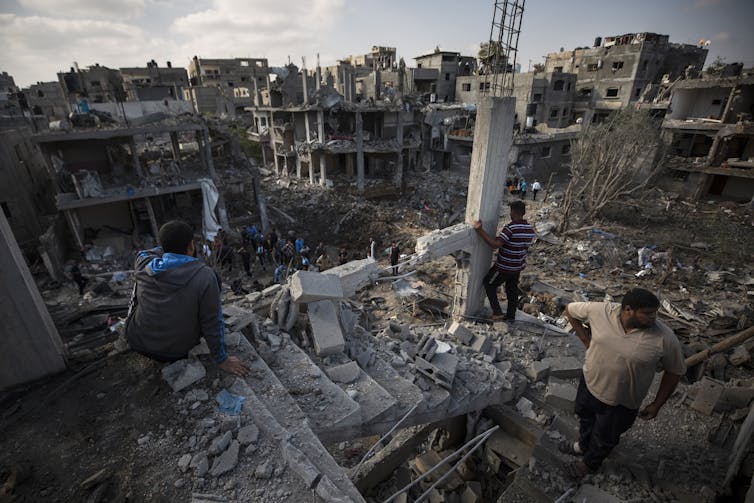
Collateral damage to Israel’s reputation is an unavoidable consequence of the use of a heavy bombardment against Hamas targets in one of the world’s most densely populated areas.
There are two million Palestinians in Gaza, a narrow strip of land between Israeli territory and the Mediterranean Sea. Many are living in refugee camps their families have occupied since they fled Israel in 1948, in what Palestinians refer to as the nakba, or catastrophe.
The deaths of an extended Palestinian family at the weekend whose three-storey home was demolished by an Israeli airstrike is a grating reminder of fallout from the use of weapons of war in civilian areas.
This is the reality of a population held hostage to an unresolved – and possibly unresolvable – conflict involving Palestinians living under occupation.
So far, international reaction has been muted. The United States and its allies have gone through the motions in condemning the violence.
US President Joe Biden, in a phone call with Netanyahu, seemed to endorse Israel’s heavy hand. Biden’s conciliatory tone has drawn widespread criticism in view of the shocking images emanating from Gaza. These include live footage of a building housing foreign media being destroyed by an Israeli airstrike.
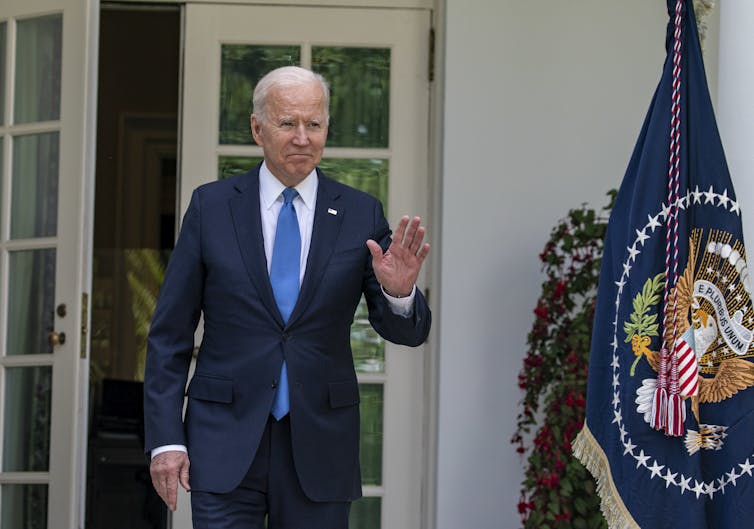
Belatedy, the US has sent an envoy to the region.
In Australia, politicians from both sides have called for a de-escalation.
Regionally, Arab states have expressed their support for the Palestinian cause, but remarks by their leaders have been restrained.
However, circumstances leading to the outbreak of violence, notably Israeli policing of demonstrations in places sacred to Muslims, have left Arab leaderships no choice but to condemn Israel’s actions.
A hitherto limp US response reflects the Biden administration’s hope that the Israel-Palestine issue would not be allowed to intrude on Washington’s wider Middle East foreign policy efforts. Biden is trying to entice Iran back to the negotiating table to re-energise the nuclear peace deal ripped up by former President Donald Trump.
Part of this strategy has been to calm Israel’s concerns about renewed US efforts to re-engage Iran. Those efforts have been complicated by the violence of recent days.
Washington has been reminded, if that was necessary, that the toxic Palestinian issue could not simply be shoved aside, however much the US and its moderate Arab allies would like it to go away. This was always an unrealistic expectation.
Israeli violence against Palestinians in retaliation for rocket attacks on its territory is an embarrassment for Arab states that had established diplomatic relations with Israel under pressure from the Trump administration.
The so-called Abraham Accords, involving an exchange of ambassadors between Israel and the United Arab Emirates, is at risk of being discredited in the eyes of the Arab world by the latest conflagration.
Other Arab states that established diplomatic relations with Israel, brokered by Trump officials, include Bahrain, Sudan and Morocco. Sporadic demonstrations in support of the Palestinians have occurred in the latter two countries.
Finally, this latest conflict between Israelis and Palestinians exposes the failure of various parties to advance a peace agreement based on a two-state solution.
That prospect appears further away than ever, and may even be dead given Israel’s declared intention to annex territory in the West Bank. Such action would end any possibility of compromise based on land swaps to accommodate Israeli settlements in areas contiguous with Israel itself.
These are bleak moments for those who might have believed at the time of the Oslo Declaration in 1993, and subsequent establishment of relations between Israel and the leadership of the Palestinian national movement, that peace might be possible at last.
We are now a very long way indeed from Oslo.
Tony Walker, Vice-chancellor’s fellow, La Trobe University
This article is republished from The Conversation under a Creative Commons license. Read the original article.







