


Linda J. Bilmes, Harvard Kennedy School
President Joe Biden calls climate change “the existential crisis of our time” and has taken steps to curb it that match those words. They include returning the U.S. to the Paris Agreement; creating a new climate Cabinet position; introducing a plan to slash fossil fuel subsidies; and announcing ambitious goals to cut U.S. greenhouse gas emissions.
But climate change is not the only global environmental threat that demands attention. Scientists widely agree that loss of wildlife and the natural environment is an equally urgent crisis. Some argue that biodiversity loss threatens to become Earth’s sixth mass extinction. But unlike efforts to fight climate change – which center on clear, measurable goals to reduce greenhouse gas emissions – there is no globally accepted metric for saving biodiversity.
As an expert on budgeting and public finance, I know that governments and private businesses alike pay much more attention to resources when they have a well-defined price tag. I believe that overhauling society’s concept of wealth to include “natural capital” – the value nature provides to humans – is a critical step for slowing and reversing the loss of precious ecosytems.
What is natural capital?
Natural capital can be defined as the world’s stocks of natural assets – soil, air, water, grasslands, forests, wetlands, rocks and minerals – and all of its living things, from mammals and fish to plants and microbes. Conservation experts estimate that these resources contribute more than US$125 trillion to the global economy every year.
Humans depend on nature’s contributions for survival. For example, forests absorb carbon and filter the water we drink. Wetlands and coral reefs mitigate flooding. Bees and other insects pollinate crops, enabling us to grow food.
But human societies don’t formally recognize the economic value of these services. This oversight encourages people to recklessly deplete the natural environment.


A recent review of the economics of biodiversity, commissioned by the U.K. government and led by Cambridge University economist Sir Parth Dasgupta, warns that human prosperity is growing at a “devastating cost to nature” and estimates that it would take 1.6 Earths to maintain the world’s current living standards. The report calls for the world to treat nature like an asset to be reported in financial statements and national accounts.
The Capitals Coalition, a global consortium of 380 initiatives and businesses, is trying to “change the math.” The organization seeks to persuade at least half of the world’s businesses, financial institutions and governments to incorporate natural capital into their decision-making by 2030.
Valuing ecosystems
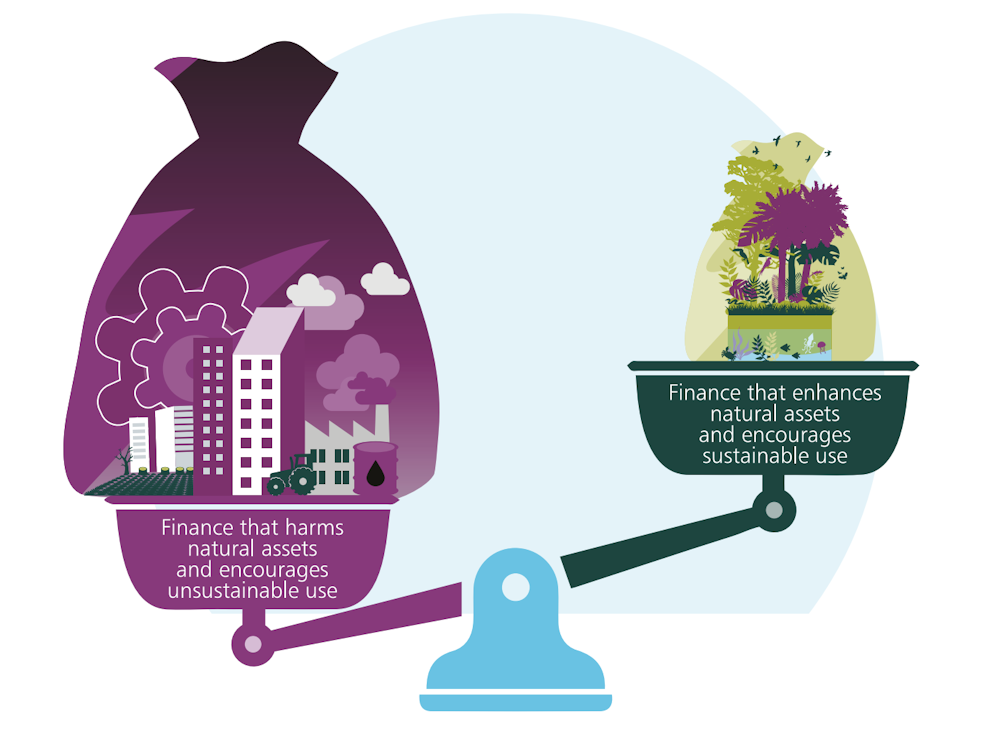
Current accounting methods used by corporations and governments largely ignore what ecosystems and their services contribute to the economy and to human social well-being, jobs and livelihoods. As a consequence, modern societies spend far more on investments that deplete or exploit natural assets than they do to preserve them.
Under the current model, short-term economic gains typically win out against longer-term ecological benefits. For example, failing to maintain forests can spark wildfires. And constructing homes on fragile coastal wetlands can erode soil and reduce fish stocks, destroying local communities.
A recent study by the Paulson Institute, a research institute founded by former U.S. Treasury Secretary Henry Paulson, estimated that global investments that degrade nature exceed conservation efforts by $600 billion to $824 billion per year.
Natural capital accounting would require businesses and governments to calculate how human activity affects nature, much as they assess depreciation of buildings or machinery. Analyzed in this way, nature is a financial asset, and damage to it becomes a liability. This approach creates incentives to conserve natural resources and restore others that have been degraded or depleted.
Global recognition of this issue is growing. In March 2021 the United Nations updated a statistical framework for standardizing ecosystem accounting, which was first published in 2012. These guidelines help countries track changes in ecosystems and their services and provide leaders with a baseline with which to compare their stocks and flows when making policy decisions.
Some 90 countries have adopted this System of Environmental Economic Accounting and produced baseline “national capital accounts.” They include European Union members, Australia, Canada, the United Kingdom and more than 40 developing countries. The U.S. is planning to implement this approach but has not done so yet.
Assessing nature’s value
Placing values on natural assets is really no different from government assessments of the benefits of new roads, bridges and other infrastructure. People intuitively understand that natural resources are precious. And the COVID-19 pandemic has made clear how closely human health is intertwined with the health of the planet.
In response to the biodiversity crisis, President Biden has aligned the U.S. with the global 30×30 campaign, a plan to protect at least 30% of the planet’s land and oceans by 2030. Multiple scientific studies have shown that achieving this goal would conserve species, store carbon, prevent future pandemics and boost economic growth.
The year 2021 marks the start of the U.N. Decade on Ecosystem Restoration, which aims to prevent, halt and reverse the degradation of ecosystems worldwide. Today, according to a recent study, less than 3% of the world’s land remains ecologically intact with healthy wildlife populations and undisturbed habitat.
The U.S has lost decades of potential progress since Congress suspended fledgling efforts by the Bureau of Economic Analysis to develop environmental accounting methods in 1995. Researchers at the U.S. Geological Survey and other federal agencies are now urging the U.S. to adopt national capital accounts using the U.N. framework.
In contrast, the U.K. created public environmental accounts and set up a Natural Capital Committee in 2012, led by its finance ministry, to help corporations develop natural capital accounts. Today, the U.K. maintains these accounts, which capture data on the size, condition, quantity and value of habitats and ecosystem services. President Biden could empower the U.S. Treasury Department to spearhead a similar initiative.
Adopting metrics to measure and track the benefits people receive from wildlife and ecosystems would clarify how human activities affect nature and show how much investment is needed to reverse humanity’s current destructive trajectory. Conservation advocates will be much better positioned to protect our planet’s resources with a strong balance sheet to back it up.
Linda J. Bilmes, Daniel Patrick Moynihan Senior Lecturer in Public Policy and Public Finance, Harvard Kennedy School
This article is republished from The Conversation under a Creative Commons license. Read the original article.







