

• Advertise
  • About us
  • Terms and Conditions
  • Contact us
Tuesday, March 24, 2026
Australian Times News
  • News
    • Weather
    • Sport
    • Technology
    • Business & Finance
      • Currency Zone
    • Lotto Results
      • The Lott
  • Lifestyle
    • Entertainment
    • Horoscopes
    • Health & Wellness
    • Recipes
  • Travel
  • Expat Life
  • Move to Australia
No Result
View All Result
  • News
    • Weather
    • Sport
    • Technology
    • Business & Finance
      • Currency Zone
    • Lotto Results
      • The Lott
  • Lifestyle
    • Entertainment
    • Horoscopes
    • Health & Wellness
    • Recipes
  • Travel
  • Expat Life
  • Move to Australia
No Result
View All Result
Australian Times News
No Result
View All Result
Home News

Space tourism – 20 years in the making – is finally ready for launch

NASA has long been hesitant to play host to space tourists, so Russia – looking for sources of money post-Cold War in the 1990s and 2000s – has been the only option available for those looking for this kind of extreme adventure.

The Conversation by The Conversation
30-04-2021 09:17
in News
Photo by Andrew Scofield on Unsplash

Photo by Andrew Scofield on Unsplash

Wendy Whitman Cobb, US Air Force School of Advanced Air and Space Studies

For most people, getting to the stars is nothing more than a dream. On April 28, 2001, Dennis Tito achieved that lifelong goal – but he wasn’t a typical astronaut. Tito, a wealthy businessman, paid US$20 million for a seat on a Russian Soyuz spacecraft to be the first tourist to visit the International Space Station. Only seven people have followed suit in the 20 years since, but that number is poised to double in the next 12 months alone.

NASA has long been hesitant to play host to space tourists, so Russia – looking for sources of money post-Cold War in the 1990s and 2000s – has been the only option available for those looking for this kind of extreme adventure. However, it seems the rise of private space companies is going to make it easier for regular people to experience space.

From my perspective as a space policy analyst, I see the beginning of an era in which more people can experience space. With companies like SpaceX and Blue Origin hoping to build a future for humanity in space, space tourism is a way to demonstrate both the safety and reliability of space travel to the general public.

Three men floating in the International Space Station
Dennis Tito, on the left beside two Russian astronauts, was the first private citizen to ever go to space – and he spent more than a week on the International Space Station. NASA/WikimediaCommons

The development of space tourism

Flights to space like Dennis Tito’s are expensive for a reason. A rocket must burn a lot of costly fuel to travel high and fast enough to enter Earth’s orbit.

Another cheaper possibility is a suborbital launch, with the rocket going high enough to reach the edge of space and coming right back down. While passengers on a suborbital trip experience weightlessness and incredible views, these launches are more accessible.

The difficulty and expense of either option has meant that, traditionally, only nation-states have been able to explore space. This began to change in the 1990s as a series of entrepreneurs entered the space arena. Three companies led by billionaire CEOs have emerged as the major players: Virgin Galactic, Blue Origin and SpaceX. Though none have taken paying, private customers to space, all anticipate doing so in the very near future.


AlsoRead...

Design Without Compromise: Where Gutter Protection Meets Modern Architecture

Design Without Compromise: Where Gutter Protection Meets Modern Architecture

20 March 2026
The Rise of This Lead Generation Workshop Across Australia

The Rise of This Lead Generation Workshop Across Australia

13 February 2026

British billionaire Richard Branson has built his brand on not just business but also his love of adventure. In pursuing space tourism, Branson has brought both of those to bear. He established Virgin Galactic after buying SpaceShipOne – a company that won the Ansari X-Prize by building the first reusable spaceship. Since then, Virgin Galactic has sought to design, build and fly a larger SpaceShipTwo that can carry up to six passengers in a suborbital flight.
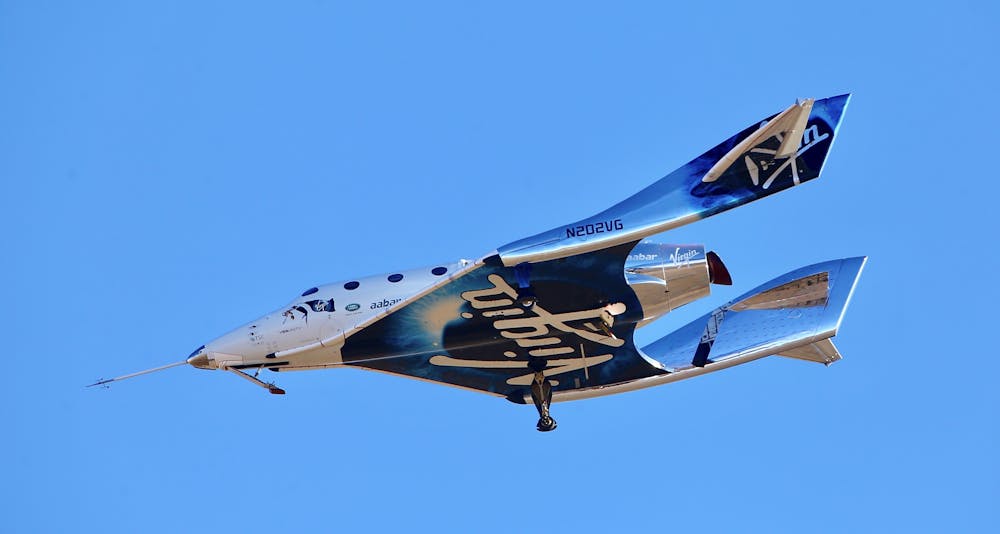
A silvery ship that looks like a fighter plane with elongated tail fins.
The VSS Unity spacecraft is one of the ships that Virgin Galactic plans to use for space tours. AP Photo/Matt Hartman

The going has been harder than anticipated. While Branson predicted opening the business to tourists in 2009, Virgin Galactic has encountered some significant hurdles – including the death of a pilot in a crash in 2014. After the crash, engineers found significant problems with the design of the vehicle, which required modifications.

Elon Musk and Jeff Bezos, respective leaders of SpaceX and Blue Origin, began their own ventures in the early 2000s.

Musk, fearing that a catastrophe of some sort could leave Earth uninhabitable, was frustrated at the lack of progress in making humanity a multiplanetary species. He founded SpaceX in 2002 with the goal of first developing reusable launch technology to decrease the cost of getting to space. Since then, SpaceX has found success with its Falcon 9 rocket and Dragon spacecraft. SpaceX’s ultimate goal is human settlement of Mars – sending paying customers to space is an intermediate step. Musk says he hopes to show that space travel can be done easily and that tourism might provide a revenue stream to support development of the larger, Mars-focused Starship system.

Bezos, inspired by the vision of physicist Gerard O’Neill, wants to expand humanity and industry not to Mars, but to space itself. Blue Origin, established in 2004, has proceeded slowly and quietly in also developing reusable rockets. Its New Shepard rocket, first successfully flown in 2015, will eventually offer tourists a suborbital trip to the edge of space, similar to Virgin Galactic’s. For Bezos, these launches represent an effort at making space travel routine, reliable and accessible to people as a first step to enabling further space exploration.
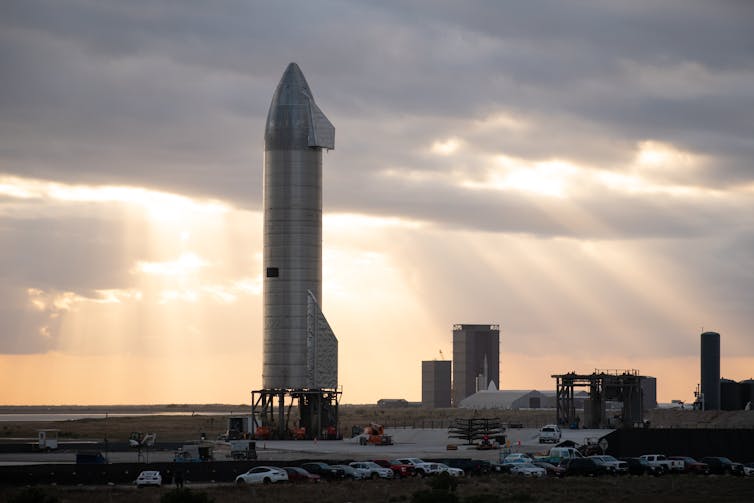
A large silvery rocket standing upright on a launchpad.
SpaceX has already started selling tickets to the public and has future plans to use its Starship rocket, a prototype of which is seen here, to send people to Mars. Jared Krahn/WikimediaCommons, CC BY-SA

Outlook for the future

Now, SpaceX is the only option for someone looking to go into space and orbit the Earth. It currently has two tourist launches planned. The first is scheduled for as early as September 2021, funded by billionaire businessman Jared Isaacman. The other trip, planned for 2022, is being organized by Axiom Space. These trips will be costly, at $55 million for the flight and a stay on the International Space Station. The high cost has led some to warn that space tourism – and private access to space more broadly – might reinforce inequality between rich and poor.

Blue Origin’s and Virgin Galactic’s suborbital trips are far more reasonable in cost, with both priced between $200,000 and $250,000. Blue Origin appears to be the nearest to allowing paying customers on board, saying after a recent launch that crewed missions would be happening “soon.” Virgin Galactic continues to test SpaceShipTwo, but no specific timetable has been announced for tourist flights.

Though these prices are high, it is worth considering that Dennis Tito’s $20 million ticket in 2001 could pay for 100 flights on Blue Origin soon. The experience of viewing the Earth from space, though, may prove to be priceless for a whole new generation of space explorers.

[Over 104,000 readers rely on The Conversation’s newsletter to understand the world. Sign up today.]

Wendy Whitman Cobb, Professor of Strategy and Security Studies, US Air Force School of Advanced Air and Space Studies

This article is republished from The Conversation under a Creative Commons license. Read the original article.


Tags: SB001
DMCA.com Protection Status

SUBSCRIBE to our NEWSLETTER

[mc4wp_form id=”2384248″]

Don't Miss

Design Without Compromise: Where Gutter Protection Meets Modern Architecture

by Fazila Olla-Logday
20 March 2026
Design Without Compromise: Where Gutter Protection Meets Modern Architecture
Business & Finance

Design without compromise by integrating gutter protection seamlessly into modern architecture. Discover how innovative gutter systems enhance your home’s aesthetics...

Read moreDetails

How WageSafe Secured Australia’s Most Reputable Retail Business Among Its Premium Clients

by Fazila Olla-Logday
12 March 2026
How WageSafe Secured Australia’s Most Reputable Retail Business Among Its Premium Clients
at

Learn how WageSafe helps businesses stay compliant with payroll and wage regulations through reliable monitoring, risk management, and expert support—protecting...

Read moreDetails

Zakeke AI Agent Studio Removes the E-Commerce Content Bottleneck With Outputs in Seconds

by Fazila Olla-Logday
3 March 2026
Zakeke AI Agent Studio Removes the E-Commerce Content Bottleneck With Outputs in Seconds
at

Zakeke AI Agent Studio removes the e-commerce content bottleneck by generating product content and visuals in seconds, enabling brands to...

Read moreDetails

Empire Traveller launches to give Small and Medium Businesses Enterprise-Level Travel rates

by Pauline Torongo
20 February 2026
Empire Traveller launches to give Small and Medium Businesses Enterprise-Level Travel rates
Travel

Empire Traveller suggests the travel sector may be entering a more inclusive phase — one where advantage is shaped less...

Read moreDetails

Is Feng Shui Master Xu Really A Modern Genius?

by Fazila Olla-Logday
19 February 2026
Is Feng Shui Master Xu Really A Modern Genius?
at

Is Feng Shui Master Xu truly a modern genius, or simply a master of timeless wisdom? Blending ancient Feng Shui...

Read moreDetails

The Rise of This Lead Generation Workshop Across Australia

by Pauline Torongo
13 February 2026
The Rise of This Lead Generation Workshop Across Australia
Business & Finance

“Where U?”, is a two-day in-person lead generation workshop that teaches Australian business owners how to build their own acquisition...

Read moreDetails

Lyca Mobile Australia’s Customer-First Overhaul Pays Off with Finder Award Win

by Fazila Olla-Logday
2 February 2026
Lyca Mobile Australia's Customer-First Overhaul Pays Off with Finder Award Win
Technology

Lyca Mobile Australia’s customer-first overhaul has earned a Finder Award, recognising its improved value, service, and stronger focus on Australian...

Read moreDetails
Load More

Copyright © Blue Sky Publications Ltd. All Rights Reserved.
australiantimes.co.uk is a division of Blue Sky Publications Ltd. Reproduction without permission prohibited. DMCA.com Protection Status

  • About us
  • Write for Us
  • Advertise
  • Contact us
  • T&Cs, Privacy and GDPR
No Result
View All Result
  • News
    • Weather
    • Sport
    • Technology
    • Business & Finance
      • Currency Zone
    • Lotto Results
      • The Lott
  • Lifestyle
    • Entertainment
    • Horoscopes
    • Health & Wellness
    • Recipes
  • Travel
  • Expat Life
  • Move to Australia

Copyright © Blue Sky Publications Ltd. All Rights Reserved.
australiantimes.co.uk is a division of Blue Sky Publications Ltd. Reproduction without permission prohibited. DMCA.com Protection Status

No Result
View All Result
  • News
    • Weather
    • Sport
    • Technology
    • Business & Finance
      • Currency Zone
    • Lotto Results
      • The Lott
  • Lifestyle
    • Entertainment
    • Horoscopes
    • Health & Wellness
    • Recipes
  • Travel
  • Expat Life
  • Move to Australia

Copyright © Blue Sky Publications Ltd. All Rights Reserved.
australiantimes.co.uk is a division of Blue Sky Publications Ltd. Reproduction without permission prohibited. DMCA.com Protection Status





