• Advertise
  • About us
  • Terms and Conditions
  • Contact us
Sunday, December 7, 2025
Australian Times News
  • News
    • Weather
    • Sport
    • Technology
    • Business & Finance
      • Currency Zone
    • Lotto Results
      • The Lott
  • Lifestyle
    • Entertainment
    • Horoscopes
    • Health & Wellness
    • Recipes
  • Travel
  • Expat Life
  • Move to Australia
No Result
View All Result
  • News
    • Weather
    • Sport
    • Technology
    • Business & Finance
      • Currency Zone
    • Lotto Results
      • The Lott
  • Lifestyle
    • Entertainment
    • Horoscopes
    • Health & Wellness
    • Recipes
  • Travel
  • Expat Life
  • Move to Australia
No Result
View All Result
Australian Times News
No Result
View All Result
Home News

As extreme fires transform Alaska’s boreal forest, more aspen and birch are coming in – that can slow fires and their climate impact

As forests burn, they release organic carbon that has accumulated in tree trunks, leaves and roots and in soils. This sets up a potentially dangerous climate feedback loop: More fires release more carbon from the land, which further exacerbates global warming, which means more hot, dry weather that can fuel more fire activity.

The Conversation by The Conversation
16-04-2021 22:15
in News
Photo by Anthony Gotter on Unsplash

Photo by Anthony Gotter on Unsplash

Jill Johnstone, University of Saskatchewan; Heather Dawn Alexander, Auburn University; Michelle C. Mack, Northern Arizona University, and Xanthe Walker, Northern Arizona University

Fire is a hot topic these days, particularly when it comes to the boreal forest, the vast expanse of trees that stretches across Alaska, Canada and other cold northern regions. Large fires have been burning more frequently and severely in these remote landscapes, driven by longer seasons of hot, dry weather and more lightning strikes as the climate warms.
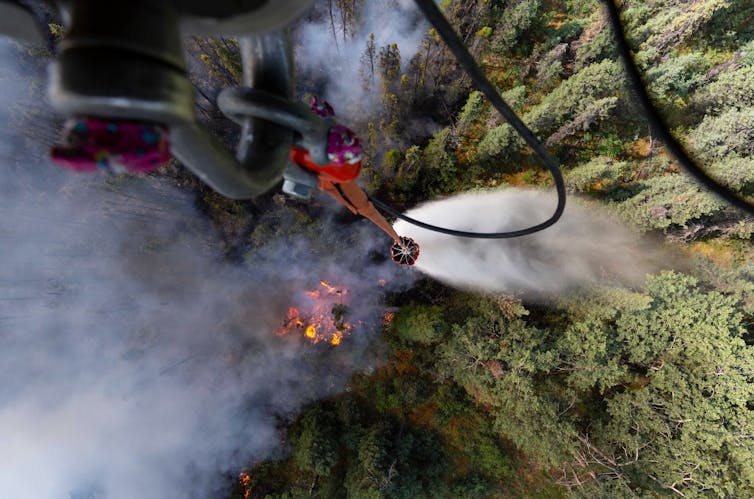
A helicopter drops water on a forest fire in Alaska. Michael Risinger/U.S. Army National Guard, CC BY

As forests burn, they release organic carbon that has accumulated in tree trunks, leaves and roots and in soils. This sets up a potentially dangerous climate feedback loop: More fires release more carbon from the land, which further exacerbates global warming, which means more hot, dry weather that can fuel more fire activity.

It’s enough to keep scientists like ourselves awake at night. However, new results from our research team published in the journal Science on April 15, 2021, suggest there may be a natural brake on the system.

We found that when black spruce forests that had recently burned in interior Alaska began regrowing, more aspen and birch trees were mixed in with the spruce. In fact, broadleaf deciduous trees like these were becoming the dominant species.

This has two important effects when it comes to climate change and wildfires: The deciduous trees store more carbon, and they don’t burn as quickly or a severely as dry, resinous black spruces and their needles do.

The result is that these changing forests could mitigate the fire-climate feedback loop, and maybe even reverse it – at least for now.


AlsoRead...

Ryan: Building real freedom through e-commerce

Ryan: Building real freedom through e-commerce

27 November 2025
Design Australia Group: Redefining Drafting as the engine of housing growth

Design Australia Group: Redefining Drafting as the engine of housing growth

26 November 2025
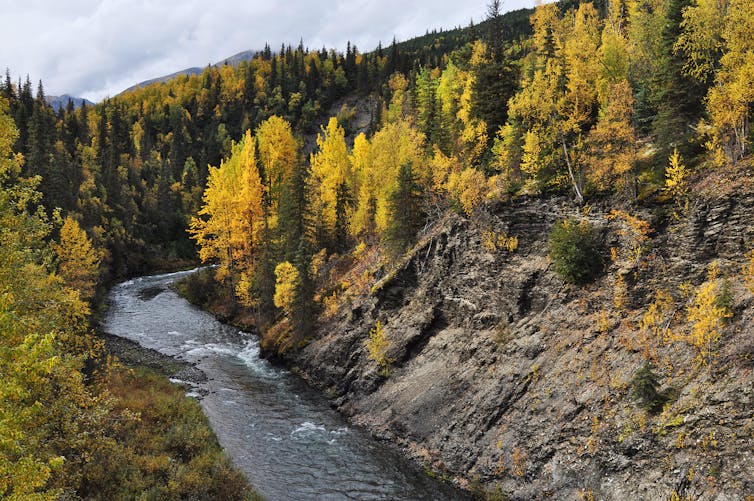
A river runs through a forest of yellow broadleaf trees with spruce mixed in.
Deciduous forests have been taking over historic black spruce forests in Alaska after severe fires. Paxson Woelber/Flickr, CC BY

Aspen and birch trees take over

When severe fires in black spruce forests burn deep into the soil organic layer, more carbon is lost during the blaze. But something else happens as well: Instead of spruce trees regrowing after these severe fires, they are often replaced by deciduous broadleaf trees that make up for that carbon loss when they regrow.

Severely burned black spruce stands, or groups of trees, lose the most carbon during a fire, but once these forests transition to aspen and birch, they store carbon at a rate that is four times faster than in similarly aged black spruce stands. By 50 years, they have compensated for fire-driven carbon losses.

By the time deciduous forests are 100 years old, the typical interval between burns in this region, carbon pools are 1.6 times larger than in black spruce forests, according to our calculations. The net effect is an increase in stored carbon that more than compensates for the increased carbon lost during the previous fire.
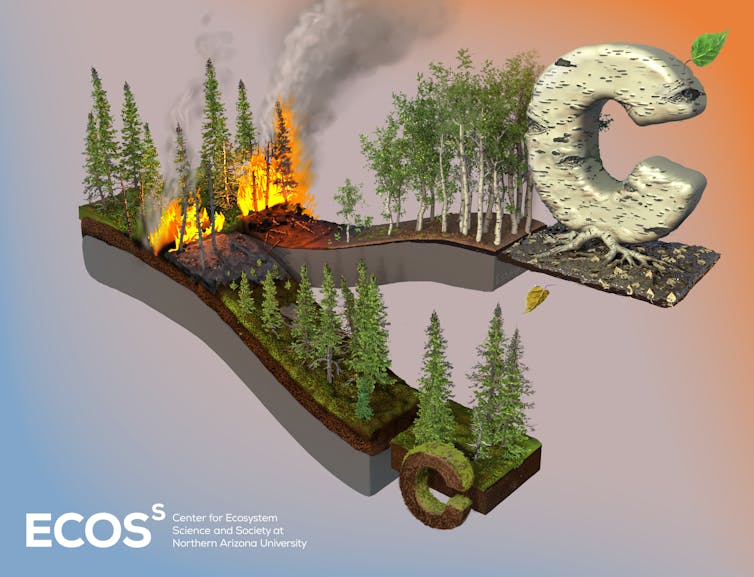
Illustration of forests and carbon storage above and below ground
Deciduous forests store more carbon above ground, while spruce forests store more in the soil. Victor O. Leshyk, Center for Ecosystem Science and Society, Northern Arizona University

Most of the carbon stored in deciduous stands is in the trees’ biomass above ground – woody trunks and branches – not in soils like in spruce stands. This is because trees like birch and aspen grow much more rapidly than spruce and are more effective at cycling nutrients and sequestering carbon in wood.

15 years of changing forests

Our research began over 15 years ago, when an intense fire season in 2004 burned a record 6.7 million acres across Alaska.

We suspected then that the worsening fires carried the fingerprint of contemporary climate change, and we wondered what it might mean for patterns of forest recovery.
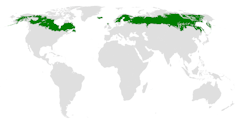
Map showing boreal forest regions
Boreal forests stretch across Alaska and Canada, Europe and Russia. Wikimedia/Mark Baldwin-Smith, CC BY

After the fires, we established a broad network of research sites in burned black spruce forests across the region. In each, we measured the amount of carbon in the ecosystems as they recovered.

We discovered that recent fires had burned deeper into the soil, disrupting the relatively shallow burn patterns that had allowed black spruce to dominate the landscape. The severe burning resulted from the warmer climate and consequently drier, more flammable fuels. Once deciduous seedlings become established after a fire, they quickly dominate the forest canopy.

It is still too early to know how widespread these changes may be, but recent estimates from remote sensing suggest that deciduous forests could replace conifer forests at a rate as high as 5% per decade, mostly due to fire.

Putting all those pieces together, we now understand that such rapid shifts in forest composition and their effects on carbon storage patterns could shape the long-term feedback loops between boreal forests and the Earth’s atmosphere.

Less flammable trees, but that may not last

There’s more to the story about the potential for deciduous trees to mitigate fire and climate feedbacks in the boreal forest.

Importantly, wildfire studies indicate deciduous broadleaf forests often burn less easily when a fire ignites, and fires in deciduous forests are more easily put out by rainfall or human efforts. Although not immune to fire, aspen or birch stands burn more slowly and less severely than black spruce stands, which have dry, resinous and highly flammable fuels.

The result is that more deciduous stands across boreal forests are likely to translate into smaller, less severe fires.
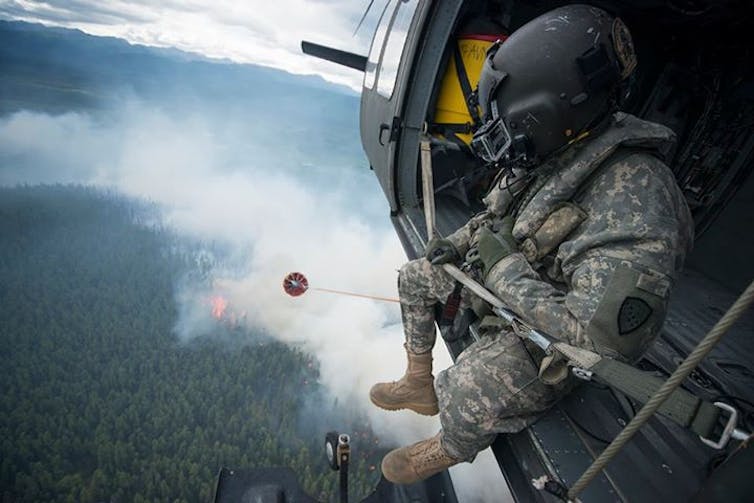
View of a burning forest from a helicopter with a soldier sitting in the open helicopter door
Alaska fires are much harder to control in the rugged, remote landscape, and often left to burn. Sherman Hogue/U.S. Army, CC BY

However, we do not know how long deciduous forests’ lower flammability will persist as the climate warms. There likely is a threshold at which even resistant trees will readily burn. Other ecological changes as the forests transform could also influence their long-term carbon storage.

The ability of deciduous forests to slow climate warming will depend on both the local landscape and the choices people make about their carbon emissions. For the time being, it is welcome news that natural shifts in forest ecosystems have the potential to be important players in bolstering the resilience of the Earth system to climate warming.

This article was updated to change the illustration credit.

Jill Johnstone, Adjunct Professor of Biology, University of Saskatchewan; Heather Dawn Alexander, Assistant Professor of Forest Ecology, Auburn University; Michelle C. Mack, Professor of Ecosystem Ecology, Northern Arizona University, and Xanthe Walker, Assistant Research Professor, Northern Arizona University

This article is republished from The Conversation under a Creative Commons license. Read the original article.


Tags: SB001
DMCA.com Protection Status

SUBSCRIBE to our NEWSLETTER

[mc4wp_form id=”2384248″]

Don't Miss

The evolution of Aesthetic Surgery through the lens of Dr Kourosh Tavakoli

by Pauline Torongo
4 December 2025
The evolution of Aesthetic Surgery through the lens of Dr. Kourosh Tavakoli
Health & Wellness

As global interest in Australian cosmetic surgery continues to grow, the combination of regulation, research and emerging digital tools is...

Read moreDetails

Ryan: Building real freedom through e-commerce

by Pauline Torongo
27 November 2025
Ryan: Building real freedom through e-commerce
Business & Finance

Ryan’s greatest achievement isn’t any single business or revenue milestone — it’s the ecosystem he’s built through the Change community.

Read moreDetails

Design Australia Group: Redefining Drafting as the engine of housing growth

by Pauline Torongo
26 November 2025
Design Australia Group: Redefining Drafting as the engine of housing growth
Business & Finance

Australia is under pressure to build homes faster, but design bottlenecks slow progress. Design Australia Group is fixing this by...

Read moreDetails

Louis Guy Detata builds Global Trading Empires through autonomous systems and disciplined leadership

by Pauline Torongo
25 November 2025
Louis Guy Detata builds Global Trading Empires through autonomous systems and disciplined leadership
Business & Finance

The path from investment banking to leading a global trading platform has taught Louis Detata that sustainable success requires more...

Read moreDetails

Burning Eucalyptus Wood: Tips, Advantages, Disadvantages & Alternatives

by Fazila Olla-Logday
20 November 2025
Image Supplied
Enviroment

Learn about burning eucalyptus wood for stoves and fireplaces. Discover benefits, drawbacks, harvesting tips, and better alternative firewood options for...

Read moreDetails

Everything Parents Need to Know About Baby Soft Play and Why It’s a Game Changer

by Fazila Olla-Logday
11 November 2025
Everything Parents Need to Know About Baby Soft Play
Health & Wellness

Baby soft play is a fun, safe, and educational way for little ones to explore and grow. Discover the benefits...

Read moreDetails

WOMAD Sets Up a New Camp in Wiltshire – Australian festival fans take note!

by Kris Griffiths
11 November 2025
Kumbia Boruka brought their reggae and dancehall flavour to the Taste the World Stage at WOMAD 2024 - Credit - Mike Massaro
Entertainment

With its 2026 edition moving to Neston Park in England, WOMAD offers Aussie music lovers a chance to reconnect with global...

Read moreDetails
Load More

Copyright © Blue Sky Publications Ltd. All Rights Reserved.
australiantimes.co.uk is a division of Blue Sky Publications Ltd. Reproduction without permission prohibited. DMCA.com Protection Status

  • About us
  • Write for Us
  • Advertise
  • Contact us
  • T&Cs, Privacy and GDPR
No Result
View All Result
  • News
    • Weather
    • Sport
    • Technology
    • Business & Finance
      • Currency Zone
    • Lotto Results
      • The Lott
  • Lifestyle
    • Entertainment
    • Horoscopes
    • Health & Wellness
    • Recipes
  • Travel
  • Expat Life
  • Move to Australia

Copyright © Blue Sky Publications Ltd. All Rights Reserved.
australiantimes.co.uk is a division of Blue Sky Publications Ltd. Reproduction without permission prohibited. DMCA.com Protection Status

No Result
View All Result
  • News
    • Weather
    • Sport
    • Technology
    • Business & Finance
      • Currency Zone
    • Lotto Results
      • The Lott
  • Lifestyle
    • Entertainment
    • Horoscopes
    • Health & Wellness
    • Recipes
  • Travel
  • Expat Life
  • Move to Australia

Copyright © Blue Sky Publications Ltd. All Rights Reserved.
australiantimes.co.uk is a division of Blue Sky Publications Ltd. Reproduction without permission prohibited. DMCA.com Protection Status