


Patricia A. O’Brien, Georgetown University
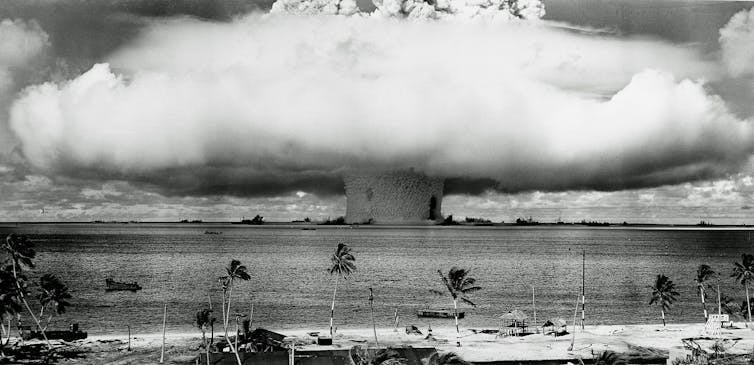
This year marks 75 years since the United States launched its immense atomic testing program in the Pacific. The historical fallout from tests carried out over 12 years in the Marshall Islands, then a UN Trust Territory governed by the US, have framed seven decades of US relations with the Pacific nation.
Due to the dramatic effects of climate change, the legacies of this history are shaping the present in myriad ways.
This history has Australian dimensions too, though decades of diplomatic distance between Australia and the Marshall Islands have hidden an entangled atomic past.
In 1946, the Marshall Islands seemed very close for many Australians. They feared the imminent launch of the US’s atomic testing program on Bikini Atoll might split the earth in two, catastrophically change the earth’s climate, or produce earthquakes and deadly tidal waves.
A map accompanying one report noted Sydney was only 3,100 miles from ground zero. Residents as far away as Perth were warned if their houses shook on July 1, “it may be the atom bomb test”.
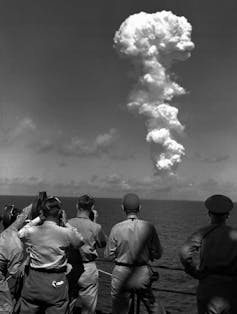
Australia was “included in the tests” as a site for recording blast effects and monitoring for atom bombs detonated anywhere in the world by hostile nations. This Australian site served to keep enemies in check and achieve one of the Pacific testing program’s objectives: to deter future war. The other justification was the advancement of science.


The earth did not split in two after the initial test (unless you were Marshallese) so they continued; 66 others followed over the next 12 years. But the insidious and multiple harms to people and place, regularly covered up or denied publicly, became increasingly hard to hide.
Radiation poisoning, birth defects, leukaemia, thyroid and other cancers became prevalent in exposed Marshallese, at least four islands were “partially or completely vapourised”, the exposed Marshallese “became subjects of a medical research program” and atomic refugees. (Bikinians were allowed to return to their atoll for a decade before the US government removed them again when it was realised a careless error falsely claimed radiation levels were safe in 1968.)
In late 1947, the US moved its operations to Eniwetok Atoll, a decision, it was argued, to ensure additional safety. Eniwetok was more isolated and winds were less likely to carry radioactive particles to populated areas.
Australian reports noted this site was only 3,200 miles from Sydney. Troubling reports of radioactive clouds as far away as the French Alps and the known shocking health effects appeared.
Dissenting voices were initially muted due to the steep escalation of the Cold War and Soviet atomic weapon tests beginning in 1949.
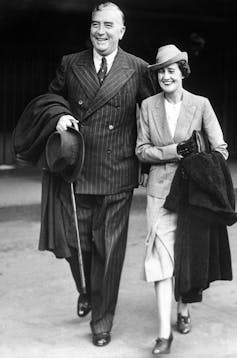
Opinion in Australia split along political lines. Conservative Cold War warriors, chief among them Robert Menzies who became prime minister again in 1949, kept Australia in lockstep with the US, and downplayed the ill-effects of testing. Left-wing elements in Australia continued to draw attention to the “horrors” it unleashed.
The atomic question came home in 1952, when the first of 12 British atomic tests began on the Montebello Islands, off Western Australia.
Australia’s involvement in atomic testing expanded again in 1954, when it began supplying South Australian-mined uranium to the US and UK’s joint defence purchasing authority, the Combined Development Agency.
Australia’s economic stake in the atomic age from 1954 collided with the galvanisation of global public opinion against US testing in Eniwetok. The massive “Castle Bravo” hydrogen bomb test in March exposed Marshall Islanders and a Japanese fishing crew on The Lucky Dragon to catastrophic radiation levels “equal to that received by Japanese people less than two miles from ground zero” in the 1945 Hiroshima and Nagasaki atomic blasts. Graphic details of the fishermen’s suffering and deaths and a Marshallese petition to the United Nations followed.
When a UN resolution to halt US testing was voted on in July, Australia voted for its continuation. But the tide of public opinion was turning against testing. The events of 1954 dispelled the notion atomic waste was safe and could be contained. The problem of radioactive fish travelling into Australian waters highlighted these new dangers, which spurred increasing world wide protests until the US finally ceased testing in the Marshalls in 1958.
In the 1970s, US atomic waste was concentrated under the Runit Island dome, part of Enewetak Atoll (about 3,200 miles from Sydney). Recent alarming descriptions of how precarious and dangerous this structure is due to age, sea water inundation and storm damage exacerbated by climate change were contested in a 2020 Trump-era report.
The Biden administration’s current renegotiation of the Compact of Free Association with the Republic of the Marshall Islands, and its prioritisation of action on climate change, will put Runit Island high on the agenda. There is an opportunity for historical redress for the US that is even more urgent given the upsurge in discrimination against US-based Pacific Islander communities devastated by the COVID-19 pandemic. Some are peoples displaced by the tests.
Australia is also embarking on a new level of engagement with the Marshall Islands: it is due to open its first embassy in the capital Majuro in 2021.
It should be remembered this bilateral relationship has an atomic history too. Australia supported the US testing program, assisted with data collection and voted in the UN for its continuation when Marshallese pleaded for it to be stopped. It is also likely Australian-sourced atomic waste lies within Runit Island, cementing Australia in this history.
Patricia A. O’Brien, Historian, Visiting Fellow in the School of History, Australian National University and Adjunct Professor in the Asian Studies Program, Georgetown University
This article is republished from The Conversation under a Creative Commons license. Read the original article.







