


Aaron Hertzmann, University of Washington
As an academic researcher, developer of artistic technology and amateur artist, I was quite skeptical about crypto art when I first read about it several years ago.
However, I follow a community of artists on social media, and some of the artists there whom I respect, like Mario Klingemann and Jason Bailey, embraced and advocated for crypto art. Within the past few months, activity and prices seemed to snowball. I started thinking it deserves to be taken seriously.
Then the Beeple sale happened.
On March 11, Beeple, a computer science graduate whose real name is Mike Winkelmann, auctioned a piece of crypto art at Christie’s for US$69 million.
The winning bidder is now named in a digital record that confers ownership. This record, called a nonfungible token, or NFT, is stored in a shared global database. This database is decentralized using blockchain, so that no single individual or company controls the database. As long as the specific blockchain survives in the world, anyone can read or access it, and no one can change it.
But “ownership” of crypto art confers no actual rights, other than being able to say that you own the work. You don’t own the copyright, you don’t get a physical print, and anyone can look at the image on the web. There is merely a record in a public database saying that you own the work – really, it says you own the work at a specific URL.


So why would anyone buy crypto art – let alone spend millions on what’s essentially a link to a JPEG file?
Art is inherently social
It might be helpful to think about crypto art in the context of why people buy original works of art.
Some people buy art for their homes, hoping to incorporate it into their living spaces for pleasure and inspiration.
But art also plays many important social roles. The art in your home communicates your interests and tastes. Artworks can spark conversation, whether they’re in museums or homes. People form communities around their passion for the arts, whether it’s through museums and galleries, or magazines and websites. Buying work supports the artists and the arts.
Then there are collectors. People get into collecting all sorts of things – model trains, commemorative plates, rare vinyl LPs, sports memorabilia – and, like other collectors, art collectors are passionate about trying to hunt down those rare pieces.
Perhaps the most visible form of art collecting today, and the one that drives so much public discussion about art, is the art purchased for millions of dollars – the pieces by Picasso and Damien Hirst traded by the ultrawealthy. This is still social: Whether they’re at Sotheby’s auctions or museum board dinners, wealthy art collectors mingle, meet and talk about who bought what.
Finally, I think many people buy art strictly as an investment, hoping that it will appreciate in value.
Is crypto art really that different?
If you look at the reasons people buy art, only one of them – buying art for your home – has to do with the physical work.
Every other reason for buying art that I listed could apply to crypto art.
You can build your own virtual gallery online and share it with other people online. You can convey your tastes and interests through your virtual gallery and support artists by buying their work. You can participate in a community: Some crypto artists, who have felt excluded by the mainstream art world, say they have found more support in the crypto community and can now earn a living making art.
While Beeple’s big sale made headlines, most crypto art sales are much more affordable, in the tens or hundreds of dollars. This supports a much larger community than just a select few artists. And some resale values have gone up.
Value as a social construct
Aside from the visual pleasure of physical objects, nearly all the value art offers is, in some way, a social construct. This does not mean that art is interchangeable, or that the historical significance and technical skill of a Rembrandt is imaginary. It means that the value we place on these attributes is a choice.
When someone pays $90 million for a metal balloon animal made by Jeff Koons, it’s hard to believe that the work has that much “intrinsic” value. Even if the materials and craftsmanship are quite good, surely some of those millions are simply buying the right to say “I bought a Koons. And I spent a lot of money on it.” If you just want an artfully made metal balloon animal, there are cheaper ways to get one.
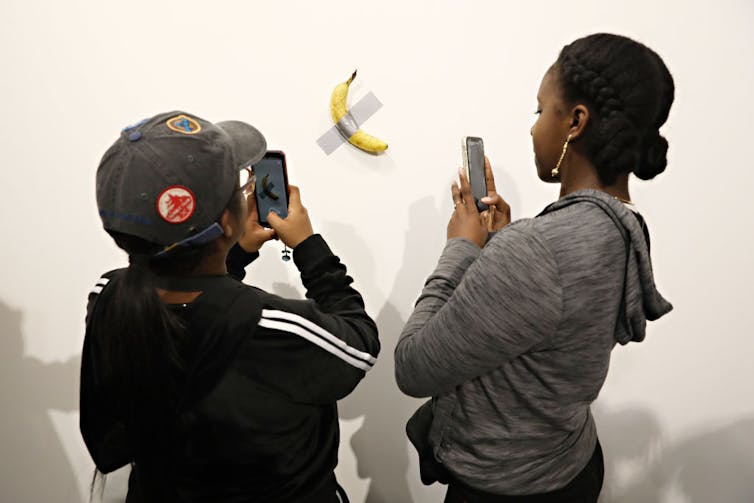
Conversely, the conceptual art tradition has long separated the object itself from the value of the work. Maurizio Cattelan sold a banana taped to a wall for six figures, twice; the value of the work was not in the banana or in the duct tape, nor in the way that the two were attached, but in the story and drama around the work. Again, the buyers weren’t really buying a banana, they were buying the right to say they “owned” this artwork.
Depending on your point of view, crypto art could be the ultimate manifestation of conceptual art’s separation of the work of art from any physical object. It is pure conceptual abstraction, applied to ownership.
On the other hand, crypto art could be seen as reducing art to the purest form of buying and selling for conspicuous consumption.
In Victor Pelevin’s satirical novel “Homo Zapiens,” the main character visits an art exhibition where only the names and sale prices of the works are shown. When he says he doesn’t understand – where are the paintings themselves? – it becomes clear that this isn’t the point. Buying and selling is more important than the art.
This story was satire. But crypto art takes this one step further. If the point of ownership is to be able to say you own the work, why bother with anything but a receipt?
Manufacturing scarcity
It still seems hard to get used to the idea of spending money for nothing tangible.
Would anyone pay money for NFTs that say they “own” the Brooklyn Bridge or the whole of the Earth or the concept of love? People can create all the NFTs they want about anything, over and over again. I could make my own NFT claiming that I own the Mona Lisa, and record it to the blockchain, and no one could stop me.
But I think this misses the point.
In crypto art, there is an implicit contract that what you’re buying is unique. The artist makes only one of these tokens, and the one right you get when you buy crypto art is to say that you own that work. No one else can. Note, though, that this is not a legal right, nor is there any enforcement other than social mores. Nonetheless, the value comes from the artist creating scarcity.
This is the same thing that’s happened in the art world ever since photographers and printmakers had to figure out how to sell their work. In the world of photography, a limited-edition print is considered more valuable than an unlimited edition; the fewer prints in the edition, the more valuable they are. Knowing that you have one of a few prints personally made and signed by the artist gives you an emotional connection to the artist that a mass-produced print doesn’t.
This connection could be even weaker in digital art. But what you are buying is still, in part, a connection with the artist. Artists sometimes publicly tweet their thanks to their crypto art patrons, which may strengthen this emotional connection.
A bubble bound to burst?
Personally, I want to buy only art I can hang on my walls, so I have no interest in buying crypto art. There are also environmental costs. Certain blockchains used for crypto art are really bad for the climate, because they require computations that consume staggering amounts of energy.
That said, if buying it right now gives you pleasure – and you enjoy sharing what you’ve bought and the community around it and you’re using a more environmentally friendly blockchain – that’s great.
If you’re buying it for some future reward, however, that’s risky. Will people care about your personal virtual gallery in the future? Will you care? Will crypto art even be a thing in a few years?
As an investment, it just seems inconceivable to me that the higher prices reflect true value, in the sense of these works having higher resale value in the long term. As in the traditional art world, there are a lot more works being sold than could ever possibly be considered significant in a generation’s time.
And, in the crypto world, we’re seeing highly volatile prices, a sudden frenzy of interest, and huge sums being paid for things that seem, on the surface, not to have the slightest bit of value at all, such as the $2.5 million bid to “own” Jack Dorsey’s first tweet or even the $1,000 bid on a photo of a cease-and-desist letter about NFTs.
Much of this energy seems to be driven by price speculation. It’s also worth noting that the winner of the Beeple auction seems to be heavily invested in the success of crypto art. The cryptocurrencies that drive crypto art are often considered highly speculative.
I have no doubt that, right now, there’s a big NFT bubble.
There have been lots of bubbles before – tulips, baseball cards, Beanie Babies – objects that were flying off the shelves one year and then piled up in landfills the next. And, in a bubble, a few headline-making winners get rich, while a whole lot of others lose their shirts. Even if crypto art lasts, maybe the particular artist or platform where you’re buying won’t be popular in the future.
My feelings about crypto art aside, I do believe that art is, fundamentally, a social activity. The more our social lives are lived online, the more it may make sense for some people to have their art collections online, too – whether or not blockchain is involved.
Aaron Hertzmann, Affiliate Faculty of Computer Science, University of Washington
This article is republished from The Conversation under a Creative Commons license. Read the original article.







