


• Advertise
  • About us
  • Terms and Conditions
  • Contact us
Monday, November 23, 2026
Australian Times News
  • News
    • Weather
    • Sport
    • Technology
    • Business & Finance
      • Currency Zone
    • Lotto Results
      • The Lott
  • Lifestyle
    • Entertainment
    • Horoscopes
    • Health & Wellness
    • Recipes
  • Travel
  • Expat Life
  • Move to Australia
No Result
View All Result
  • News
    • Weather
    • Sport
    • Technology
    • Business & Finance
      • Currency Zone
    • Lotto Results
      • The Lott
  • Lifestyle
    • Entertainment
    • Horoscopes
    • Health & Wellness
    • Recipes
  • Travel
  • Expat Life
  • Move to Australia
No Result
View All Result
Australian Times News
No Result
View All Result
Home News

Greta Thunberg effect: people familiar with young climate activist may be more likely to act

Seeing or hearing Greta Thunberg once doesn’t instantly turn someone into a climate activist. Nonetheless, we discovered a potentially important pattern of associations. Those more familiar with Thunberg were more likely to think their actions were effective and meaningful and were more intent on doing something about climate change.

The Conversation by The Conversation
06-02-2021 22:13
in News
Andrew Matthews/PA Archive/PA Images

Andrew Matthews/PA Archive/PA Images

Anandita Sabherwal, London School of Economics and Political Science and Sander van der Linden, University of Cambridge

She was declared Time magazine’s person of the year in the same month that Donald Trump told her to “work on her anger management issues”. Greta Thunberg has attracted international attention since her lone demonstration outside the Swedish Parliament in August 2018. Her “school strike for the climate” has now grown into a global movement that has brought more than 10 million people onto streets worldwide to demand action on climate change.

In the same time that Greta Thunberg has become a household name, public concern about climate change has reached record highs in the US. But what role has Thunberg’s personal influence played in this? Do her speeches appeal to diverse audiences or is she simply preaching to the choir?

Based on a nationally representative survey of over 1,300 US adults, our study found that Americans who report being more familiar with Greta Thunberg also feel more confident that they can help mitigate climate change as part of a collective effort. They are also more willing to take action themselves, by contacting elected officials or giving time and money to campaigns. We call this the Greta Thunberg effect.

Familiarity breeds empowerment

Seeing or hearing Greta Thunberg once doesn’t instantly turn someone into a climate activist. Nonetheless, we discovered a potentially important pattern of associations. Those more familiar with Thunberg were more likely to think their actions were effective and meaningful and were more intent on doing something about climate change. Our model seemed to show this might be the case because people who knew Thunberg’s story – how her lonely stand inspired millions around the world to join her – were more likely to recognise the potential for ordinary people to make a difference.

We wanted to know how widespread this effect might be, so we tried to find out which audiences Thunberg most appealed to. In her public appearances, she’s often surrounded by young people and her demands for climate action align most strongly with liberal policy preferences. Since people tend to listen more to those they identify with, we thought that young and left-leaning people would be more strongly influenced by her.

Young people walk past a sign advertising Greta Thunberg's book in Italy.
Young people are likely to be most receptive, but Thunberg’s influence defies generational and political divides. Antonello Marangi/Shutterstock

Surprisingly, the Greta Thunberg effect seems to be similar across age groups and the political spectrum for US adults, though it was stronger among liberals than conservatives. We didn’t survey children and teenagers, but we expect them to be most strongly influenced by Thunberg’s school strikes.


AlsoRead...

How She Sells with Brooke helps thousands of women build new careers through high-ticket sales

How She Sells with Brooke helps thousands of women build new careers through high-ticket sales

6 October 2026
Mark Levin and Yael Eckstein: Celebrating 250 Years - The Bond Between America and Israel

Mark Levin and Yael Eckstein: Celebrating 250 Years – The Bond Between America and Israel

30 September 2026

‘No one is too small to make a difference’

Pope Francis, James Hansen and Jeff Bezos have all tried to spur momentum on climate action using their religious, academic and financial authority. Greta Thunberg lacks any such elite status, so how has she been able to succeed?

Given the prevailing sense of doom about climate change, empowering people to take action requires an ability to convey that change is possible. In her speeches, Thunberg proclaims that “there is still time to change everything around”. Her Fridays for Future campaign is also founded on the empowering message that anyone – even school students – can make a difference.

Greta Thunberg sits reading with her famous sign nearby.
Greta Thunberg’s example to others is that ordinary person can inspire extraordinary change. Liv Oeian/Shutterstock

Most importantly, Thunberg’s actions are consistent with her words. Her fiery demands to world leaders, whether at the United Nations or the US Congress demonstrate that anyone can – and should – challenge powerful institutions and people.

What does this mean for climate action?

How can we be sure that our findings reflect Greta Thunberg’s own effect and not the influence of climate activism more generally? The short answer is that we can’t. But to help isolate Thunberg’s influence, we asked our study participants to rate their support for climate activism and found that familiarity with Thunberg remained relevant even when controlling for this.

Of course, there are other things that could explain why people may want to take action on climate change, such as their prior support for environmental reform or their having heard about climate change in the news. But much of this is already captured indirectly by political ideology in our model, which is one of the most important predictors of what a person reads and how much they support climate action. So, while there are many reasons people might want to tackle climate change, being familiar with Greta Thunberg appears to have a unique influence on the extent to which they feel empowered to make a difference.
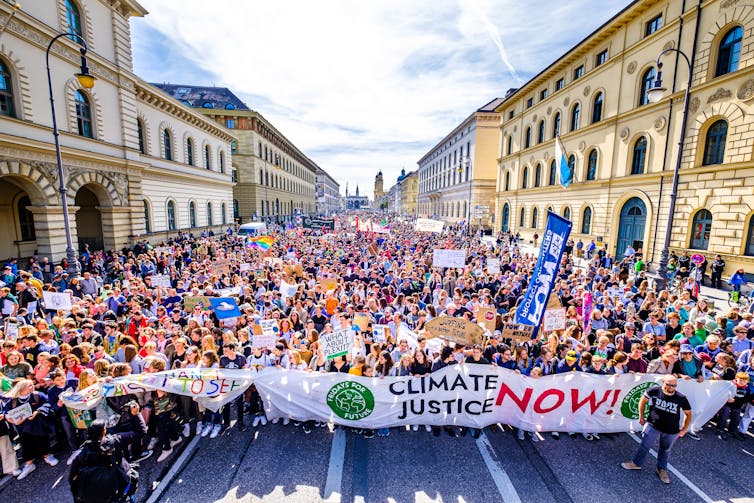
A vast crowd holding protest banners march along a wide city street.
Munich, Germany on Friday September 20, 2019: 30,000 people strike for the climate. FooTToo/Shutterstock

But what if the Greta Thunberg effect is actually operating the other way? Did we instead find that people who are already more likely to act on climate change are just more familiar with Greta Thunberg? We can’t be certain because this type of study can’t prove cause and effect, it can only show associations. But statistical tests showed that this reverse explanation did not explain the data as well as our original one. Of course, reality may be more complex than what our models can capture. A positive feedback loop – where both explanations operate in tandem to inspire climate action – is also possible.

Future research can build on our findings using controlled experiments, but the patterns in our data at least suggest that Greta Thunberg is a particularly inspirational leader in part because she’s a convincing example that sudden, big change is possible. Now, how can activists amplify their own impact? Considering how politicised climate change is, one answer might be appealing to people across the political spectrum by highlighting aspects of their identity that they tend to share with the wider public. The Greta Thunberg effect suggests that calls to action may be able to mobilise broad segments of society, regardless of age or politics.

Anandita Sabherwal, PhD Student in Psychological and Behavioural Science, London School of Economics and Political Science and Sander van der Linden, Professor of Social Psychology in Society and Director, Cambridge Social Decision-Making Lab, University of Cambridge

This article is republished from The Conversation under a Creative Commons license. Read the original article.


Tags: SB001
DMCA.com Protection Status

SUBSCRIBE to our NEWSLETTER

[mc4wp_form id=”2384248″]

Don't Miss

NRMA welcomes dogs at four NSW South Coast Holiday Parks

by Pauline Torongo
22 October 2026
NRMA welcomes dogs at four NSW South Coast Holiday Parks
Lifestyle

Pet-friendly stays and nearby beaches give families more coastal holiday options as Australian caravan and camping trips reach record levels.

Read moreDetails

How She Sells with Brooke helps thousands of women build new careers through high-ticket sales

by Pauline Torongo
6 October 2026
How She Sells with Brooke helps thousands of women build new careers through high-ticket sales
Business & Finance

More than 3,000 women have joined She Sells with Brooke Triplett to build careers in high-ticket sales. For many, the...

Read moreDetails

Qualities to look for in a Caribbean Luxury Cruise Experience

by Pauline Torongo
6 October 2026
Qualities to look for in a Caribbean Luxury Cruise Experience. Image: Supplied
Travel

Luxury Caribbean cruises are often associated with beaches, sunshine, and tropical ease, but they can be more than that with...

Read moreDetails

Mark Levin and Yael Eckstein: Celebrating 250 Years – The Bond Between America and Israel

by Pauline Torongo
30 September 2026
Mark Levin and Yael Eckstein: Celebrating 250 Years - The Bond Between America and Israel
News

As America marks 250 years since the Declaration of Independence, Yael Eckstein and Mark Levin explore the biblical values and...

Read moreDetails

How supporting Australia’s Care Workforce could strengthen care in the community

by Pauline Torongo
10 September 2026
How supporting Australia’s Care Workforce could strengthen care in the community
News

Australian care funding faces growing scrutiny after a 2025 ANAO report found NDIS losses from fraud, non-compliance, and payment errors...

Read moreDetails

The Future of Work Is Changing: What HR must champion next, according to Energy Collective Co

by Pauline Torongo
28 August 2026
What HR Must Champion Next, According to Energy Collective Co
Business & Finance

Energy Collective Co examines the root causes of performance by considering how work is designed, how leadership is enacted and...

Read moreDetails

From Empathy Burnout to Body-Led Recovery: What Heidi Jane of Intuition Co. learned by living through what she teaches

by Pauline Torongo
25 August 2026
What Heidi Jane of Intuition Co. learned by living through what she teaches
Lifestyle

Recognising emotional exhaustion is only the first step. While supportive habits such as rest, time in nature, hydration, and reduced...

Read moreDetails
Load More

Copyright © Blue Sky Publications Ltd. All Rights Reserved.
australiantimes.co.uk is a division of Blue Sky Publications Ltd. Reproduction without permission prohibited. DMCA.com Protection Status

  • About us
  • Write for Us
  • Advertise
  • Contact us
  • T&Cs, Privacy and GDPR
No Result
View All Result
  • News
    • Weather
    • Sport
    • Technology
    • Business & Finance
      • Currency Zone
    • Lotto Results
      • The Lott
  • Lifestyle
    • Entertainment
    • Horoscopes
    • Health & Wellness
    • Recipes
  • Travel
  • Expat Life
  • Move to Australia

Copyright © Blue Sky Publications Ltd. All Rights Reserved.
australiantimes.co.uk is a division of Blue Sky Publications Ltd. Reproduction without permission prohibited. DMCA.com Protection Status