

• Advertise
  • About us
  • Terms and Conditions
  • Contact us
Saturday, August 15, 2026
Australian Times News
  • News
    • Weather
    • Sport
    • Technology
    • Business & Finance
      • Currency Zone
    • Lotto Results
      • The Lott
  • Lifestyle
    • Entertainment
    • Horoscopes
    • Health & Wellness
    • Recipes
  • Travel
  • Expat Life
  • Move to Australia
No Result
View All Result
  • News
    • Weather
    • Sport
    • Technology
    • Business & Finance
      • Currency Zone
    • Lotto Results
      • The Lott
  • Lifestyle
    • Entertainment
    • Horoscopes
    • Health & Wellness
    • Recipes
  • Travel
  • Expat Life
  • Move to Australia
No Result
View All Result
Australian Times News
No Result
View All Result
Home News

The less equal we become, the less we trust science, and that’s a problem

Scientists around the world frequently feel governments do not pay enough attention to scientific advice. That was the view of some half of the 25,307 researchers surveyed by Frontiers, a Swiss publisher of scientific journals, in May and June.

The Conversation by The Conversation
29-12-2020 06:19
in News
Trust varies by location

Trust varies by location Photo by Obi Onyeador on Unsplash

Tony Ward, University of Melbourne

In mid November, South Dakota emergency room nurse Jodi Doering tweeted her experience of caring for dying patients.

PopTika/Shutterstock

Many, she said, were denying the existence of COVID-19 until their final breaths.

Their last dying words are “this can’t be happening, it’s not real.” And when they should be … FaceTiming their families, they’re filled with anger and hatred

Five months earlier, a 30 year old man died of COVID-19 in the Methodist Hospital in San Antonio, Texas. His dying words, to his nurse:

I think I made a mistake. I thought this was a hoax, but it’s not

The hospital’s chief medical officer reported that the patient became infected at a party with other sceptics, all thinking the virus was “fake news”.

Trust varies by location

That Texas party was doubtless organised by mobile phone, and the friends drove their cars there. Both pieces of technology have much more computer storage and processing power than the Apollo 11 moon landing had in 1969.

Ironically, recent advances in science and technology helped people gather to express their doubts about scientific advice.

AlsoRead...

Managing Aussie Share Portfolios Abroad: Tips for Growth

Managing Aussie Share Portfolios Abroad: Tips for Growth

2 July 2026
The New Meaning of Luxury: Lessons from Entrepreneur Chloe Hardy

The New Meaning of Luxury: Lessons from Entrepreneur Chloe Hardy

2 July 2026

But it is not just individuals who have downplayed scientific advice and warnings about the virus.

Scientists around the world frequently feel governments do not pay enough attention to scientific advice. That was the view of some half of the 25,307 researchers surveyed by Frontiers, a Swiss publisher of scientific journals, in May and June.

New Zealand takes advice, the US not so much

The survey asked the international scientists whether lawmakers in their country had used scientific advice to inform their COVID strategy.

Overall, the scientists split 50:50 on how much, or how little, their government had considered the scientific advice.

Opinions varied widely between countries. In New Zealand, almost 80% were happy with the attention their government paid to scientific advice. In the United States, fewer than 20% of the scientists thought the same about their government.


Where policy makers take scientific advice into account
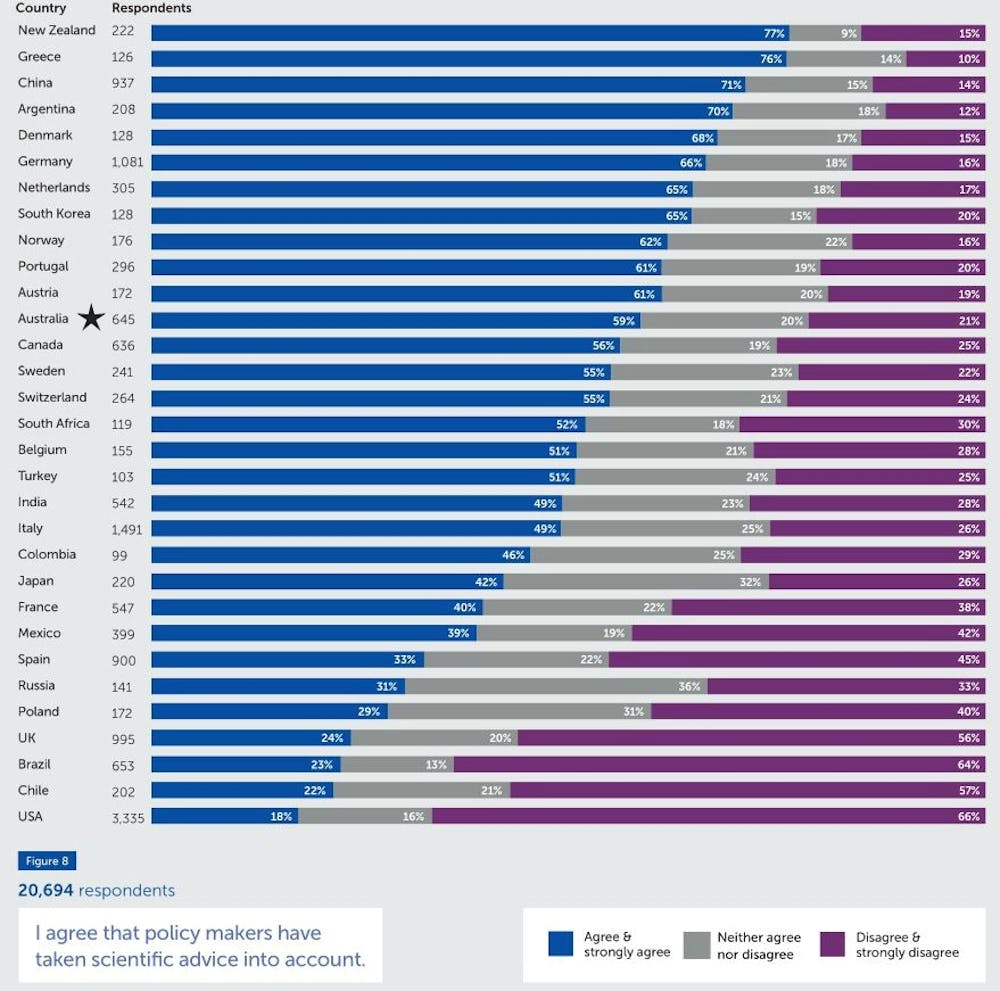
The Academic Response to COVID-19, Frontiers in Public Health, October 2000

One obvious factor in scientists’ attitudes is the penchant some politicians from various parts of the world have for denigrating experts.

Outgoing US President Donald Trump frequently dismisses anything he disagrees with as “fake news”.

In Britain in the 2016 Brexit referendum, a raft of economists argued that Brexit would damage the UK economy. Leading Conservative politician and Brexit supporter Michael Gove ignored them, saying: “people in this country have had enough of experts”.


And recently in Australia, the Grattan Institute, an independent think tank, issued a report Flame Out, which argued there is limited future need for natural gas.

A spokesman for the energy minister Angus Taylor dismissed the report, saying its findings about the manufacturing sector did not reflect the industry’s own views.

Who needs experts when they can rely on industry?

Less-equal societies trust less

But there are other, less obvious, factors underlying how much attention countries and governments have paid to expert advice.

A significant one is the level of inequality in the country. This graph maps the results from the Frontiers survey against levels of income inequality.

Inequality is measured by the standard Gini coefficient, which runs from 0.0 (everyone has the same income) to 1.0 (one person has all of a country’s income).


Proportion of scientists saying government took scientific advice on COVID
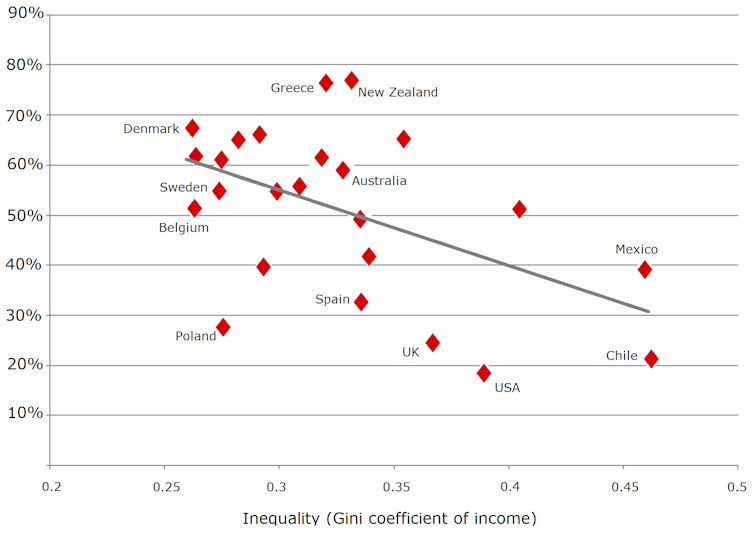
Gini coefficient measures inequality on scale where 0 = income is shared equally, 1 = one person has all the income. Frontiers in Public Health, OECD

The line running through the diamonds is a trend line. It shows that, on average, trust in science declines as inequality increases.

On average, an increase of one percentage point in inequality is associated with a decrease of 1.5 percentage points in listening to scientists.

Richard Wilkinson and Kate Pickett provide an clue as to why this might be the case in their 2009 book The Spirit Level, observing that

inequality affects how you see those around you … people in less equal societies are less likely to trust each other”.

In such countries the beliefs that it’s a “dog-eat-dog” world, or that “everyone’s out for themselves”, seem to be more prevalent.

New York Times columnist David Brooks believes collapsing levels of trust are devastating America. In his view

an anti-institutional bias has manifested itself as hatred of government; an unwillingness to defer to expertise, authority, and basic science; and a reluctance to fund the civic infrastructure of society, such as a decent public health system.

World-wide, efforts to tackle the coronavirus have been hampered by communities disputing the severity – or even the existence – of the virus.

Australia still has a fair measure of trust. Announcing restrictions earlier this year, Victorian Premier Dan Andrews said “everybody will pay a price” if Victorians don’t play their part and act on the advice of experts.

So far we have, impressively; and in Sydney too. But trust is fragile.

Inequality is a corrosive solvent.

Tony Ward, Fellow in Historical Studies, University of Melbourne

This article is republished from The Conversation under a Creative Commons license. Read the original article.

Tags: SB001
DMCA.com Protection Status

SUBSCRIBE to our NEWSLETTER

[mc4wp_form id=”2384248″]

Don't Miss

Why Smarter Fleet Management Is For All Modern Business Options

by Fazila Olla-Logday
29 July 2026
Smarter Fleet Management
Motoring

Operating a business that relies on vehicles is harder than ever.

Read moreDetails

Animal Communication Goes Beyond What Science Can Currently Measure: Zoologist and Spiritual teacher Artemis, the heart whisperer on what the textbooks don’t teach

by Australian Times
7 July 2026
Animal Communication Goes Beyond What Science Can Currently Measure
Lifestyle

Animal communication classes and formal training can be valuable, providing tools, structure, and guidance.

Read moreDetails

Managing Aussie Share Portfolios Abroad: Tips for Growth

by Fazila Olla-Logday
2 July 2026
Managing Aussie Share Portfolios Abroad: Tips for Growth
at

Unlock the secrets to optimizing your Aussie share portfolios abroad. Discover essential tips for growth and navigate the global market...

Read moreDetails

The New Meaning of Luxury: Lessons from Entrepreneur Chloe Hardy

by Pauline Torongo
2 July 2026
The New Meaning of Luxury: Lessons from Entrepreneur Chloe Hardy
Business & Finance

Chloe Hardy, the founder and CEO of Dupes & Co established an Australian-made beauty brand focused on affordability and product...

Read moreDetails

Excel Funding Group emerges as Specialist in SMSF Property Lending amid growing demand

by Pauline Torongo
26 June 2026
Excel Funding Group emerges as Specialist in SMSF Property Lending amid growing demand
Business & Finance

Excel Funding Group has hit a new milestone, tripling its SMSF loan settlement volumes compared to Q1 2025.

Read moreDetails

Svitla Systems acquires Australia’s Kiandra IT to expand Global Engineering Footprint and Accelerate AI-Driven delivery

by Pauline Torongo
11 May 2026
Svitla Systems
Business & Finance

Acquisition marks Svitla’s entry into the Australian market and strengthens capabilities in low-code, Microsoft technologies, and enterprise software engineering.

Read moreDetails

Residential Healthcare Practices: Revolution or Evolution?

by Pauline Torongo
11 May 2026
Residential Healthcare Practices: Revolution or Evolution?
Lifestyle

President Bill Lutz’s "revolution" was born from his background in fine dining, which instilled a disciplined, customer-focused approach.

Read moreDetails
Load More

Copyright © Blue Sky Publications Ltd. All Rights Reserved.
australiantimes.co.uk is a division of Blue Sky Publications Ltd. Reproduction without permission prohibited. DMCA.com Protection Status

  • About us
  • Write for Us
  • Advertise
  • Contact us
  • T&Cs, Privacy and GDPR
No Result
View All Result
  • News
    • Weather
    • Sport
    • Technology
    • Business & Finance
      • Currency Zone
    • Lotto Results
      • The Lott
  • Lifestyle
    • Entertainment
    • Horoscopes
    • Health & Wellness
    • Recipes
  • Travel
  • Expat Life
  • Move to Australia

Copyright © Blue Sky Publications Ltd. All Rights Reserved.
australiantimes.co.uk is a division of Blue Sky Publications Ltd. Reproduction without permission prohibited. DMCA.com Protection Status

No Result
View All Result
  • News
    • Weather
    • Sport
    • Technology
    • Business & Finance
      • Currency Zone
    • Lotto Results
      • The Lott
  • Lifestyle
    • Entertainment
    • Horoscopes
    • Health & Wellness
    • Recipes
  • Travel
  • Expat Life
  • Move to Australia

Copyright © Blue Sky Publications Ltd. All Rights Reserved.
australiantimes.co.uk is a division of Blue Sky Publications Ltd. Reproduction without permission prohibited. DMCA.com Protection Status





