
• Advertise
  • About us
  • Terms and Conditions
  • Contact us
Thursday, May 14, 2026
Australian Times News
  • News
    • Weather
    • Sport
    • Technology
    • Business & Finance
      • Currency Zone
    • Lotto Results
      • The Lott
  • Lifestyle
    • Entertainment
    • Horoscopes
    • Health & Wellness
    • Recipes
  • Travel
  • Expat Life
  • Move to Australia
No Result
View All Result
  • News
    • Weather
    • Sport
    • Technology
    • Business & Finance
      • Currency Zone
    • Lotto Results
      • The Lott
  • Lifestyle
    • Entertainment
    • Horoscopes
    • Health & Wellness
    • Recipes
  • Travel
  • Expat Life
  • Move to Australia
No Result
View All Result
Australian Times News
No Result
View All Result
Home News

Paris Agreement: five years on, it’s time to fix carbon trading

With the election of Joe Biden, the US is set to rejoin the Paris Agreement. The country’s commitment, made in 2015, to restrain temperature rises to 2°C as part of an international effort is again endorsed, at least on paper.

The Conversation by The Conversation
13-12-2020 09:17
in News
All parties to the Paris Agreement must commit

All parties to the Paris Agreement must commit Photo by Terry Vlisidis on Unsplash

Mark Huxham, Edinburgh Napier University and Imi Melissa Dencer-Brown, Edinburgh Napier University

With the election of Joe Biden, the US is set to rejoin the Paris Agreement. The country’s commitment, made in 2015, to restrain temperature rises to 2°C as part of an international effort is again endorsed, at least on paper.

But progress since 2015 has been painfully slow. Signatories to the Paris Agreement must pledge actions, known as “nationally determined contributions” (NDCs), which increase in ambition at each five-year submission. The latest set are due in 2020, but with little time left, many are yet to be published.

It’s hoped this process will produce public displays of virtue as governments jockey for leadership. But some nations – including Australia, New Zealand, Russia and Indonesia – have already stated they will not increase their ambition during this round of submissions, in violation of the agreement. Global policies currently in place, combined with newly pledged NDCs, give an estimated 66% chance of keeping global temperatures below 2.9°C by the end of the century.

We’re deep in the danger zone. With the broad aspirations of the Paris Agreement confirmed, attention must now focus on rapid implementation. An immediate issue is clarifying article six – the most contentious part of the agreement. It deals with how countries can cooperate through carbon markets, emissions trading and support for less developed nations at international, national and local levels.

It will shape how the world supports nature-based solutions to climate change, which protect and expand natural carbon sinks such as forests. Take blue carbon habitats for example – mangroves, salt marshes and seagrass meadows. 151 countries contain at least one of these natural carbon stores. Stopping their destruction would save half a gigatonne of CO₂ per year – more than the UK’s entire annual emissions.

Investing in blue carbon

Conserving these ecosystems will depend on empowering local communities to lead the effort. Kenya exemplifies the opportunities and challenges. The country has 61,271 hectares of mangroves and 31,700 hectares of seagrass, which together store at least 77 million tonnes of carbon, more than 11 times the country’s annual CO₂ emissions. By nurturing the species that local fishers catch, these beautiful habitats provide livelihoods for thousands along the coast and attract visitors from around the world.


AlsoRead...

Svitla Systems

Svitla Systems acquires Australia’s Kiandra IT to expand Global Engineering Footprint and Accelerate AI-Driven delivery

11 May 2026
How Clevero is helping Australian Service Businesses compete with Enterprises on a Fraction of the Budget

How Clevero is helping Australian Service Businesses compete with Enterprises on a Fraction of the Budget

28 April 2026
A yellow seahorse rests amid a vast underwater seagrass meadow.
Blue carbon habitats, like seagrass beds, are particularly good at storing carbon. Nina Milton/Shutterstock

Fortunately, Kenya hosts world-leading examples of how carbon trading can support natural solutions to climate change. People and organisations can choose to offset their carbon pollution using a voluntary market, which operates independently of international agreements like Paris.

One project their money can support is Mikoko Pamoja (“mangroves together” in Kiswahili), which protects a mangrove forest in Gazi Bay, southern Kenya. The carbon saved by conserving and expanding these mangroves is independently verified and the money raised pays for tree nurseries, efficient wood stoves and forest patrols which prevent poaching and monitor the health of the forest. It also contributes to a community benefit fund. Decisions regarding how to spend that money – building schools, hospitals or other community projects – are made by the local community.

This kind of small-scale and locally controlled offsetting looks very different to that supported under the old Kyoto Protocol. Under that treaty, carbon trading often funded large-scale green technology and energy projects, but research suggests that up to 85% of these would probably have happened anyway, even without offsetting funds.

Kenya could incorporate the protection and expansion of all its blue carbon ecosystems into the nation’s NDCs, making a high-profile commitment to their conservation. But this won’t happen without new sources of income. Money could come from emissions trading in a newly formed international market, which was originally envisaged in article six. To be successful, this market must allow the lessons learned from small, voluntary projects to be applied nationally. There are three major challenges if this is to work.
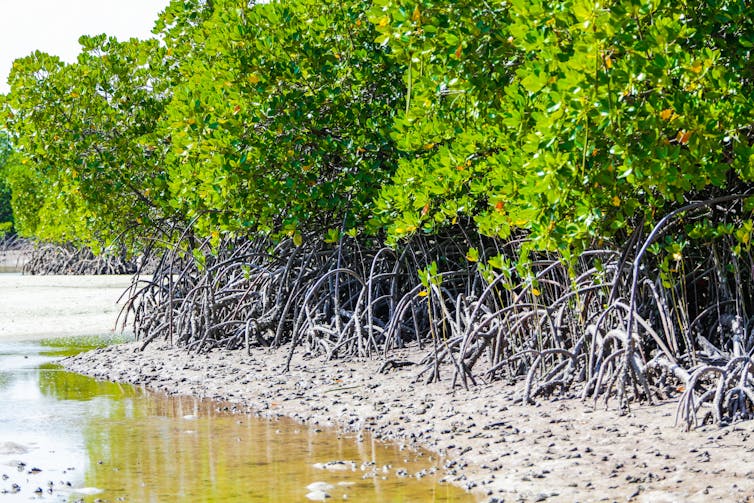
A sandy bank filled with twisted roots of mangrove trees.
Kenya could commit to preserving its vast mangrove forests as part of its national contribution to slowing climate change. Marius Dobilas/Shutterstock

Getting it right

First, there is a danger of double counting. If rich countries fund the conservation of blue carbon habitats in Kenya, are these climate benefits included in the Kenyan NDC or in that of the funder? Second, can voluntary market projects contribute to a country’s entire NDC? And if so, how will they retain the flexibility and local control that made them a success? Lastly, and perhaps most importantly, the whole idea of trading carbon is dangerous if it becomes an excuse for inaction. Carbon trading must not allow large polluters to avoid making the urgent cuts in emissions needed.

Setting the rules that govern emissions trading, financing and support for developing countries over 2021 will be critical. These must ensure that investment goes to additional projects – those that would not have happened without support –and that the rights of communities that depend on carbon-rich ecosystems are respected. Nature based solutions, with all their added benefits for wildlife and local wellbeing, should feature prominently. And all parties to the Paris Agreement must commit to and demonstrate immediate reductions in emissions rather than look to offsetting as an excuse for inaction.

The election of President Biden was a step in the right direction. Now we need to start running.

Mark Huxham, Professor of Teaching and Research in Environmental Biology, Edinburgh Napier University and Imi Melissa Dencer-Brown, Lecturer in Blue Carbon, Edinburgh Napier University

This article is republished from The Conversation under a Creative Commons license. Read the original article.


Tags: SB001
DMCA.com Protection Status

SUBSCRIBE to our NEWSLETTER

[mc4wp_form id=”2384248″]

Don't Miss

Svitla Systems acquires Australia’s Kiandra IT to expand Global Engineering Footprint and Accelerate AI-Driven delivery

by Pauline Torongo
11 May 2026
Svitla Systems
Business & Finance

Acquisition marks Svitla’s entry into the Australian market and strengthens capabilities in low-code, Microsoft technologies, and enterprise software engineering.

Read moreDetails

Residential Healthcare Practices: Revolution or Evolution?

by Pauline Torongo
11 May 2026
Residential Healthcare Practices: Revolution or Evolution?
Lifestyle

President Bill Lutz’s "revolution" was born from his background in fine dining, which instilled a disciplined, customer-focused approach.

Read moreDetails

Medicana Health Group launches HPV vaccination campaign to support cervical cancer prevention

by Pauline Torongo
28 April 2026
Medicana Health Group launches HPV vaccination campaign to support cervical cancer prevention
Health & Wellness

The Türkiye-based healthcare group has introduced a new awareness campaign focused on HPV vaccination, regular check-ups and early detection, with...

Read moreDetails

How Clevero is helping Australian Service Businesses compete with Enterprises on a Fraction of the Budget

by Pauline Torongo
28 April 2026
How Clevero is helping Australian Service Businesses compete with Enterprises on a Fraction of the Budget
Business & Finance

By consolidating CRM, scheduling, workflow automation, invoicing, reporting, and client communications into a single platform, Clevero gives smaller operators the...

Read moreDetails

How CJAM Group is building 1,100 homes across Southeast Queensland

by Pauline Torongo
24 March 2026
How CJAM Group is building 1,100 homes across Southeast Queensland
Lifestyle

The CJAM Group founder is quietly building a 1,100+ home pipeline, with projects in Hervey Bay and Toowoomba, using a...

Read moreDetails

Design Without Compromise: Where Gutter Protection Meets Modern Architecture

by Fazila Olla-Logday
20 March 2026
Design Without Compromise: Where Gutter Protection Meets Modern Architecture
Business & Finance

Design without compromise by integrating gutter protection seamlessly into modern architecture. Discover how innovative gutter systems enhance your home’s aesthetics...

Read moreDetails

How WageSafe Secured Australia’s Most Reputable Retail Business Among Its Premium Clients

by Fazila Olla-Logday
12 March 2026
How WageSafe Secured Australia’s Most Reputable Retail Business Among Its Premium Clients
at

Learn how WageSafe helps businesses stay compliant with payroll and wage regulations through reliable monitoring, risk management, and expert support—protecting...

Read moreDetails
Load More

Copyright © Blue Sky Publications Ltd. All Rights Reserved.
australiantimes.co.uk is a division of Blue Sky Publications Ltd. Reproduction without permission prohibited. DMCA.com Protection Status

  • About us
  • Write for Us
  • Advertise
  • Contact us
  • T&Cs, Privacy and GDPR
No Result
View All Result
  • News
    • Weather
    • Sport
    • Technology
    • Business & Finance
      • Currency Zone
    • Lotto Results
      • The Lott
  • Lifestyle
    • Entertainment
    • Horoscopes
    • Health & Wellness
    • Recipes
  • Travel
  • Expat Life
  • Move to Australia

Copyright © Blue Sky Publications Ltd. All Rights Reserved.
australiantimes.co.uk is a division of Blue Sky Publications Ltd. Reproduction without permission prohibited. DMCA.com Protection Status

No Result
View All Result
  • News
    • Weather
    • Sport
    • Technology
    • Business & Finance
      • Currency Zone
    • Lotto Results
      • The Lott
  • Lifestyle
    • Entertainment
    • Horoscopes
    • Health & Wellness
    • Recipes
  • Travel
  • Expat Life
  • Move to Australia

Copyright © Blue Sky Publications Ltd. All Rights Reserved.
australiantimes.co.uk is a division of Blue Sky Publications Ltd. Reproduction without permission prohibited. DMCA.com Protection Status