• Advertise
  • About us
  • Terms and Conditions
  • Contact us
Wednesday, March 25, 2026
Australian Times News
  • News
    • Weather
    • Sport
    • Technology
    • Business & Finance
      • Currency Zone
    • Lotto Results
      • The Lott
  • Lifestyle
    • Entertainment
    • Horoscopes
    • Health & Wellness
    • Recipes
  • Travel
  • Expat Life
  • Move to Australia
No Result
View All Result
  • News
    • Weather
    • Sport
    • Technology
    • Business & Finance
      • Currency Zone
    • Lotto Results
      • The Lott
  • Lifestyle
    • Entertainment
    • Horoscopes
    • Health & Wellness
    • Recipes
  • Travel
  • Expat Life
  • Move to Australia
No Result
View All Result
Australian Times News
No Result
View All Result
Home News

Coronavirus: why is eastern Europe’s second wave so much worse than its first?

Eastern Europe was praised for being exceptional during the first wave of the pandemic. By introducing very strict prevention measures early on, countries in the region had significantly fewer COVID-related deaths than their western European counterparts.

The Conversation by The Conversation
02-12-2020 22:15
in News
Eastern European countries chose to respond differently during the second wave

Eastern European countries chose to respond differently during the second wave Photo by Erik Mclean on Unsplash

Tamara Popic, European University Institute and Alexandru D Moise, European University Institute

Eastern Europe was praised for being exceptional during the first wave of the pandemic. By introducing very strict prevention measures early on, countries in the region had significantly fewer COVID-related deaths than their western European counterparts.

Some argued that this was because of economics: that eastern European countries locked down early because they feared their economies would not be able to handle many people getting sick. Others suggested this eastern European exceptionalism could be explained by culture, with success in limiting the first wave being down to a mentality of fear and readiness to follow harsh rules stemming from the communist era.

But if these factors were at play in the first wave, they haven’t had the same effect in the second. Eastern Europe’s pandemic experience has been dramatically different this autumn. All countries in the region have seen significant increases in cases and deaths. Here, we take a look at why this has happened.

A head start in the first wave

One thing is clear: eastern Europe exited the first wave at the end of June in much better shape than western Europe. Adjusting for population size, both cases and deaths were substantially lower in the east, as shown in this comparison of the COVID-19 death rate in the two regions.
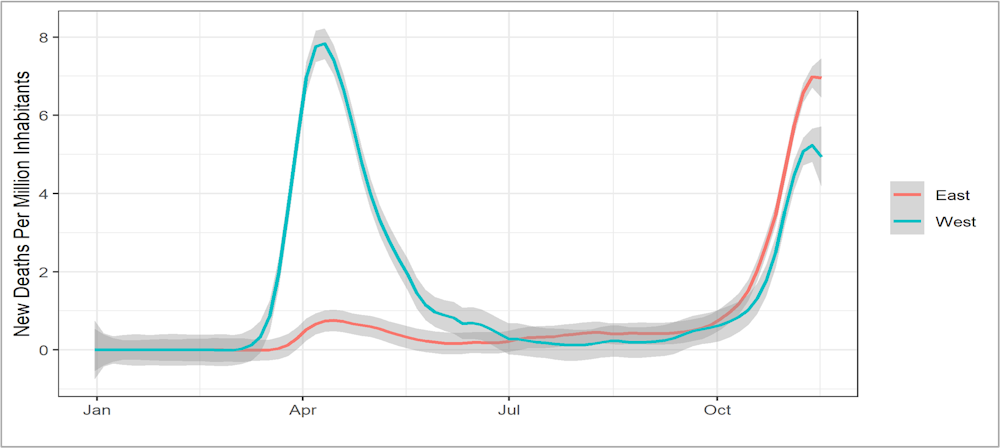
Graph showing that during March-June 2020, COVID-19 deaths per head of population spiked in western Europe but remained low in eastern Europe.
Daily new COVID-19 deaths per million inhabitants, eastern and western Europe. Our World in Data COVID-19 Dataset. Authors’ compilation.

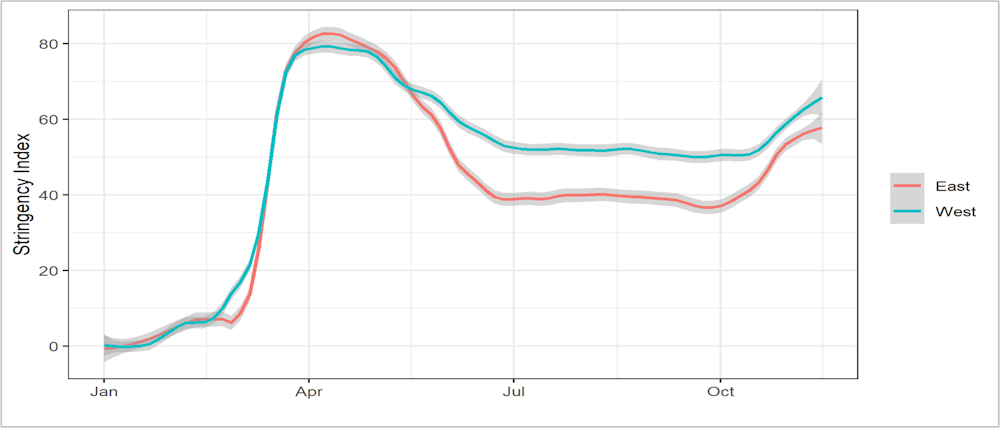
We can also compare how restrictive the two regions’ disease-prevention measures were during the first wave using the Oxford COVID-19 government response tracker (OxCGRT). This tool measures the stringency of efforts to control the virus on a scale of 0-100, with 100 being the most restrictive. We can see from the next graph that, at the same time in the spring, the two regions introduced measures that were similarly strict.

However, if we look back at the death rates of the two regions in the graph above, it’s clear that eastern European countries introduced restrictions when experiencing far fewer cases and deaths. Therefore, the simplest explanation for why eastern Europe initially fared much better is that it had a head start. Countries in the region imposed strict measures while being relatively mildly affected, whereas western countries waited until things got bad.


AlsoRead...

Design Without Compromise: Where Gutter Protection Meets Modern Architecture

Design Without Compromise: Where Gutter Protection Meets Modern Architecture

20 March 2026
The Rise of This Lead Generation Workshop Across Australia

The Rise of This Lead Generation Workshop Across Australia

13 February 2026
Graph showing how eastern Europe's COVID-19 control measures were initially as stringent as western Europe's, but since the summer have been more relaxed.
Stringency of COVID-19 control measures in eastern and western Europe. OxCGRT. Authors’ compilation.

This shows that eastern European countries took the opportunity to act quickly.

Squandering the spring gains

When we turn to the second wave (starting around September and ongoing), we’re faced with the opposite question: why did eastern European countries not act in spite of rapidly rising infections and deaths?

Eastern European death rates overtook those in the west in early October, but restrictions in the region – which had eased after the first wave – still lagged behind controls reintroduced in the west. Look again at the second graph above. It shows that in between the two waves, the east relaxed its measures further than the west, and was then less eager in reimposing them. Eastern Europe squandered its spring gains and then repeated the mistakes made by the west in spring: waiting until cases and deaths are out of control before imposing controls.

What explains this reluctance to reintroduce restrictions? One explanation might be that these countries are victims of their own success. Eastern Europe contained the virus so successfully in spring, it didn’t experience the horrific hospital scenes seen in northern Italy, for example. This may have produced scepticism about the severity of the pandemic. Pandemic fatigue is present across the entire continent, and may be especially present in the east, where some people may have felt that they went into a lockdown for nothing.

Not all in the same boat

Importantly, however, there have been major differences within eastern Europe too. Up until the beginning of November, the spike in the death rate was largely driven by the Czech Republic. Cases and deaths have not been spread evenly across the region.
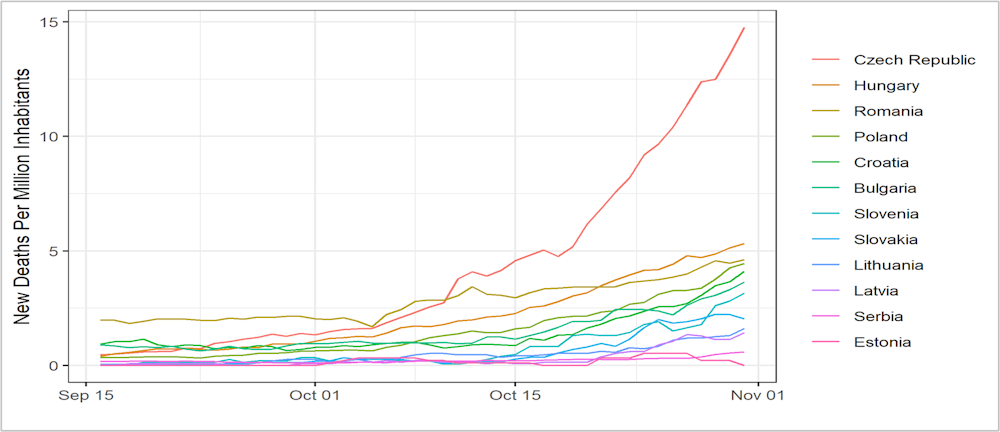
Graph showing COVID deaths per head of population in eastern European countries from September 15 to November 1, with the Czech Republic faring significantly worse than others.
Daily new COVID-19 deaths per million inhabitants, second wave, eastern Europe. Our World in Data COVID-19 Dataset. Authors’ compilation.

If we look at the stringency of control measures, we can also see that not all countries acted in the same way. The Czech Republic acted very late, for example, imposing stricter measures at the end of October, even though cases and deaths had been soaring upwards during the month. Neighbouring Slovakia, on the other hand, imposed stricter measures despite having far fewer cases and deaths. It seems that at least some countries in the region have learned their lessons.
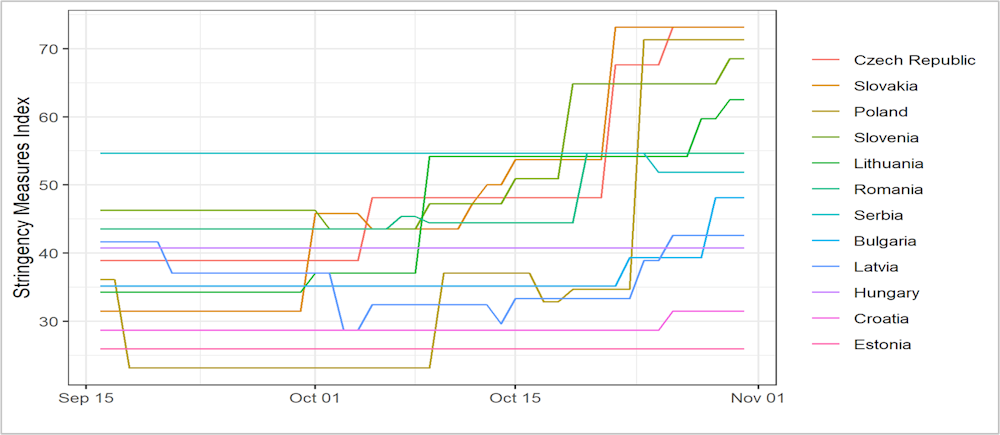
Graph showing how the stringency of some eastern European countries' COVID-19 control measures increased between September 15 and November 1.
Stringency of COVID-19 restrictions, second wave, eastern Europe. OxCGRT. Authors’ compilation.

Understanding why eastern European countries chose to respond differently during the second wave is complicated, though.

For example, differences in economic strength could explain why the relatively richer Czech Republic waited to reintroduce restrictions (thinking it could bear the brunt of a high number of infections), but this doesn’t account for the relatively poorer Romania’s decision to do the same.

Politics might provide a hint: the Czech Republic held regional elections in October, while Romania voted in local elections in September and is about to vote in national elections in December. Electoral politics could explain the reluctance of the two countries to enter another lockdown – with politicians seeing it as an unpopular measure that would also delay elections.

But one explanation that can probably be ditched is the culture argument mentioned previously. Even in countries where governments reintroduced relatively strong restrictions in October, such as Slovenia and Lithuania, infections and deaths have remained high throughout November – suggesting low compliance with the rules.

Tamara Popic, Max Weber Fellow in Social and Political Sciences, European University Institute and Alexandru D Moise, Max Weber Fellow in Social and Political Sciences, European University Institute

This article is republished from The Conversation under a Creative Commons license. Read the original article.


Tags: SB001
DMCA.com Protection Status

SUBSCRIBE to our NEWSLETTER

[mc4wp_form id=”2384248″]

Don't Miss

How CJAM Group is building 1,100 homes across Southeast Queensland

by Pauline Torongo
24 March 2026
How CJAM Group is building 1,100 homes across Southeast Queensland
Lifestyle

The CJAM Group founder is quietly building a 1,100+ home pipeline, with projects in Hervey Bay and Toowoomba, using a...

Read moreDetails

Design Without Compromise: Where Gutter Protection Meets Modern Architecture

by Fazila Olla-Logday
20 March 2026
Design Without Compromise: Where Gutter Protection Meets Modern Architecture
Business & Finance

Design without compromise by integrating gutter protection seamlessly into modern architecture. Discover how innovative gutter systems enhance your home’s aesthetics...

Read moreDetails

How WageSafe Secured Australia’s Most Reputable Retail Business Among Its Premium Clients

by Fazila Olla-Logday
12 March 2026
How WageSafe Secured Australia’s Most Reputable Retail Business Among Its Premium Clients
at

Learn how WageSafe helps businesses stay compliant with payroll and wage regulations through reliable monitoring, risk management, and expert support—protecting...

Read moreDetails

Zakeke AI Agent Studio Removes the E-Commerce Content Bottleneck With Outputs in Seconds

by Fazila Olla-Logday
3 March 2026
Zakeke AI Agent Studio Removes the E-Commerce Content Bottleneck With Outputs in Seconds
at

Zakeke AI Agent Studio removes the e-commerce content bottleneck by generating product content and visuals in seconds, enabling brands to...

Read moreDetails

Empire Traveller launches to give Small and Medium Businesses Enterprise-Level Travel rates

by Pauline Torongo
20 February 2026
Empire Traveller launches to give Small and Medium Businesses Enterprise-Level Travel rates
Travel

Empire Traveller suggests the travel sector may be entering a more inclusive phase — one where advantage is shaped less...

Read moreDetails

Is Feng Shui Master Xu Really A Modern Genius?

by Fazila Olla-Logday
19 February 2026
Is Feng Shui Master Xu Really A Modern Genius?
at

Is Feng Shui Master Xu truly a modern genius, or simply a master of timeless wisdom? Blending ancient Feng Shui...

Read moreDetails

The Rise of This Lead Generation Workshop Across Australia

by Pauline Torongo
13 February 2026
The Rise of This Lead Generation Workshop Across Australia
Business & Finance

“Where U?”, is a two-day in-person lead generation workshop that teaches Australian business owners how to build their own acquisition...

Read moreDetails
Load More

Copyright © Blue Sky Publications Ltd. All Rights Reserved.
australiantimes.co.uk is a division of Blue Sky Publications Ltd. Reproduction without permission prohibited. DMCA.com Protection Status

  • About us
  • Write for Us
  • Advertise
  • Contact us
  • T&Cs, Privacy and GDPR
No Result
View All Result
  • News
    • Weather
    • Sport
    • Technology
    • Business & Finance
      • Currency Zone
    • Lotto Results
      • The Lott
  • Lifestyle
    • Entertainment
    • Horoscopes
    • Health & Wellness
    • Recipes
  • Travel
  • Expat Life
  • Move to Australia

Copyright © Blue Sky Publications Ltd. All Rights Reserved.
australiantimes.co.uk is a division of Blue Sky Publications Ltd. Reproduction without permission prohibited. DMCA.com Protection Status

No Result
View All Result
  • News
    • Weather
    • Sport
    • Technology
    • Business & Finance
      • Currency Zone
    • Lotto Results
      • The Lott
  • Lifestyle
    • Entertainment
    • Horoscopes
    • Health & Wellness
    • Recipes
  • Travel
  • Expat Life
  • Move to Australia

Copyright © Blue Sky Publications Ltd. All Rights Reserved.
australiantimes.co.uk is a division of Blue Sky Publications Ltd. Reproduction without permission prohibited. DMCA.com Protection Status