


Brian Grodsky, University of Maryland, Baltimore County
A Russian-brokered cease-fire between Armenia and Azerbaijan this week halted fighting over the disputed Nagorno-Karabakh territory, where long-standing hostilities reerupted on Sept. 27.
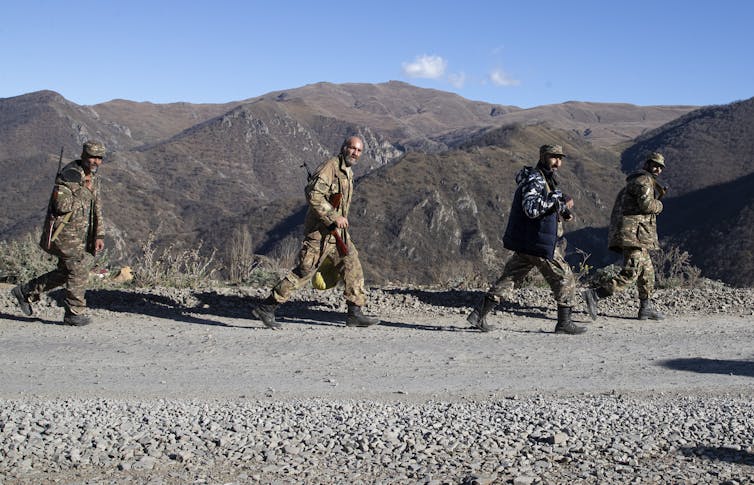
The deal leaves Azerbaijan, which was given Nagorno-Karabakh by the Soviets in 1923, largely in control of the majority-Armenian territory. Leaders in Nagorno-Karabakh, located in Western Azerbaijan close to Armenia, continue to demand independence.
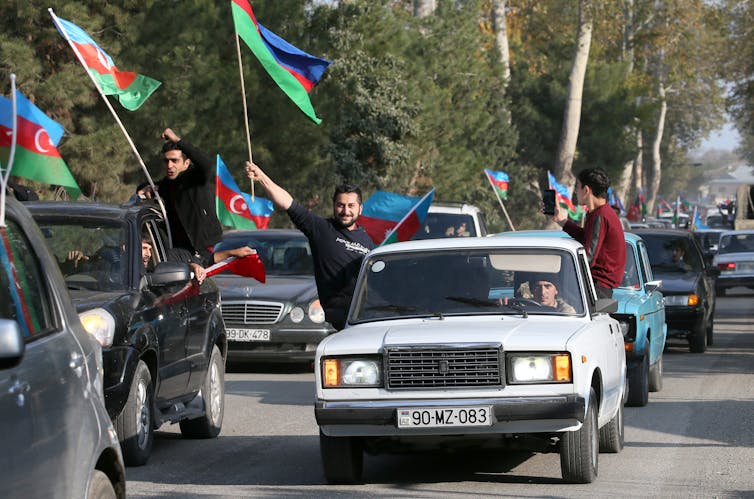
Thousands have died and an estimated 100,000 have been displaced in Nagorno-Karabakh since September. As the cease-fire took effect on Nov. 10, Azerbaijanis danced in the streets. But angry Armenians stormed the Armenian parliament and office of the prime minister.
Both sides in the conflict have claimed that fighting in Nagorno-Karabakh isn’t just about territorial control – it is a fight to prevent genocide, a fight for their lives. These grave accusations, while yet unproven, may make a lasting resolution to the conflict much harder.
Freedom fighting and genocide claims
Violence first broke out in Nagorno-Karabakh in the 1980s, when the region’s ethnic Armenian leaders sought to gain independence from Azerbaijan. There has been intermittent fighting since then, including a bloody war in the 1990s that ended in another Russia-brokered cease-fire giving Azerbaijan legal control of the region.
But Armenian leaders in Nagorno-Karabakh declared themselves an independent republic, and have repeatedly tried to secede.


In my research on self-determination, I find that genocide is often invoked by secessionist regions as a last-ditch effort to secure outside intervention in their conflict.
The United Nations defines genocide as the destruction or partial destruction of a “national, ethnical, racial or religious group.” It is a war crime under international law, and countries are supposed to “prevent and punish” it under a 1948 U.N. agreement.
Secessionist leaders often try to rally foreign powers around their cause with arguments based on geopolitical strategy, economic self-interest, religious bonds or shared ideology. Those reasons broadly explain why Iran supports the Iraqi Kurds in their quest for greater autonomy, and why the Arab states back the Palestinians’ efforts at statehood.
But when all else fails, freedom fighters will highlight their own repression in the starkest of terms to gain international assistance. In war a global campaign for victimhood is the weapon of the weaker side – and genocide claims are the most powerful weapon in this arsenal.
According to my research, more than two-thirds of members in the Unrepresented Nations and Peoples Organization, a nongovernmental organization composed of autonomy-minded minority groups like the Kurds, have alleged genocide.
Genocide makes peace hard
Genocide may be, as one scholar puts it, the “embodiment of radical evil,” but as a war crime it is incredibly difficult to prove.
Under international law, accusers must show perpetrators acted with the “intent to destroy, in whole or in part,” specified groups. Demonstrating intent is a tall order.
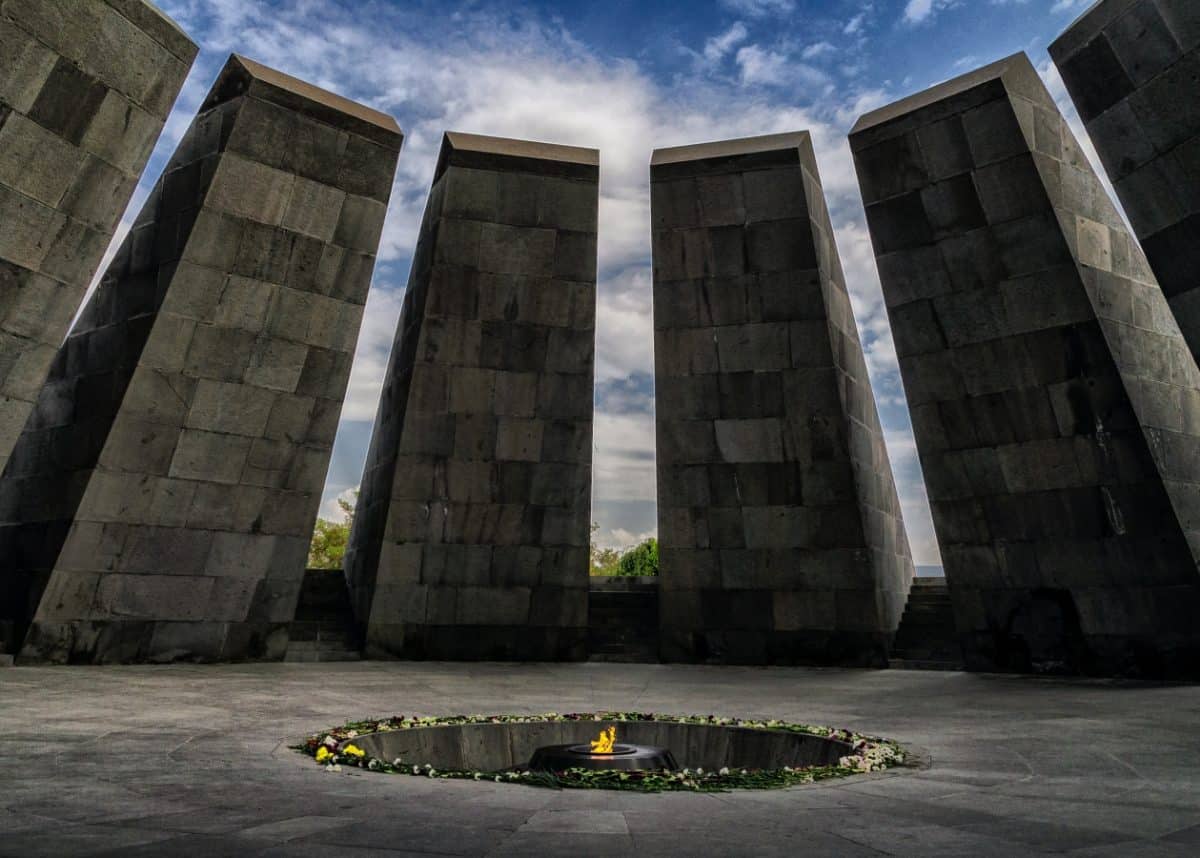
Armenia knows this as well as any nation. The 1915 Armenian genocide by Turkey is recognized by fewer than three dozen countries. In terms of both law and politics, declaring a deadly military campaign to be genocide – versus just the atrocities of a bloody conflict – is tricky indeed.

Genocide allegations, on the other hand, are more easily come by. But according to my research they don’t bode well for peace.
Genocide claims turn “the other side” into an enemy bent on the destruction of an entire people. Once the public sees a conflict in these terms, history shows, leaders understandably balk at the prospect of sitting down at the negotiating table with that enemy.
Genocide claims also reduce the likelihood of effective outside mediation by winnowing away the pool of “honest brokers” – that is, objective intermediaries. Opposing parties can and do reject would-be peacekeepers based on their acknowledgment of – or refusal to acknowledge – genocide accusations, my research finds.
In archived coverage of the South Ossetian region of Georgia, for example, local leaders in the 2000s insisted various European and American troops could not serve as peacekeepers since they had not defended Ossetians from an alleged 1992 genocide.
Nagorno-Karabakh and genocide
Genocide claims in the Georgia cases did eventually lead to international intervention and separation from Georgia, but not through peaceful negotiations. Instead, South Ossetia, like another breakaway Georgian state called Abkhazia, gained de facto independence after a brutal Russian military assault on Georgia in 2008.
This mirrored what occurred in Kosovo nearly a decade earlier when Serbian atrocities prompted Western intervention. Western powers recognized Kosovo’s independence in 2008, but Serbia continues to contest Kosovo’s separation.
In the case of Nagorno-Karabakh, genocide claims on both sides are nothing new. In archival research I found media reports showing that Armenian leaders have repeatedly reminded foreign powers of the 1915 Armenian genocide when pressing for outside intervention in their conflict with Azerbaijan.
Azerbaijanis, for their part, retort it is their citizens who should fear genocide. During a 1992 Armenian military campaign in Nagorno-Karabakh, Armenians committed what is now called the Khojaly massacre, when at least 613 civilians were reportedly killed. As newspapers from the era reveal, Azerbaijani leaders declared then that without international intervention, Armenians would finish the job.
It is impossible to determine whether genocide has in fact occurred in Nagorno-Karabakh without in-depth investigations. But the accusations alone may overpower any truce. And as Armenians’ angry reaction to the recent cease-fire demonstrates, peace between the two nations is fragile at best.
Brian Grodsky, Professor of Political Science, University of Maryland, Baltimore County
This article is republished from The Conversation under a Creative Commons license. Read the original article.







