



Andrew Lee, University of Sheffield
The news of a potentially viable vaccine for COVID-19 is exciting, but even once we start administering an effective jab it will take a long time to halt the spread of the virus. Many countries are still trying to contain dangerous epidemics, and several have had to implement further economically damaging lockdowns. But why is the virus still spreading after months of the basic public health message of hand washing, mask wearing and social distancing?
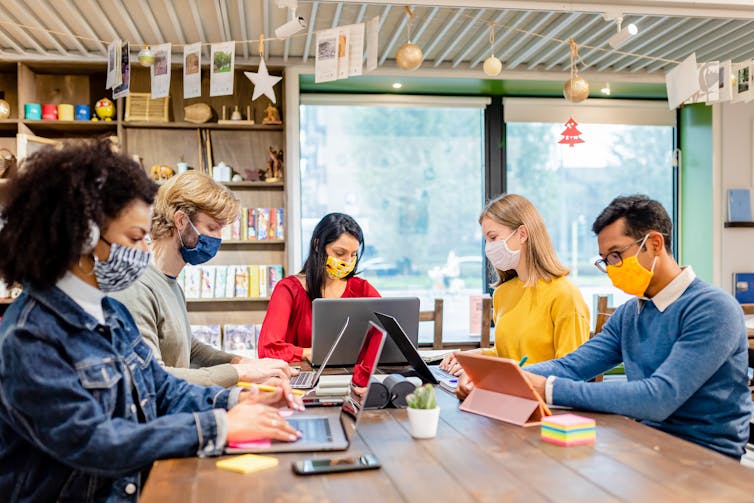
The main way the virus is thought to spread is through respiratory droplets and fomites (contaminated objects or materials such as clothes, furniture and door handles). With this mode of spread, most infections take place through close contact, for example, between people positioned face to face, less than 2m apart.
This is why there has been such a focus on face masks and social distancing, as well as thorough cleaning. And yet it’s still very common to see people not wearing masks properly (if at all) or staying 2m apart, even as they repeatedly sanitise their hands.
Unsurprisingly, spread is common within households, social gatherings, dining together or travelling on public transport. In an analysis of 75,465 COVID-19 cases in China, 78%-85% of clusters occurred within households, suggesting that transmission occurs during close and prolonged contact.
In another study from the US, infected people passed the virus on to an average of 53% of the people they lived with. However, this does not explain all of the disease transmission, and other factors probably also account for the ongoing spread.
Airborne spread
In the early months of the pandemic, there was considerable debate over whether smaller aerosol particles in the air played a significant role in disease transmission. In reality, this debate was artificial as droplets and aerosolised virus lie on a spectrum of particle size, and transmission is possible through both routes.


While the available evidence still points to droplets as the main route of transmission, there is now greater recognition of the role played by aerosol (airborne) spread. Aerosolised virus travels further, spread out more and can stay suspended in the air for hours, while most droplets will probably land no more than a few feet away from the source.
Imagine aerosolised viral particles as cigarette smoke: if you stood close to a smoker you are more likely to inhale a great deal of smoke. Some activities such as talking, and especially singing and shouting, increase aerosol and droplet exhalation.

This highlights why wearing a mask doesn’t mean you don’t also need to social distance. Barrier methods (such as face masks and visors) can certainly protect against droplets, but are less protective against airborne spread, especially if prolonged contact takes place indoors. Transmission can occur even if people aren’t facing each other, or are more than 2m apart – even if face masks are worn.
Ventilation
This is where ventilation is important. In a poorly ventilated room, the concentration of viral particles is likely to build up and could increase the risk of infection. But good ventilation will dilute the concentration of viral particles in the air.
It’s not yet clear what proportion of infections occur through airborne transmission. But if it turns out to be higher than previously thought, people in high-risk jobs, such as health workers, will need a higher grade of personal protective equipment (PPE).
Likewise, settings where people are likely to spend a long time indoors, such as workplaces and classrooms, will need solutions to improve ventilation or avoid indoor crowding. Public messaging may also need to put more emphasis on the importance of ventilation and the avoidance of indoor crowding, in addition to advice on handwashing, face masks and social distancing.
Super-spreading
The other phenomenon increasingly recognised for driving infections is the role of super-spreading events. Super-spreading occurs when one person infects a much higher number of other people than average. Some research suggests less than 20% of infected people produce over 80% of infections.
Super-spreading events often occur when people are gathered close together in crowded areas and insufficiently ventilated indoor spaces. Examples include workplaces such as factories, bars and nightclubs, house parties, gyms, places of worship and choirs. Super-spreading events can also take place in hospitals and care homes where infection control measures are usually more stringent and PPE are used.
Notably, these events almost all occur in indoor locations. The likelihood of getting infected in a closed indoor space is 18.7 times higher than outdoors. Unfortunately, in the winter, people spend more time indoors and this may heighten the risks of transmission, hence the need to minimise mixing between households.
Not self-isolating
UK surveys have found less than 25% of infected people properly self-isolate when asked to and only 12% of their contacts reportedly comply with quarantine requests. This is probably making a big contribution to the spread of the virus.
But isolation can be unpleasant, distressing and have significant social and economic costs. So more needs to be done to motivate and normalise self-isolation as soon as people start experiencing COVID symptoms or are asked to quarantine. And more help needs to be given to overcome the practical barriers that stop people doing so.
Asymptomatic spread
Around 20% of people who catch COVID are thought to display no symptoms, and many more will only develop mild symptoms or show symptoms later in the course of their illness despite being infectious. As a result, these people are unlikely to be self-isolating and may be unwittingly spreading infections.
This could be made worse by the fact that mass testing programmes will inevitably produce a significant number of false-negative results, that tell people they aren’t infected when in fact they are, because of the limitations of the test. Asymptomatic people who receive a false negative test may wrongly think there’s less need for them to take protective measures.
In October, there were close to 1 million infected people in the UK. Numbers this high simply makes it much easier for the virus to keep spreading. If we really want to reduce the spread of COVID-19 while we wait for a vaccine without a constant cycle of lockdowns, the best advice to the public remains to act as though you might already be infected.
Andrew Lee, Reader in Global Public Health, University of Sheffield
This article is republished from The Conversation under a Creative Commons license. Read the original article.







