

• Advertise
  • About us
  • Terms and Conditions
  • Contact us
Friday, February 6, 2026
Australian Times News
  • News
    • Weather
    • Sport
    • Technology
    • Business & Finance
      • Currency Zone
    • Lotto Results
      • The Lott
  • Lifestyle
    • Entertainment
    • Horoscopes
    • Health & Wellness
    • Recipes
  • Travel
  • Expat Life
  • Move to Australia
No Result
View All Result
  • News
    • Weather
    • Sport
    • Technology
    • Business & Finance
      • Currency Zone
    • Lotto Results
      • The Lott
  • Lifestyle
    • Entertainment
    • Horoscopes
    • Health & Wellness
    • Recipes
  • Travel
  • Expat Life
  • Move to Australia
No Result
View All Result
Australian Times News
No Result
View All Result
Home News

How a 1940s treaty set airlines on a path to high emissions and low regulation

Before the pandemic, aviation was on course to be the UK’s most polluting sector and produce as much as 22% of global emissions by 2050.

The Conversation by The Conversation
04-11-2020 22:27
in News
1940s treaty set airlines on a path to high emissions

1940s treaty set airlines on a path to high emissions Photo by Isaac Struna on Unsplash

Roger Tyers, University of Nottingham

Before the pandemic, aviation was on course to be the UK’s most polluting sector and produce as much as 22% of global emissions by 2050. The industry is suffering from low demand due to coronavirus restrictions, but without meaningful policy changes, flight numbers and emissions are expected to return to pre-COVID-19 levels by 2024.

Studiostoks/Shutterstock

When accounting for emissions, aviation is often seen as a special case because there is no alternative to flying at any meaningful scale without fossil fuels, unlike the energy sector, where there’s wind or solar, or land transport, where electric vehicles exist. But alternatives to fossil-fuelled flight do exist. Arguably, the most viable options are carbon-neutral synthetic fuels, which are made by combining carbon from air and hydrogen from water using electricity. These fuels wouldn’t require new fleets of aircraft and could be generated by capturing carbon directly from the air rather than taking more out of the ground.

So why aren’t these innovations – alongside biofuels and electric planes – being adopted at a significant scale? To answer this question, we have to go as far back as the mid-1940s, when the aviation industry was just taking off.
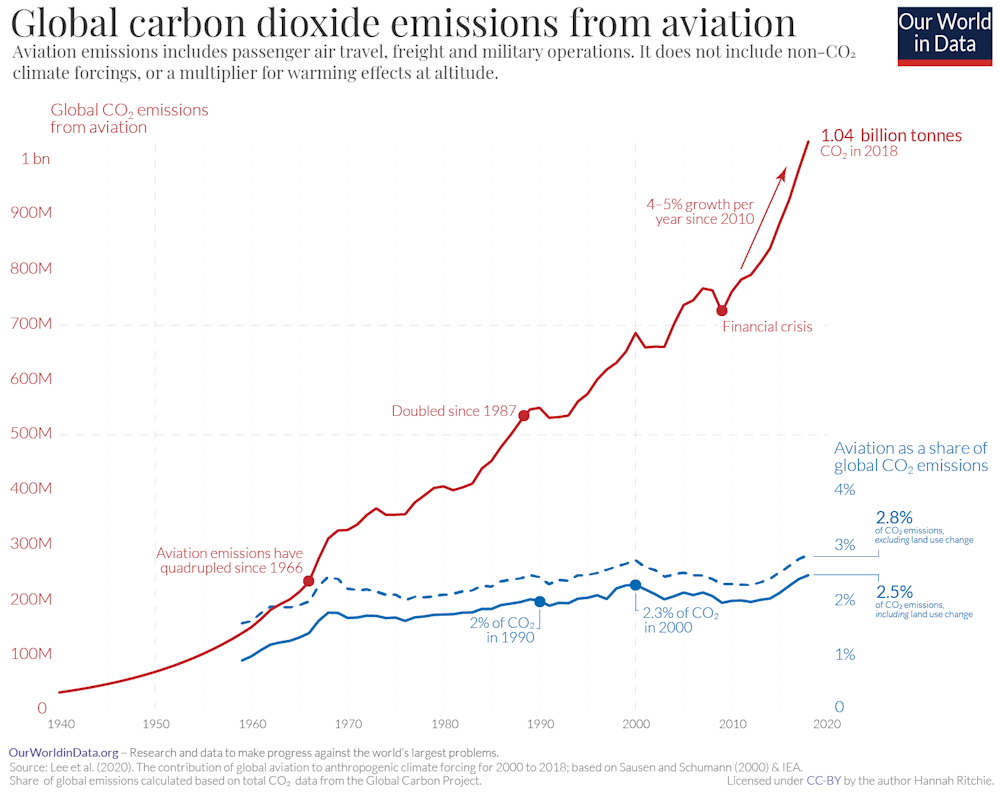
A graph showing airline emissions rising steadily from 1940 to 2018.
9/11 and the 2008 financial crisis caused airline emissions to fall, but they soon rebounded. Lee et al. (2020), CC BY

A historical anomaly

The lifeblood of aviation is kerosene, a fossil fuel. Burning a tonne of kerosene generates about three tonnes of carbon dioxide. Burn 359 billion litres, as the aviation industry did in 2018, and you create about 900 million tonnes of CO₂ – more than Germany did that year.

The UN agency tasked with overseeing the aviation industry, the International Civil Aviation Organisation (ICAO), was established by the Chicago Convention in the aftermath of World War II. In a bid to stimulate growth in what was, at the time, a fledgling industry, the convention essentially banned governments from taxing kerosene for international flights and prohibited VAT on tickets. This enabled budget air travel, and along with other government subsidies, gave aviation a competitive advantage over ferries or night trains, which have a lower carbon footprint than flights but can’t compete on price.

Drivers pay a tax on motor fuel, and even drinkers pay taxes on beer and wine. It’s a historical anomaly that aviation, generally seen as the fastest way for individuals to warm the atmosphere, isn’t taxed according to the amount of fuel it consumes. As long as kerosene remains cheap and untaxed, there is little incentive for airlines to invest in low-carbon innovations.


AlsoRead...

Brandon Willington: The Marketing Entrepreneur turning heads across Australia

Brandon Willington: The Marketing Entrepreneur Turning Heads Across Australia

8 January 2026
How Turnkey Building Group Is Restoring Trust In An Industry Known For Customer Disappointment

How Turnkey Building Group Is Restoring Trust In An Industry Known For Customer Disappointment

17 December 2025
A black-and-white photograph of men standing around a table.
Signed in December 1944, the convention came into effect in 1947. Max Hymans/Wikipedia, CC BY-SA

On a wing and a prayer

Some argue that sovereign states can still override the ICAO’s aviation tax exemptions by renegotiating individual air service agreements, which are the bilateral treaties that govern flights between states. This has yet to be tested in court. But whether by unilaterally taxing fuel, amending bilateral treaties between countries or even adopting a fuel tax multilaterally through the EU or similar institutions, any such moves would likely lead to “tankering” – when carriers refuel outside a taxation zone. States feel powerless to go it alone and can conveniently delegate responsibility back to the ICAO.

The ICAO has a decent track record on harmonising rules on routes, safety and security between states. But its highly secretive nature, its susceptibility to corporate influence and its (conveniently) low public profile make it less well-suited to environmental policymaking. The responsibility for aviation emissions was only outsourced to ICAO due to an eleventh-hour decision at the Kyoto climate summit in 1997 that removed aviation from national carbon targets in order to get the rest of the agreement over the line. Progress since has been slow. As an industry insider once put it to me, “ICAO moves at a glacial pace, in an age of melting glaciers”.

After almost 20 years, ICAO did produce a scheme to mitigate emissions with efficiency measures, biofuels and by purchasing carbon offsets from other sectors, without limiting growth in air travel demand and supply. Sadly, the extremely low cost of offsets mean that cheap flights are likely to continue.

Governments can still impose taxes on tickets, instead of fuel, as the UK did with air passenger duty. These can be made fairer through a frequent flyer levy, which would ensure those who fly more pay more. For domestic flights – which are not subject to ICAO rules – governments have much more freedom to impose taxes so that trains are not so much more expensive than flights on similar routes, as they currently often are.

Local government has a role to play too. Aviation can only keep expanding if it’s given capacity to do so. The many UK councils considering airport expansions could fill the vacuum of responsibility left by nation states and the ICAO by rejecting such proposals. While that wouldn’t fix the problem, it would stop it getting worse.

It’s possible that national leaders at the Glasgow climate summit in 2021, exasperated by ICAO, will drag aviation into national carbon reduction targets. They might call for a worldwide, tapered phase-out of aviation kerosene, which could spark innovation in cleaner alternatives, as seen in the car industry with future bans on diesel and petrol vehicles. If not, national governments could make their own unilateral plans. If none of these things happen, then airlines will continue to enjoy lax regulation, and the aviation industry’s contribution to the climate emergency will only grow.

Roger Tyers, Teaching Associate in Sociology and Social Policy, University of Nottingham

This article is republished from The Conversation under a Creative Commons license. Read the original article.


Tags: SB001
DMCA.com Protection Status

SUBSCRIBE to our NEWSLETTER

[mc4wp_form id=”2384248″]

Don't Miss

Lyca Mobile Australia’s Customer-First Overhaul Pays Off with Finder Award Win

by Fazila Olla-Logday
2 February 2026
Lyca Mobile Australia's Customer-First Overhaul Pays Off with Finder Award Win
Technology

Lyca Mobile Australia’s customer-first overhaul has earned a Finder Award, recognising its improved value, service, and stronger focus on Australian...

Read moreDetails

From Driveway to Dream Court: The Rise of High-Performance Hoops at Home in 2026

by Fazila Olla-Logday
20 January 2026
The Rise of High-Performance Hoops at Home in 2026
Sport

High-performance home basketball hoops are gaining momentum in 2026, as more homeowners invest in durable, professional-grade systems that combine advanced...

Read moreDetails

Brandon Willington: The Marketing Entrepreneur Turning Heads Across Australia

by Pauline Torongo
8 January 2026
Brandon Willington: The Marketing Entrepreneur turning heads across Australia
Business & Finance

Brandon Willington, founder of “Where U?” is changing the narrative for Australian businesses tired of inconsistent leads and empty promises.

Read moreDetails

How Turnkey Building Group Is Restoring Trust In An Industry Known For Customer Disappointment

by Fazila Olla-Logday
17 December 2025
How Turnkey Building Group Is Restoring Trust In An Industry Known For Customer Disappointment
Business & Finance

Turnkey Building Group is changing the narrative in an industry often associated with missed deadlines and broken promises. By prioritizing...

Read moreDetails

Risk Awareness for International Travellers – What Australians Should Know Before Entering Multi-State Regions

by Fazila Olla-Logday
10 December 2025
Schengen
Travel

This guide helps Australian travellers understand cross-border requirements, assess political and environmental risks, manage health and safety considerations, and prepare...

Read moreDetails

The evolution of Aesthetic Surgery through the lens of Dr Kourosh Tavakoli

by Pauline Torongo
4 December 2025
The evolution of Aesthetic Surgery through the lens of Dr. Kourosh Tavakoli
Health & Wellness

As global interest in Australian cosmetic surgery continues to grow, the combination of regulation, research and emerging digital tools is...

Read moreDetails

Ryan: Building real freedom through e-commerce

by Pauline Torongo
27 November 2025
Ryan: Building real freedom through e-commerce
Business & Finance

Ryan’s greatest achievement isn’t any single business or revenue milestone — it’s the ecosystem he’s built through the Change community.

Read moreDetails
Load More

Copyright © Blue Sky Publications Ltd. All Rights Reserved.
australiantimes.co.uk is a division of Blue Sky Publications Ltd. Reproduction without permission prohibited. DMCA.com Protection Status

  • About us
  • Write for Us
  • Advertise
  • Contact us
  • T&Cs, Privacy and GDPR
No Result
View All Result
  • News
    • Weather
    • Sport
    • Technology
    • Business & Finance
      • Currency Zone
    • Lotto Results
      • The Lott
  • Lifestyle
    • Entertainment
    • Horoscopes
    • Health & Wellness
    • Recipes
  • Travel
  • Expat Life
  • Move to Australia

Copyright © Blue Sky Publications Ltd. All Rights Reserved.
australiantimes.co.uk is a division of Blue Sky Publications Ltd. Reproduction without permission prohibited. DMCA.com Protection Status

No Result
View All Result
  • News
    • Weather
    • Sport
    • Technology
    • Business & Finance
      • Currency Zone
    • Lotto Results
      • The Lott
  • Lifestyle
    • Entertainment
    • Horoscopes
    • Health & Wellness
    • Recipes
  • Travel
  • Expat Life
  • Move to Australia

Copyright © Blue Sky Publications Ltd. All Rights Reserved.
australiantimes.co.uk is a division of Blue Sky Publications Ltd. Reproduction without permission prohibited. DMCA.com Protection Status





