

• Advertise
  • About us
  • Terms and Conditions
  • Contact us
Thursday, May 14, 2026
Australian Times News
  • News
    • Weather
    • Sport
    • Technology
    • Business & Finance
      • Currency Zone
    • Lotto Results
      • The Lott
  • Lifestyle
    • Entertainment
    • Horoscopes
    • Health & Wellness
    • Recipes
  • Travel
  • Expat Life
  • Move to Australia
No Result
View All Result
  • News
    • Weather
    • Sport
    • Technology
    • Business & Finance
      • Currency Zone
    • Lotto Results
      • The Lott
  • Lifestyle
    • Entertainment
    • Horoscopes
    • Health & Wellness
    • Recipes
  • Travel
  • Expat Life
  • Move to Australia
No Result
View All Result
Australian Times News
No Result
View All Result
Home News

A new laser technique designed to authenticate rare whisky could also detect disease

Whisky is big business in Scotland. In 2019, the golden liquid accounted for 75% of the nation’s food and drink exports, with a value of almost £5 billion to the Scottish economy.

The Conversation by The Conversation
31-10-2020 09:17
in News
Whisky is big business

Whisky is big business Photo by Levi Midnight on Unsplash

Graham D Bruce, University of St Andrews and Kishan Dholakia, University of St Andrews

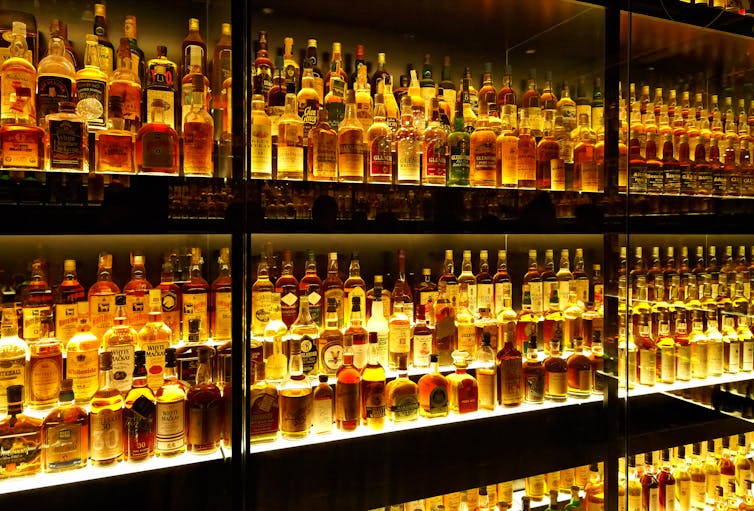
Whisky is big business in Scotland. In 2019, the golden liquid accounted for 75% of the nation’s food and drink exports, with a value of almost £5 billion to the Scottish economy. Iconic bottles have sold at auction for over £1 million. But if you are the lucky owner of such a whisky, how can you be confident that what you are buying is the genuine product?
Shutterstock

Studies have shown that around one-third of rare whiskies on sale at auction may be fakes. In a well-publicised incident in 2017, a collector paid a world-record £7,600 for a single dram of rare whisky, only to later discover he had been sold a knock-off. Such counterfeit drinks cost the UK economy over £200m in lost revenue each year, as well as damaging the reputation of sellers.

The problem of counterfeit alcohol is not restricted to only wealthy collectors. Several cases have been reported of people being poisoned and dying from drinking whisky containing high levels of poisonous methanol.

But soon these kind of problems may be a thing of the past, as our research has enabled us to develop a new method that can use lasers to chemically test the authenticity of whisky, without ever opening the bottle. And crucially, the technique has the potential to measure other substances in this way, including human tissue.

How does it work?

When a laser beam is shone into a substance like whisky, the liquid scatters some of the light into a variety of different colours. The exact mix of colours produced is unique to the chemical make-up of the sample, and can be used like a fingerprint to identify the sample.

The technique of measuring this fingerprint, which gives us a detailed understanding of the interaction between the light and the atoms and molecules which make up a sample, is known as spectroscopy. Just like fingerprint identification of criminals, the identity of a whisky sample can be tested by cross-referencing the spectroscopic signal against a database of known samples.


AlsoRead...

Svitla Systems

Svitla Systems acquires Australia’s Kiandra IT to expand Global Engineering Footprint and Accelerate AI-Driven delivery

11 May 2026
How Clevero is helping Australian Service Businesses compete with Enterprises on a Fraction of the Budget

How Clevero is helping Australian Service Businesses compete with Enterprises on a Fraction of the Budget

28 April 2026

Whisky is a particularly complex mix of chemicals, known as congeners, which give the contents of each cask a unique flavour, aroma and colour. While criminals have become increasingly sophisticated in mimicking the taste, smell and appearance of sought-after drams, to fool this system requires a sham whisky to be chemically identical to the real thing – a very, very hard thing to create.

We have been developing spectroscopy-based tests for whisky authenticity for almost a decade. The method also works for other food and drink where counterfeiting can be a problem, such as olive oil, wine and honey.

However, the contents are not the only source of scattered light. A common problem in all of those tests is that the glass container can produce a signal even larger than the one from the contents.

This is avoided in the lab by testing a sample placed in a standardised container. But if you had just spent a small fortune on the latest addition to your collection of rare whiskies, would you want us to remove and use up some of your precious purchase?
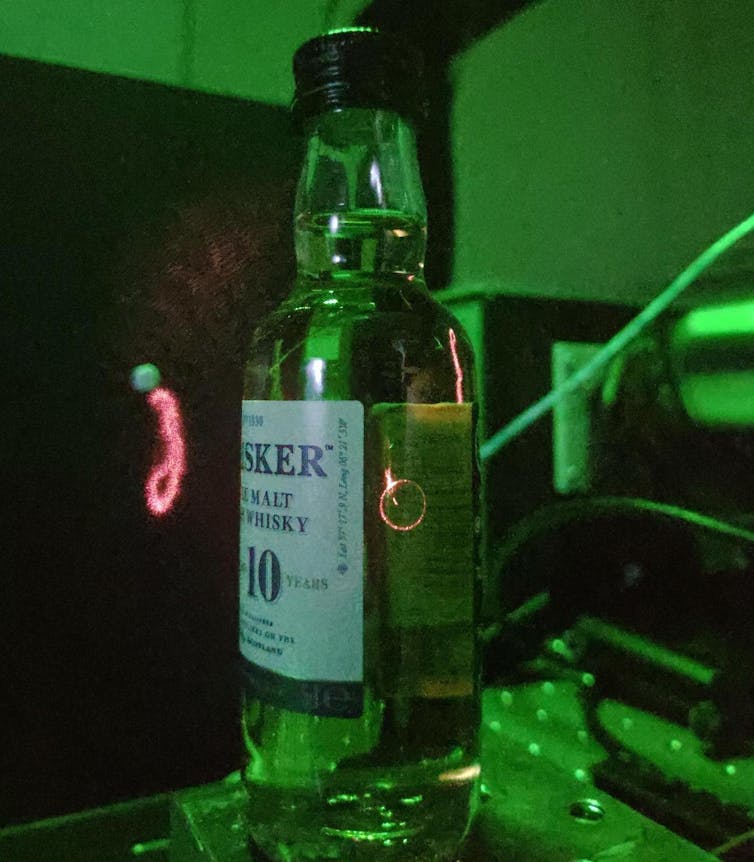
A bottle of whisky with a cone-shaped laser shining through it.
A special cone-shaped laser ensures the signal from the glass bottle does not interfere with the measurement of the liquid inside. University of St Andrews, Author provided

Our new technique was designed to overcome this challenge. Rather than illuminating the bottle with a standard laser beam, we introduced a cone-shaped piece of glass in front of the bottle to reshape the light.

By forming a ring of laser light on the bottle surface which is gathered into a tightly focused spot within the liquid contents, we can now place our detector so that only scattered light produced inside the bottle is collected – and any light produced by the ring on the glass misses.

In this way we can measure the contents (like recording an accurate fingerprint) without that annoying contribution from the container. We tested the method on whiskies from a range of distilleries, and were able to distinguish them with ease. We have also shown the method works for other spirits including vodka and gin.

Other useful benefits

Going beyond food and drink, all sorts of other substances can be measured in this way. Recently, our group showed that you can use a similar laser-based approach to measure bacteria and test their response to antibiotics.

Methods based on laser light offer the potential advantage of telling us the chemical make-up of what they see with high resolution and in a much cheaper and more compact set-up than an MRI scanner, providing vital information in diagnosis.

Laser spectroscopy gives us the chemical information but, because light usually doesn’t penetrate far into the skin, this is currently limited to diagnosis close to the surface. We plan to test our new laser-shaping method to see if it will allow light to penetrate deeper into tissue and potentially chemically detect cancer inside the body.

For now, spectroscopy offers a potentially simple way to test alcohols, when compared with other lab-based methods such as radiocarbon dating. It is non-destructive, and as our work demonstrates, can be performed without even opening the original container.

The simplicity of the approach suggests devices could be easily manufactured for widespread use. In future, we hope connoisseurs will be able to authenticate their expensive alcohol at the point of purchase, without wasting a drop.

Graham D Bruce, Senior Researcher & Laboratory Manager, University of St Andrews and Kishan Dholakia, Professor of Physics and Astronomy, University of St Andrews

This article is republished from The Conversation under a Creative Commons license. Read the original article.


Tags: SB001
DMCA.com Protection Status

SUBSCRIBE to our NEWSLETTER

[mc4wp_form id=”2384248″]

Don't Miss

Svitla Systems acquires Australia’s Kiandra IT to expand Global Engineering Footprint and Accelerate AI-Driven delivery

by Pauline Torongo
11 May 2026
Svitla Systems
Business & Finance

Acquisition marks Svitla’s entry into the Australian market and strengthens capabilities in low-code, Microsoft technologies, and enterprise software engineering.

Read moreDetails

Residential Healthcare Practices: Revolution or Evolution?

by Pauline Torongo
11 May 2026
Residential Healthcare Practices: Revolution or Evolution?
Lifestyle

President Bill Lutz’s "revolution" was born from his background in fine dining, which instilled a disciplined, customer-focused approach.

Read moreDetails

Medicana Health Group launches HPV vaccination campaign to support cervical cancer prevention

by Pauline Torongo
28 April 2026
Medicana Health Group launches HPV vaccination campaign to support cervical cancer prevention
Health & Wellness

The Türkiye-based healthcare group has introduced a new awareness campaign focused on HPV vaccination, regular check-ups and early detection, with...

Read moreDetails

How Clevero is helping Australian Service Businesses compete with Enterprises on a Fraction of the Budget

by Pauline Torongo
28 April 2026
How Clevero is helping Australian Service Businesses compete with Enterprises on a Fraction of the Budget
Business & Finance

By consolidating CRM, scheduling, workflow automation, invoicing, reporting, and client communications into a single platform, Clevero gives smaller operators the...

Read moreDetails

How CJAM Group is building 1,100 homes across Southeast Queensland

by Pauline Torongo
24 March 2026
How CJAM Group is building 1,100 homes across Southeast Queensland
Lifestyle

The CJAM Group founder is quietly building a 1,100+ home pipeline, with projects in Hervey Bay and Toowoomba, using a...

Read moreDetails

Design Without Compromise: Where Gutter Protection Meets Modern Architecture

by Fazila Olla-Logday
20 March 2026
Design Without Compromise: Where Gutter Protection Meets Modern Architecture
Business & Finance

Design without compromise by integrating gutter protection seamlessly into modern architecture. Discover how innovative gutter systems enhance your home’s aesthetics...

Read moreDetails

How WageSafe Secured Australia’s Most Reputable Retail Business Among Its Premium Clients

by Fazila Olla-Logday
12 March 2026
How WageSafe Secured Australia’s Most Reputable Retail Business Among Its Premium Clients
at

Learn how WageSafe helps businesses stay compliant with payroll and wage regulations through reliable monitoring, risk management, and expert support—protecting...

Read moreDetails
Load More

Copyright © Blue Sky Publications Ltd. All Rights Reserved.
australiantimes.co.uk is a division of Blue Sky Publications Ltd. Reproduction without permission prohibited. DMCA.com Protection Status

  • About us
  • Write for Us
  • Advertise
  • Contact us
  • T&Cs, Privacy and GDPR
No Result
View All Result
  • News
    • Weather
    • Sport
    • Technology
    • Business & Finance
      • Currency Zone
    • Lotto Results
      • The Lott
  • Lifestyle
    • Entertainment
    • Horoscopes
    • Health & Wellness
    • Recipes
  • Travel
  • Expat Life
  • Move to Australia

Copyright © Blue Sky Publications Ltd. All Rights Reserved.
australiantimes.co.uk is a division of Blue Sky Publications Ltd. Reproduction without permission prohibited. DMCA.com Protection Status

No Result
View All Result
  • News
    • Weather
    • Sport
    • Technology
    • Business & Finance
      • Currency Zone
    • Lotto Results
      • The Lott
  • Lifestyle
    • Entertainment
    • Horoscopes
    • Health & Wellness
    • Recipes
  • Travel
  • Expat Life
  • Move to Australia

Copyright © Blue Sky Publications Ltd. All Rights Reserved.
australiantimes.co.uk is a division of Blue Sky Publications Ltd. Reproduction without permission prohibited. DMCA.com Protection Status





