


• Advertise
  • About us
  • Terms and Conditions
  • Contact us
Friday, February 6, 2026
Australian Times News
  • News
    • Weather
    • Sport
    • Technology
    • Business & Finance
      • Currency Zone
    • Lotto Results
      • The Lott
  • Lifestyle
    • Entertainment
    • Horoscopes
    • Health & Wellness
    • Recipes
  • Travel
  • Expat Life
  • Move to Australia
No Result
View All Result
  • News
    • Weather
    • Sport
    • Technology
    • Business & Finance
      • Currency Zone
    • Lotto Results
      • The Lott
  • Lifestyle
    • Entertainment
    • Horoscopes
    • Health & Wellness
    • Recipes
  • Travel
  • Expat Life
  • Move to Australia
No Result
View All Result
Australian Times News
No Result
View All Result
Home News

Why England’s Premier League should bail out the lower leagues

The EPL is the top league in English football, a division of 20 teams, and sits above the football league, which consists of three divisions of 24 teams each. Between all of these divisions is promotion and relegation – the best teams move up, the worst teams move down.

The Conversation by The Conversation
05-10-2020 06:23
in News
Premier League should bail out the lower leagues

Premier League should bail out the lower leagues Photo by Mitch Rosen on Unsplash

James Reade, University of Reading

Uncertainty is what makes sports entertaining. If you always knew who was going to win a match, that would be boring. In the 1960s, an economist called Walter Neale said that the New York Yankees prayer should be: “Oh Lord, make us good, but not that good.”

This “peculiar economics of professional sports”, as Neale described it, is why leagues, such as the English Premier League (EPL) and English Football League (EFL), exist. They are collections of teams of similar quality who regularly compete against each other.

The EPL is the top league in English football, a division of 20 teams, and sits above the football league, which consists of three divisions of 24 teams each. Between all of these divisions is promotion and relegation – the best teams move up, the worst teams move down.

This maintains a reasonable degree of similarity of teams in the different divisions. More importantly, it provides a significant amount of competition and entertainment, which is a crucial feature of English football’s popularity. With lower league clubs that rely on ticket sales on the brink of collapse because of the coronavirus pandemic, it is paramount that the far wealthier top teams step in to save them.

In the EPL, just 14% of revenues come from match days. The bulk comes from television deals and sponsorship. In the football league’s top division, the Championship, 21% of revenues come from match days, but it is significantly higher still in the two leagues below – over 46% for Bolton Wanderers in League One in 2017, for example.

Cash rich

With the government announcing that sport will have to take place without fans, indefinitely, a substantial revenue stream has been lost to these clubs. To survive, they desperately need financial aid. Why should the government bail out a sport that attracts television broadcasting deals in the billions?


AlsoRead...

Brandon Willington: The Marketing Entrepreneur turning heads across Australia

Brandon Willington: The Marketing Entrepreneur Turning Heads Across Australia

8 January 2026
How Turnkey Building Group Is Restoring Trust In An Industry Known For Customer Disappointment

How Turnkey Building Group Is Restoring Trust In An Industry Known For Customer Disappointment

17 December 2025

The cash-rich Premier League, on the other hand, where teams have continued to splash millions of pounds on top global stars this summer, is the obvious source of aid. Chelsea just spent £71m on German midfielder Kai Havertz alone, for example. This is the equivalent of two Championship clubs’ average wage bills per year, almost half of all League One clubs, and almost the entire 24 clubs in League Two.

Manager of Premier League side Burnley, Sean Dyche, doesn’t appear to agree that the Premier League should help out the English Football League, however. Commenting on the idea, he said: “If you are going to apply that rule of thumb, does that mean every hedge fund manager that is incredibly successful, are they going to filter that down to the hedge fund managers that are not so successful?”

This line of thinking says football should be like any other business. Clubs should go to the wall if they aren’t successful, just like bad hedge funds go out of business. Clubs should merge, or the better ones should take over the less successful ones. Burnley should take over, say, Oxford United, a lower division team.

Yet in 1987, Burnley was 90 minutes away from relegation out of the football league altogether. They finished 90th out of 92 teams. Indeed, in 1986, Oxford United won the League Cup, and perhaps might have mounted a takeover of Burnley. Since then Burnley has enjoyed six promotions and three relegations. Oxford has fallen out of the football league in that time, too, and returned (five relegations, three promotions).

The Premier League without the intrigue of promotion and relegation would be a massively inferior product. Netflix even made a successful documentary series that followed the fate of Sunderland FC in the season after the club was relegated from the EPL. The initial idea was that Sunderland would be challenging to get promoted back to the Premier League, but in a fateful twist of events, the club was relegated a second time.

It wasn’t always this skewed

Historically, this dynamic relationship between the different leagues was better understood in the way that football was financed. Many measures have existed in the past to ensure solidarity. For much of the existence of the football league, member clubs shared revenues accrued from league matches played, and rules restricted the movement of players such that they would be equitably distributed across teams.
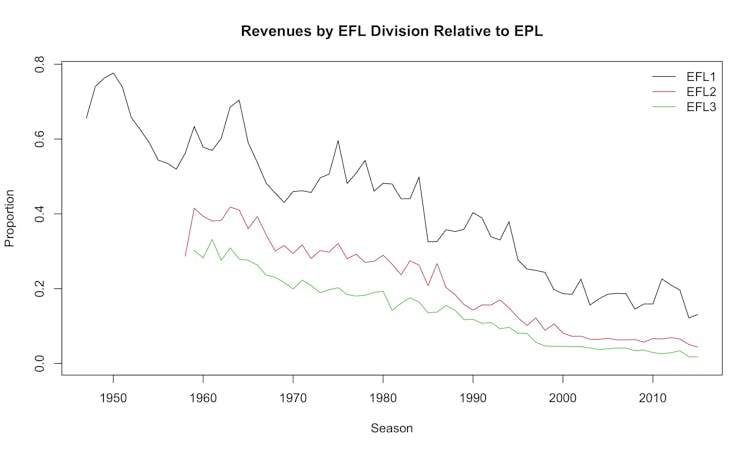
Graph of football league revenues.
Revenues in football league divisions relative to those in the Premier League (or top division of the EFL pre-EPL). James Reade, CC BY-ND

Revenue sharing was abandoned in the 1980s, however, and between 1961 and 1995 restrictions on player movements were dramatically reduced. In 1992, the EPL was formed as a breakaway by the top football league teams in order to capture more of the revenues in the game. The result has been an ever-widening financial gap between the EPL and the football leagues below.

Norwich City, in finishing top of the Championship in 2019, was awarded £7.1 million. In finishing bottom of the EPL in 2020, they were awarded £94.5 million. The graph below, taken from the published accounts of Premier League and football league teams since the second world war, shows the clear effect of these gradually relaxed restrictions. In the 1950s, the ratio of revenues in the second tier of English football was usually above 60%. In 2014, this ratio was 12%.

The EPL owes much of its charmed existence to the myriad leagues that exist below it, most notably the EFL, feeding it not just with new clubs each year, but new players, and endless romantic tales – rags to riches success and, equally dramatic, falls from grace.

Will it recognise that before it’s too late?

James Reade, Associate Professor of Economics, University of Reading

This article is republished from The Conversation under a Creative Commons license. Read the original article.


Tags: SB001
DMCA.com Protection Status

SUBSCRIBE to our NEWSLETTER

[mc4wp_form id=”2384248″]

Don't Miss

Lyca Mobile Australia’s Customer-First Overhaul Pays Off with Finder Award Win

by Fazila Olla-Logday
2 February 2026
Lyca Mobile Australia's Customer-First Overhaul Pays Off with Finder Award Win
Technology

Lyca Mobile Australia’s customer-first overhaul has earned a Finder Award, recognising its improved value, service, and stronger focus on Australian...

Read moreDetails

From Driveway to Dream Court: The Rise of High-Performance Hoops at Home in 2026

by Fazila Olla-Logday
20 January 2026
The Rise of High-Performance Hoops at Home in 2026
Sport

High-performance home basketball hoops are gaining momentum in 2026, as more homeowners invest in durable, professional-grade systems that combine advanced...

Read moreDetails

Brandon Willington: The Marketing Entrepreneur Turning Heads Across Australia

by Pauline Torongo
8 January 2026
Brandon Willington: The Marketing Entrepreneur turning heads across Australia
Business & Finance

Brandon Willington, founder of “Where U?” is changing the narrative for Australian businesses tired of inconsistent leads and empty promises.

Read moreDetails

How Turnkey Building Group Is Restoring Trust In An Industry Known For Customer Disappointment

by Fazila Olla-Logday
17 December 2025
How Turnkey Building Group Is Restoring Trust In An Industry Known For Customer Disappointment
Business & Finance

Turnkey Building Group is changing the narrative in an industry often associated with missed deadlines and broken promises. By prioritizing...

Read moreDetails

Risk Awareness for International Travellers – What Australians Should Know Before Entering Multi-State Regions

by Fazila Olla-Logday
10 December 2025
Schengen
Travel

This guide helps Australian travellers understand cross-border requirements, assess political and environmental risks, manage health and safety considerations, and prepare...

Read moreDetails

The evolution of Aesthetic Surgery through the lens of Dr Kourosh Tavakoli

by Pauline Torongo
4 December 2025
The evolution of Aesthetic Surgery through the lens of Dr. Kourosh Tavakoli
Health & Wellness

As global interest in Australian cosmetic surgery continues to grow, the combination of regulation, research and emerging digital tools is...

Read moreDetails

Ryan: Building real freedom through e-commerce

by Pauline Torongo
27 November 2025
Ryan: Building real freedom through e-commerce
Business & Finance

Ryan’s greatest achievement isn’t any single business or revenue milestone — it’s the ecosystem he’s built through the Change community.

Read moreDetails
Load More

Copyright © Blue Sky Publications Ltd. All Rights Reserved.
australiantimes.co.uk is a division of Blue Sky Publications Ltd. Reproduction without permission prohibited. DMCA.com Protection Status

  • About us
  • Write for Us
  • Advertise
  • Contact us
  • T&Cs, Privacy and GDPR
No Result
View All Result
  • News
    • Weather
    • Sport
    • Technology
    • Business & Finance
      • Currency Zone
    • Lotto Results
      • The Lott
  • Lifestyle
    • Entertainment
    • Horoscopes
    • Health & Wellness
    • Recipes
  • Travel
  • Expat Life
  • Move to Australia

Copyright © Blue Sky Publications Ltd. All Rights Reserved.
australiantimes.co.uk is a division of Blue Sky Publications Ltd. Reproduction without permission prohibited. DMCA.com Protection Status

No Result
View All Result
  • News
    • Weather
    • Sport
    • Technology
    • Business & Finance
      • Currency Zone
    • Lotto Results
      • The Lott
  • Lifestyle
    • Entertainment
    • Horoscopes
    • Health & Wellness
    • Recipes
  • Travel
  • Expat Life
  • Move to Australia

Copyright © Blue Sky Publications Ltd. All Rights Reserved.
australiantimes.co.uk is a division of Blue Sky Publications Ltd. Reproduction without permission prohibited. DMCA.com Protection Status





