• Advertise
  • About us
  • Terms and Conditions
  • Contact us
Saturday, December 6, 2025
Australian Times News
  • News
    • Weather
    • Sport
    • Technology
    • Business & Finance
      • Currency Zone
    • Lotto Results
      • The Lott
  • Lifestyle
    • Entertainment
    • Horoscopes
    • Health & Wellness
    • Recipes
  • Travel
  • Expat Life
  • Move to Australia
No Result
View All Result
  • News
    • Weather
    • Sport
    • Technology
    • Business & Finance
      • Currency Zone
    • Lotto Results
      • The Lott
  • Lifestyle
    • Entertainment
    • Horoscopes
    • Health & Wellness
    • Recipes
  • Travel
  • Expat Life
  • Move to Australia
No Result
View All Result
Australian Times News
No Result
View All Result
Home News

Prehistoric desert footprints are earliest evidence for Homo sapiens on Arabian Peninsula

Humanity originated on the African continent at least 300,000 years ago. We know from fossil evidence in southern Greece and the Levant (modern-day Israel) that some early members of our species expanded beyond Africa around 200,000 years ago, and again between 120,000 to 90,000 years ago.

The Conversation by The Conversation
20-09-2020 06:19
in News
Evidence for Homo sapiens on Arabian Peninsula

Evidence for Homo sapiens on Arabian Peninsula Photo by Michael Dziedzic on Unsplash

Richard Clark-Wilson, Royal Holloway

Humanity originated on the African continent at least 300,000 years ago. We know from fossil evidence in southern Greece and the Levant (modern-day Israel) that some early members of our species expanded beyond Africa around 200,000 years ago, and again between 120,000 to 90,000 years ago. They likely travelled through the Sinai peninsula, which formed the only land bridge connecting the continent of Africa to the rest of the world, before moving north into a landscape with a Mediterranean climate.
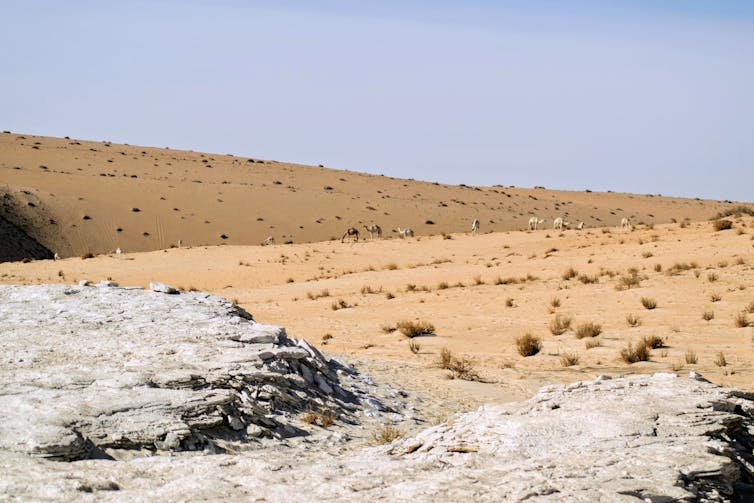
© Paul Breeze, Author provided

But it was not known at what point humans turned south after crossing the Sinai peninsula, reaching modern day Saudi Arabia. It is also often assumed that they may have taken a coastal route, avoiding the currently harsh desert interior. Previous fossil finds show this was not the case, with humans moving into the heart of Arabia at least 85,000 years ago. Now, new research pushes this date back even further.

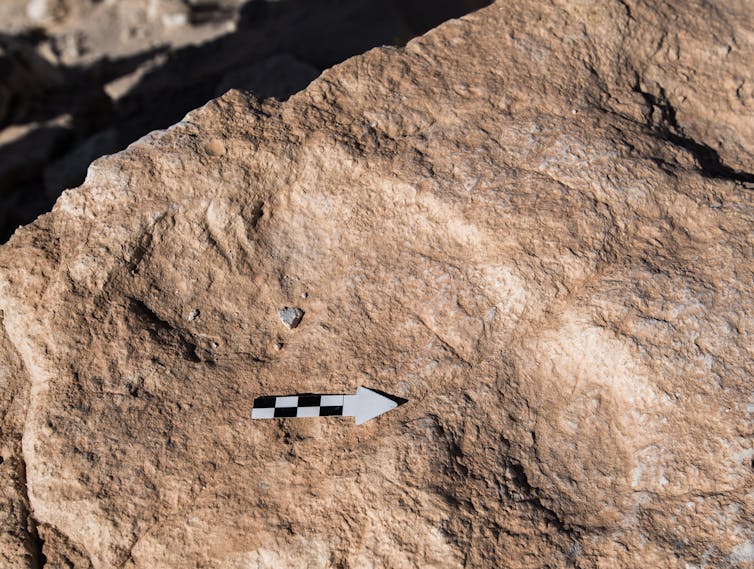
Colleagues and I discovered human and other animal footprints embedded on an ancient lake surface in the Nefud Desert in Saudi Arabia that are around 120,000 years old. These findings represent the earliest evidence for Homo sapiens on the Arabian Peninsula, and demonstrates the importance of Arabia for understanding human prehistory.
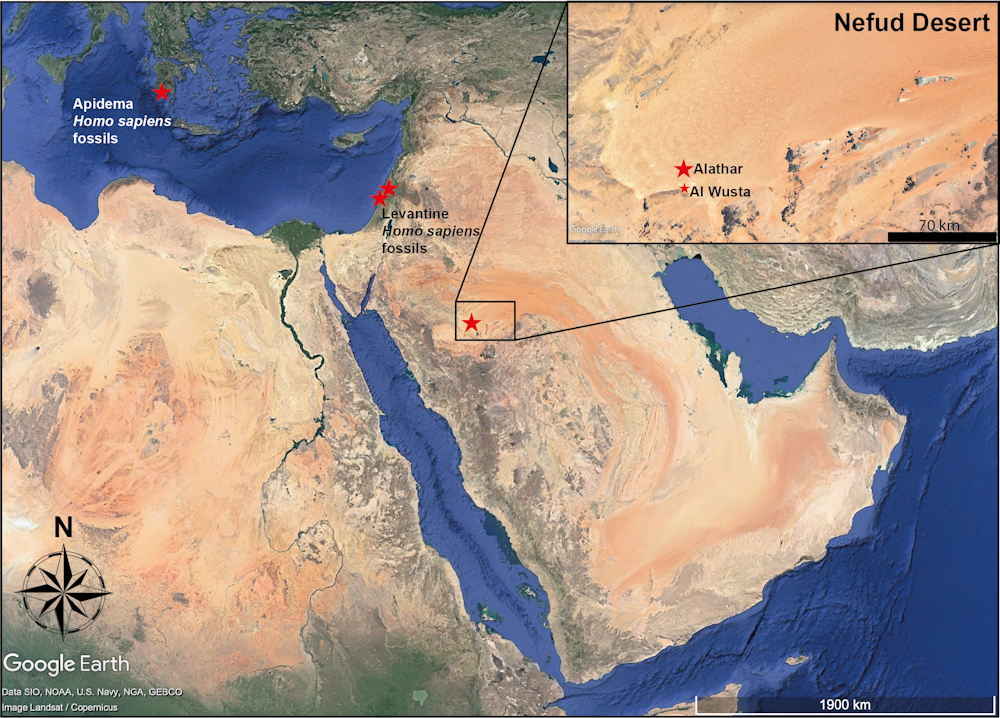
Map of modern day Saudi Arabia.
Key locations for early Homo sapiens outside-of-Africa (red stars). The Nefud Desert is highlighted inside the black rectangle. Google Maps

The Nefud Desert in modern-day Saudi Arabia lies around 500km to the southeast of the Sinai Peninsula. Today, the Arabian deserts are some of the most inhospitable environments in the world. They would form an impassable barrier for prehistoric humans or large mammals. Imagine standing at the foot of a hyper-arid desert equipped with stone tools and not much else. Could you get across? Probably not.

Scientific analysis shows that for most of their recent history, they were climatically similar to today: hyper-arid and impassable. But there is also evidence to show that at certain times in the past, the deserts transformed into savannah-like grasslands littered with freshwater resources. These “green” phases were likely short, probably lasting no more than a few millennia. Nonetheless, they provided windows of opportunity for humans and other animals to move into a new green landscape.

We know from fossil lake sediments that the Nefud Desert was one of those that periodically transformed into a more attractive landscape in the past, and the new footprints prove that early humans took advantage of one such window.


AlsoRead...

Ryan: Building real freedom through e-commerce

Ryan: Building real freedom through e-commerce

27 November 2025
Design Australia Group: Redefining Drafting as the engine of housing growth

Design Australia Group: Redefining Drafting as the engine of housing growth

26 November 2025
Faint footprint in yellow rock.
First human footprint discovered at the Alathar ancient lake. © Klint Janulis, Author provided

Fossilised footprints

We were able to date the footprints by using a technique called luminescence dating to a period of time 102-132,000 years ago. Based on wider regional evidence for increased rainfall, we suggest they date to a period roughly 120,000 years ago, called the last interglacial.

We know that around this time that vast river systems spread across the Sahara Desert, with Middle Palaeolithic archaeology scattered along them. Other evidence for increased rainfall at this time comes from fossil stalagmites found in caves in desert regions in Arabia and ~500 km north of the Nefud in the Negev Desert. These features only grow in conditions where rainfall is greater than 300mm per year; substantially more than the amount (<90mm per year) they receive today.

While it is difficult to know for sure which species of human left these prints, we think they were most likely left by our own, Homo sapiens. This is based on the fact that Homo sapiens were present in the Levant, 700km to the north of the Nefud Desert, at a similar time. Neanderthals were absent from the Levant in this period and did not move back into the region until thousands of years later, when cooler conditions prevailed. Estimates of the humans mass and statue based on the footprints are also more consistent with our species than Neanderthals.
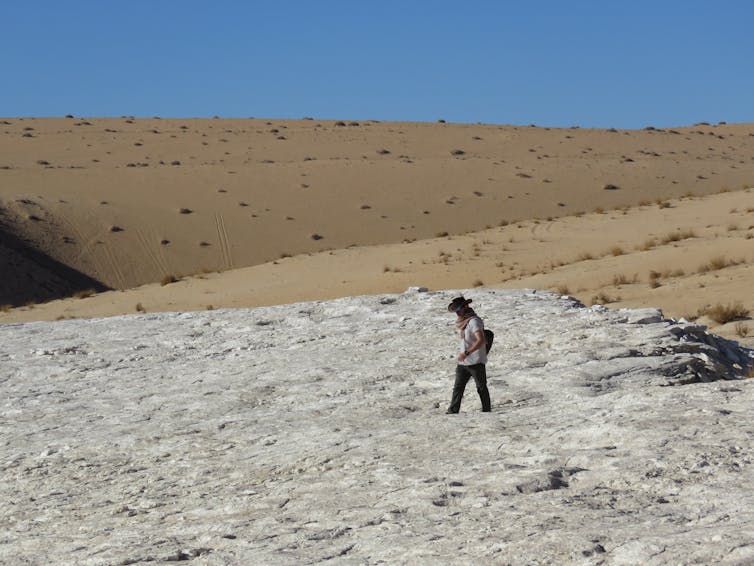
A man walks across a desert landscape.
Researcher surveying the Alathar ancient lake deposit for footprints. © Palaeodeserts Project, Author provided

High-res history

In addition to human footprints, elephant, horse and camel prints were also found. These footprints, studied in detail by Mathew Stewart at the Max Planck Institute for Chemical Ecology, provide a wealth of new information regarding prehistoric interactions between humans, animals and the environment.

Footprints are a unique form of fossil evidence as they provide precise snapshots in time that typically represent a few hours or days. This is a resolution we do not get from other records. They also allow us to understand the behaviour of their makers, which is something we cannot get from fossils.

This allows us to understand the relationship between humans and other large mammals at a geologically precise moment in time.

Environmental analysis on the lake sediments show that the lake contained fresh “drinkable” water, while the variety of footprints shows that humans, elephants, camels and horses were using this resource at a similar time. Human and large-mammal movements would have been closely tied to fresh water and the pattern of footprints show both foraged on the lake bed when it was temporarily exposed. Humans may have been drawn to the area as they tracked large mammals, who would potentially serve as prey.
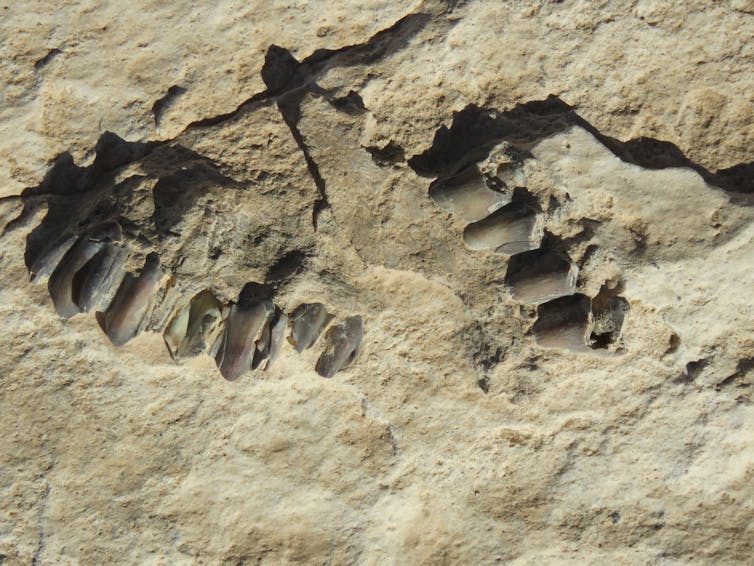
Animal prints in stone.
Animal fossils eroding out of the surface of the Alathar ancient lake deposit. © Badr Zahrani, Author provided

Surveys and analysis of fossils recovered from the site also shows that there are no stone tools or butchery of fossils. This indicates that the footprint-makers only very briefly visited the lake, foraging for resources before continuing on their journey.

It is not clear what happened to the people who left the footprints, but evidence suggests that they, along with the other early Homo sapiens explorers, either died out or retreated to more favourable environments as aridity returned to the desert.

Richard Clark-Wilson, PhD Candidate in Geography, Royal Holloway

This article is republished from The Conversation under a Creative Commons license. Read the original article.


Tags: SB001
DMCA.com Protection Status

SUBSCRIBE to our NEWSLETTER

[mc4wp_form id=”2384248″]

Don't Miss

The evolution of Aesthetic Surgery through the lens of Dr Kourosh Tavakoli

by Pauline Torongo
4 December 2025
The evolution of Aesthetic Surgery through the lens of Dr. Kourosh Tavakoli
Health & Wellness

As global interest in Australian cosmetic surgery continues to grow, the combination of regulation, research and emerging digital tools is...

Read moreDetails

Ryan: Building real freedom through e-commerce

by Pauline Torongo
27 November 2025
Ryan: Building real freedom through e-commerce
Business & Finance

Ryan’s greatest achievement isn’t any single business or revenue milestone — it’s the ecosystem he’s built through the Change community.

Read moreDetails

Design Australia Group: Redefining Drafting as the engine of housing growth

by Pauline Torongo
26 November 2025
Design Australia Group: Redefining Drafting as the engine of housing growth
Business & Finance

Australia is under pressure to build homes faster, but design bottlenecks slow progress. Design Australia Group is fixing this by...

Read moreDetails

Louis Guy Detata builds Global Trading Empires through autonomous systems and disciplined leadership

by Pauline Torongo
25 November 2025
Louis Guy Detata builds Global Trading Empires through autonomous systems and disciplined leadership
Business & Finance

The path from investment banking to leading a global trading platform has taught Louis Detata that sustainable success requires more...

Read moreDetails

Burning Eucalyptus Wood: Tips, Advantages, Disadvantages & Alternatives

by Fazila Olla-Logday
20 November 2025
Image Supplied
Enviroment

Learn about burning eucalyptus wood for stoves and fireplaces. Discover benefits, drawbacks, harvesting tips, and better alternative firewood options for...

Read moreDetails

Everything Parents Need to Know About Baby Soft Play and Why It’s a Game Changer

by Fazila Olla-Logday
11 November 2025
Everything Parents Need to Know About Baby Soft Play
Health & Wellness

Baby soft play is a fun, safe, and educational way for little ones to explore and grow. Discover the benefits...

Read moreDetails

WOMAD Sets Up a New Camp in Wiltshire – Australian festival fans take note!

by Kris Griffiths
11 November 2025
Kumbia Boruka brought their reggae and dancehall flavour to the Taste the World Stage at WOMAD 2024 - Credit - Mike Massaro
Entertainment

With its 2026 edition moving to Neston Park in England, WOMAD offers Aussie music lovers a chance to reconnect with global...

Read moreDetails
Load More

Copyright © Blue Sky Publications Ltd. All Rights Reserved.
australiantimes.co.uk is a division of Blue Sky Publications Ltd. Reproduction without permission prohibited. DMCA.com Protection Status

  • About us
  • Write for Us
  • Advertise
  • Contact us
  • T&Cs, Privacy and GDPR
No Result
View All Result
  • News
    • Weather
    • Sport
    • Technology
    • Business & Finance
      • Currency Zone
    • Lotto Results
      • The Lott
  • Lifestyle
    • Entertainment
    • Horoscopes
    • Health & Wellness
    • Recipes
  • Travel
  • Expat Life
  • Move to Australia

Copyright © Blue Sky Publications Ltd. All Rights Reserved.
australiantimes.co.uk is a division of Blue Sky Publications Ltd. Reproduction without permission prohibited. DMCA.com Protection Status

No Result
View All Result
  • News
    • Weather
    • Sport
    • Technology
    • Business & Finance
      • Currency Zone
    • Lotto Results
      • The Lott
  • Lifestyle
    • Entertainment
    • Horoscopes
    • Health & Wellness
    • Recipes
  • Travel
  • Expat Life
  • Move to Australia

Copyright © Blue Sky Publications Ltd. All Rights Reserved.
australiantimes.co.uk is a division of Blue Sky Publications Ltd. Reproduction without permission prohibited. DMCA.com Protection Status