


• Advertise
  • About us
  • Terms and Conditions
  • Contact us
Thursday, May 14, 2026
Australian Times News
  • News
    • Weather
    • Sport
    • Technology
    • Business & Finance
      • Currency Zone
    • Lotto Results
      • The Lott
  • Lifestyle
    • Entertainment
    • Horoscopes
    • Health & Wellness
    • Recipes
  • Travel
  • Expat Life
  • Move to Australia
No Result
View All Result
  • News
    • Weather
    • Sport
    • Technology
    • Business & Finance
      • Currency Zone
    • Lotto Results
      • The Lott
  • Lifestyle
    • Entertainment
    • Horoscopes
    • Health & Wellness
    • Recipes
  • Travel
  • Expat Life
  • Move to Australia
No Result
View All Result
Australian Times News
No Result
View All Result
Home News

Test positivity rate: How this one figure explains that the US isn’t doing enough testing yet

COVID-19 testing has two purposes. The first is to confirm a diagnosis so that medical treatment can be appropriately rendered. The second is to do surveillance for tracking and disease suppression.

The Conversation by The Conversation
02-08-2020 09:17
in News
Test positivity rate

Test positivity rate Photo by Colin D on Unsplash

Ronald D. Fricker, Jr., Virginia Tech

The U.S. has performed more coronavirus tests than any other country in the world. Yet, at the same time, the U.S. is notably underperforming in terms of suppressing COVID-19. Confirmed cases – as well as deaths – are surging in many parts of the country. Some people have argued that the increase in cases is solely due to increased testing.
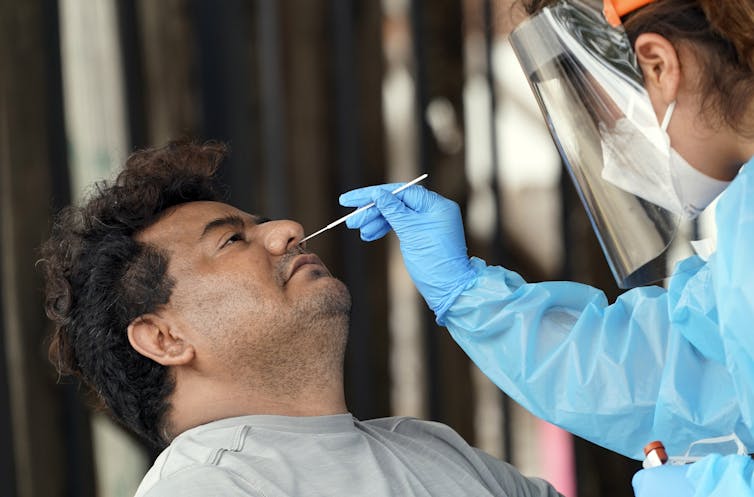
As cases surge, testing needs to increase as well. AP Photo/David J. Phillip

I am a statistician who studies how mathematics and statistics can be used to track diseases. The claim that the increase in cases is only caused by increases in testing is just not true. But how do public health officials know this?

Testing, confirmed cases and total cases

COVID-19 testing has two purposes. The first is to confirm a diagnosis so that medical treatment can be appropriately rendered. The second is to do surveillance for tracking and disease suppression – including finding those who may be asymptomatic or only have mild symptoms – so that individuals and public health officials can take actions to slow the spread of the virus.

At a White House briefing on July 13, the president said, “When you test, you create cases.”

The problem with this statement is that anyone who is infected with the coronavirus is, by definition, a case. Since taking a COVID-19 test does not cause a person to get coronavirus, just like taking a pregnancy test does not cause one to become pregnant, the president’s claim is false. Testing does not create cases.

However, because many COVID-19 cases are asymptomatic, many people are infected and don’t know it. What COVID-19 testing does do is identify unknown cases. And thus it does increase the number of cases that are known, or otherwise called the confirmed case count.


AlsoRead...

Svitla Systems

Svitla Systems acquires Australia’s Kiandra IT to expand Global Engineering Footprint and Accelerate AI-Driven delivery

11 May 2026
How Clevero is helping Australian Service Businesses compete with Enterprises on a Fraction of the Budget

How Clevero is helping Australian Service Businesses compete with Enterprises on a Fraction of the Budget

28 April 2026

Finding unknown cases is good, not bad, because identifying those who are COVID-19-positive allows individuals and public health officials to take actions that slow the spread of the disease. When public health officials find cases, they can begin contract tracing. When a person finds out they are infected, they will know to quarantine.

Since the beginning of the pandemic, the U.S. has performed more total tests and more tests per capita than any other country, though as of late July the U.K., Russia and Qatar were performing more tests per capita per day. But counting the total number of tests or the tests per capita is not the right way to judge success of a testing program.

As it says on the Johns Hopkins testing comparison page, a country’s “testing program should be scaled to the size of their epidemic, not the size of the population.” Sure, the U.S. might have a big testing program, but it has a massive epidemic. The U.S. needs an equally massive testing program if health officials want to have an accurate picture of what’s really going on.
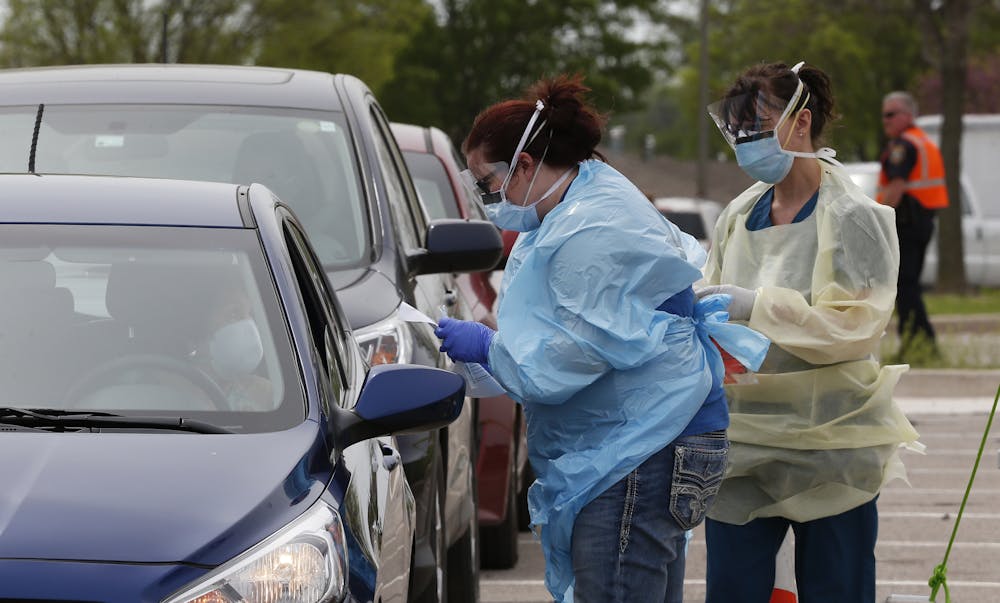
Two health care works standing outside preparing to perform a swab test at a drive-through testing station.
As the need for testing has grown, so have lines at testing facilities. Results can take more than a week to be returned. AP Photo/Sue Ogrocki

Test positivity rate

So how do public health officials know if they are doing enough testing?

Better than simply counting total number of tests, the test positivity rate is a useful measure of whether enough tests are being done. The test positivity rate is simply the fraction of tests that come back positive. It is calculated by dividing the number of positive tests by the total number of tests. Generally, a lower test positivity rate is good.

A good way to think about test positivity is to think about fishing with a net. If you catch a fish almost every time you send the net down – high test positivity – that tells you there are probably a lot of fish around that you haven’t caught – there are a lot of undetected cases. On the other hand, if you use a huge net – more testing – and only catch a fish every once in a while – low test positivity – you can be pretty sure that you’ve caught most of the fish in the area.

According to the World Health Organization, before a region can relax restrictions or begin reopening, the test positivity rate from a comprehensive testing program should be at or below 5% for at least 14 days.

There are two ways to lower a test positivity rate: either by decreasing the number of positive tests or by increasing the total number of tests. A comprehensive testing program does both. By conducting a large number of tests, most cases in the community are detected. Then, individual and government actions can be taken that contain the virus. This results in a declining number of positive tests.

[Deep knowledge, daily. Sign up for The Conversation’s newsletter.]

Returning to the fishing metaphor, the goal of a comprehensive testing program is to use a huge net to overfish in the coronavirus lake until there are very few COVID-19 cases left. Using the test positivity rate as a measure of success helps ensure that a testing program is appropriately scaled to the size of an epidemic.

As of July 27, the U.S. as a whole had a test positivity rate of 10%. States where testing programs are robust and the virus is fairly well controlled have test positivity rates well below 5%, like Massachusetts at 2.68% and New York at 1.09%. In places like Mississippi and Arizona that are experiencing large outbreaks, test positivity rates are above 20%.

The right amount of testing

The increases in confirmed cases aren’t occurring just because there is more testing. The high test positivity rates in some locations show that the virus is in fact spreading and growing so testing needs to grow with it. I believe that if the U.S. wants to beat back this virus, one of the first things that needs to happen is to increase testing. We need to deploy larger nets to catch more fish. Yes, we’ll find more cases, but that’s the point.

Ronald D. Fricker, Jr., Professor of Statistics and Associate Dean for Faculty Affairs and Administration, Virginia Tech

This article is republished from The Conversation under a Creative Commons license. Read the original article.


Tags: SB001
DMCA.com Protection Status

SUBSCRIBE to our NEWSLETTER

[mc4wp_form id=”2384248″]

Don't Miss

Svitla Systems acquires Australia’s Kiandra IT to expand Global Engineering Footprint and Accelerate AI-Driven delivery

by Pauline Torongo
11 May 2026
Svitla Systems
Business & Finance

Acquisition marks Svitla’s entry into the Australian market and strengthens capabilities in low-code, Microsoft technologies, and enterprise software engineering.

Read moreDetails

Residential Healthcare Practices: Revolution or Evolution?

by Pauline Torongo
11 May 2026
Residential Healthcare Practices: Revolution or Evolution?
Lifestyle

President Bill Lutz’s "revolution" was born from his background in fine dining, which instilled a disciplined, customer-focused approach.

Read moreDetails

Medicana Health Group launches HPV vaccination campaign to support cervical cancer prevention

by Pauline Torongo
28 April 2026
Medicana Health Group launches HPV vaccination campaign to support cervical cancer prevention
Health & Wellness

The Türkiye-based healthcare group has introduced a new awareness campaign focused on HPV vaccination, regular check-ups and early detection, with...

Read moreDetails

How Clevero is helping Australian Service Businesses compete with Enterprises on a Fraction of the Budget

by Pauline Torongo
28 April 2026
How Clevero is helping Australian Service Businesses compete with Enterprises on a Fraction of the Budget
Business & Finance

By consolidating CRM, scheduling, workflow automation, invoicing, reporting, and client communications into a single platform, Clevero gives smaller operators the...

Read moreDetails

How CJAM Group is building 1,100 homes across Southeast Queensland

by Pauline Torongo
24 March 2026
How CJAM Group is building 1,100 homes across Southeast Queensland
Lifestyle

The CJAM Group founder is quietly building a 1,100+ home pipeline, with projects in Hervey Bay and Toowoomba, using a...

Read moreDetails

Design Without Compromise: Where Gutter Protection Meets Modern Architecture

by Fazila Olla-Logday
20 March 2026
Design Without Compromise: Where Gutter Protection Meets Modern Architecture
Business & Finance

Design without compromise by integrating gutter protection seamlessly into modern architecture. Discover how innovative gutter systems enhance your home’s aesthetics...

Read moreDetails

How WageSafe Secured Australia’s Most Reputable Retail Business Among Its Premium Clients

by Fazila Olla-Logday
12 March 2026
How WageSafe Secured Australia’s Most Reputable Retail Business Among Its Premium Clients
at

Learn how WageSafe helps businesses stay compliant with payroll and wage regulations through reliable monitoring, risk management, and expert support—protecting...

Read moreDetails
Load More

Copyright © Blue Sky Publications Ltd. All Rights Reserved.
australiantimes.co.uk is a division of Blue Sky Publications Ltd. Reproduction without permission prohibited. DMCA.com Protection Status

  • About us
  • Write for Us
  • Advertise
  • Contact us
  • T&Cs, Privacy and GDPR
No Result
View All Result
  • News
    • Weather
    • Sport
    • Technology
    • Business & Finance
      • Currency Zone
    • Lotto Results
      • The Lott
  • Lifestyle
    • Entertainment
    • Horoscopes
    • Health & Wellness
    • Recipes
  • Travel
  • Expat Life
  • Move to Australia

Copyright © Blue Sky Publications Ltd. All Rights Reserved.
australiantimes.co.uk is a division of Blue Sky Publications Ltd. Reproduction without permission prohibited. DMCA.com Protection Status

No Result
View All Result
  • News
    • Weather
    • Sport
    • Technology
    • Business & Finance
      • Currency Zone
    • Lotto Results
      • The Lott
  • Lifestyle
    • Entertainment
    • Horoscopes
    • Health & Wellness
    • Recipes
  • Travel
  • Expat Life
  • Move to Australia

Copyright © Blue Sky Publications Ltd. All Rights Reserved.
australiantimes.co.uk is a division of Blue Sky Publications Ltd. Reproduction without permission prohibited. DMCA.com Protection Status





