


• Advertise
  • About us
  • Terms and Conditions
  • Contact us
Saturday, December 6, 2025
Australian Times News
  • News
    • Weather
    • Sport
    • Technology
    • Business & Finance
      • Currency Zone
    • Lotto Results
      • The Lott
  • Lifestyle
    • Entertainment
    • Horoscopes
    • Health & Wellness
    • Recipes
  • Travel
  • Expat Life
  • Move to Australia
No Result
View All Result
  • News
    • Weather
    • Sport
    • Technology
    • Business & Finance
      • Currency Zone
    • Lotto Results
      • The Lott
  • Lifestyle
    • Entertainment
    • Horoscopes
    • Health & Wellness
    • Recipes
  • Travel
  • Expat Life
  • Move to Australia
No Result
View All Result
Australian Times News
No Result
View All Result
Home News

How your car sheds microplastics into the ocean thousands of miles away

A new study has revealed that microplastics released from car tires and brake systems are a major source of marine plastic pollution.

The Conversation by The Conversation
15-07-2020 18:05
in News
How your car sheds microplastics into the ocean

How your car sheds microplastics into the ocean Photo by Clint McKoy on Unsplash

Claire Gwinnett, Staffordshire University

The impact of car travel on the environment is well known. Exhaust emissions pollute the atmosphere with gases that raise global temperatures and make the air less safe to breathe. Sadly, the problems don’t end there. Scientists have been studying another problem – and one that connects your daily commute to the most remote stretches of the world’s oceans.

Nirmal Rajendharkumar/Unsplash, CC BY-SA

A new study has revealed that microplastics released from car tires and brake systems are a major source of marine plastic pollution – much more than previously thought. Every year, 100,000 metric tonnes of microplastics are shed from tires, transported through the air and dumped in the ocean. Another 40,000 tonnes comes from brakes. To put that in perspective, if the average scrapped car tire is around nine kilograms, then the total weight of microplastics reaching the sea each year equates to just under 11 million tires.

Microplastics are polymers smaller than 5mm, and they are hazardous to the health of animals that are exposed to them. The different shapes and densities of microplastics cause them to disperse throughout habitats, making them available for different species to eat. In the ocean, microplastics can accumulate in an animal’s gills or digestive tract. Laboratory studies on fish and molluscs have shown that this can affect respiration, feeding and growth.
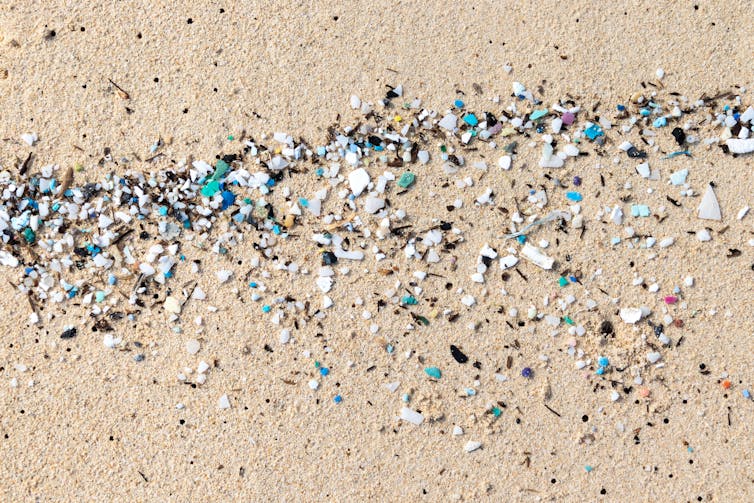
Microplastics wash up in the surf and collect on beach strandlines. Eric Dale/Shutterstock

Microplastics don’t just harm sea creatures though. We now know that their proliferation in the world’s soils has reduced how successfully worms reproduce and even affected the growth of crops.

The widespread impact of microplastics on Earth’s ecosystems makes it important to understand where they come from and how they travel between different environments. Their transportation via waterways has been well studied, but the new research highlights an overlooked route for microplastics entering the world’s ocean – the atmosphere.

Road microplastics ride the wind

Car tires are made of rubber, which contains about 50% natural and synthetic polymers. We’re used to thinking of polystyrene as a more typical synthetic polymer, while rubber is more natural. But tire rubber includes man-made elastomers which, when broken down into smaller fragments, falls within the definition of a microplastic.


AlsoRead...

Ryan: Building real freedom through e-commerce

Ryan: Building real freedom through e-commerce

27 November 2025
Design Australia Group: Redefining Drafting as the engine of housing growth

Design Australia Group: Redefining Drafting as the engine of housing growth

26 November 2025

And tires aren’t indestructible – they wear down through abrasion and friction into tiny fragments called tire wear particles. Car braking systems, which include braking pads and linings, also create particles when friction is applied. These brake wear particles are made of a mix of materials that includes plastic. Together, tire and brake wear particles make up a class of pollutants called road microplastics.

Asia produces more of both types of road microplastics than any other continent. North America and Europe, with their large numbers of road vehicles, also produce significant amounts of brake wear particles.

Not only are huge quantities of road microplastics being produced every year, but they’re exceptionally good at travelling for a long time in the air. As a result, they can end up being deposited thousands of miles from where they originated.

To understand how long these particulates can travel in the atmosphere, the researchers calculated their typical lifetimes based on their sizes. They found that smaller particles from tires can spread further, with the smallest staying airborne for an average of 18 to 37 days. Larger particles don’t travel as far, and instead create hotspots of microplastics near the roads they are released from. Smaller particles travel far and are deposited worldwide, with about 43% of their total mass ending up on land, and 57% in the ocean.
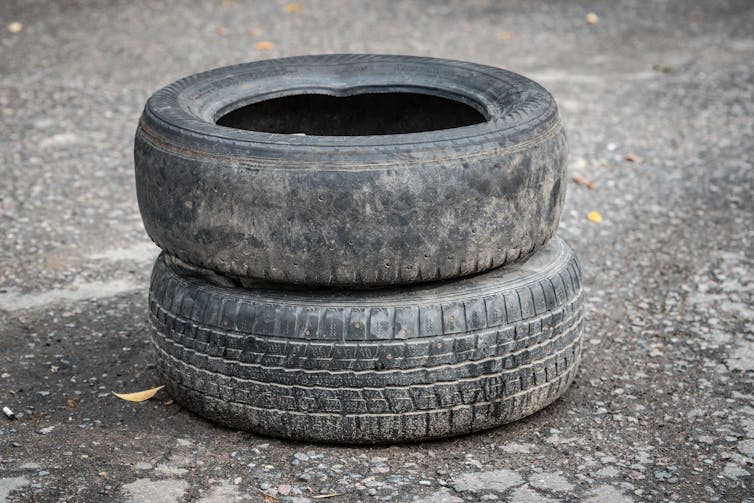
With repeated use, the surfaces of tires and brake pads shed microplastics. Andre_K/Shutterstock

A difficult road ahead

Road microplastics that started life contained in tires and brakes can end up in remote places where there are no roads or cars, like the Arctic Circle.

Here, these pollutants pose a greater threat, as tire and brake particles are dark and absorb light, potentially increasing the rate of warming and ice melting in the region.

The amount of particles released from vehicles may be even more than the recent study reported. Emissions of microplastics from non-road vehicles, such as tractors and construction machinery, weren’t considered by the research team. Although they are fewer than cars, they carry heavier loads which can speed up the abrasion of tires and brake systems into microplastics.

Given how reliant societies are on cars and road travel, and how useful synthetic rubber is for making tires, this one source of microplastics that could be very difficult to eliminate.

Claire Gwinnett, Professor in Forensic and Environmental Science, Staffordshire University

This article is republished from The Conversation under a Creative Commons license. Read the original article.


Tags: SB001
DMCA.com Protection Status

SUBSCRIBE to our NEWSLETTER

[mc4wp_form id=”2384248″]

Don't Miss

The evolution of Aesthetic Surgery through the lens of Dr Kourosh Tavakoli

by Pauline Torongo
4 December 2025
The evolution of Aesthetic Surgery through the lens of Dr. Kourosh Tavakoli
Health & Wellness

As global interest in Australian cosmetic surgery continues to grow, the combination of regulation, research and emerging digital tools is...

Read moreDetails

Ryan: Building real freedom through e-commerce

by Pauline Torongo
27 November 2025
Ryan: Building real freedom through e-commerce
Business & Finance

Ryan’s greatest achievement isn’t any single business or revenue milestone — it’s the ecosystem he’s built through the Change community.

Read moreDetails

Design Australia Group: Redefining Drafting as the engine of housing growth

by Pauline Torongo
26 November 2025
Design Australia Group: Redefining Drafting as the engine of housing growth
Business & Finance

Australia is under pressure to build homes faster, but design bottlenecks slow progress. Design Australia Group is fixing this by...

Read moreDetails

Louis Guy Detata builds Global Trading Empires through autonomous systems and disciplined leadership

by Pauline Torongo
25 November 2025
Louis Guy Detata builds Global Trading Empires through autonomous systems and disciplined leadership
Business & Finance

The path from investment banking to leading a global trading platform has taught Louis Detata that sustainable success requires more...

Read moreDetails

Burning Eucalyptus Wood: Tips, Advantages, Disadvantages & Alternatives

by Fazila Olla-Logday
20 November 2025
Image Supplied
Enviroment

Learn about burning eucalyptus wood for stoves and fireplaces. Discover benefits, drawbacks, harvesting tips, and better alternative firewood options for...

Read moreDetails

Everything Parents Need to Know About Baby Soft Play and Why It’s a Game Changer

by Fazila Olla-Logday
11 November 2025
Everything Parents Need to Know About Baby Soft Play
Health & Wellness

Baby soft play is a fun, safe, and educational way for little ones to explore and grow. Discover the benefits...

Read moreDetails

WOMAD Sets Up a New Camp in Wiltshire – Australian festival fans take note!

by Kris Griffiths
11 November 2025
Kumbia Boruka brought their reggae and dancehall flavour to the Taste the World Stage at WOMAD 2024 - Credit - Mike Massaro
Entertainment

With its 2026 edition moving to Neston Park in England, WOMAD offers Aussie music lovers a chance to reconnect with global...

Read moreDetails
Load More

Copyright © Blue Sky Publications Ltd. All Rights Reserved.
australiantimes.co.uk is a division of Blue Sky Publications Ltd. Reproduction without permission prohibited. DMCA.com Protection Status

  • About us
  • Write for Us
  • Advertise
  • Contact us
  • T&Cs, Privacy and GDPR
No Result
View All Result
  • News
    • Weather
    • Sport
    • Technology
    • Business & Finance
      • Currency Zone
    • Lotto Results
      • The Lott
  • Lifestyle
    • Entertainment
    • Horoscopes
    • Health & Wellness
    • Recipes
  • Travel
  • Expat Life
  • Move to Australia

Copyright © Blue Sky Publications Ltd. All Rights Reserved.
australiantimes.co.uk is a division of Blue Sky Publications Ltd. Reproduction without permission prohibited. DMCA.com Protection Status

No Result
View All Result
  • News
    • Weather
    • Sport
    • Technology
    • Business & Finance
      • Currency Zone
    • Lotto Results
      • The Lott
  • Lifestyle
    • Entertainment
    • Horoscopes
    • Health & Wellness
    • Recipes
  • Travel
  • Expat Life
  • Move to Australia

Copyright © Blue Sky Publications Ltd. All Rights Reserved.
australiantimes.co.uk is a division of Blue Sky Publications Ltd. Reproduction without permission prohibited. DMCA.com Protection Status





