

• Advertise
  • About us
  • Terms and Conditions
  • Contact us
Friday, December 5, 2025
Australian Times News
  • News
    • Weather
    • Sport
    • Technology
    • Business & Finance
      • Currency Zone
    • Lotto Results
      • The Lott
  • Lifestyle
    • Entertainment
    • Horoscopes
    • Health & Wellness
    • Recipes
  • Travel
  • Expat Life
  • Move to Australia
No Result
View All Result
  • News
    • Weather
    • Sport
    • Technology
    • Business & Finance
      • Currency Zone
    • Lotto Results
      • The Lott
  • Lifestyle
    • Entertainment
    • Horoscopes
    • Health & Wellness
    • Recipes
  • Travel
  • Expat Life
  • Move to Australia
No Result
View All Result
Australian Times News
No Result
View All Result
Home Technology

Renewable energy supply and demand during lockdown – and the best time to bake bread

Britain generated nearly half of its electricity from renewable sources in the first three months of 2020.

The Conversation by The Conversation
05-07-2020 22:09
in Technology
Renewable energy supply and demand during lockdown

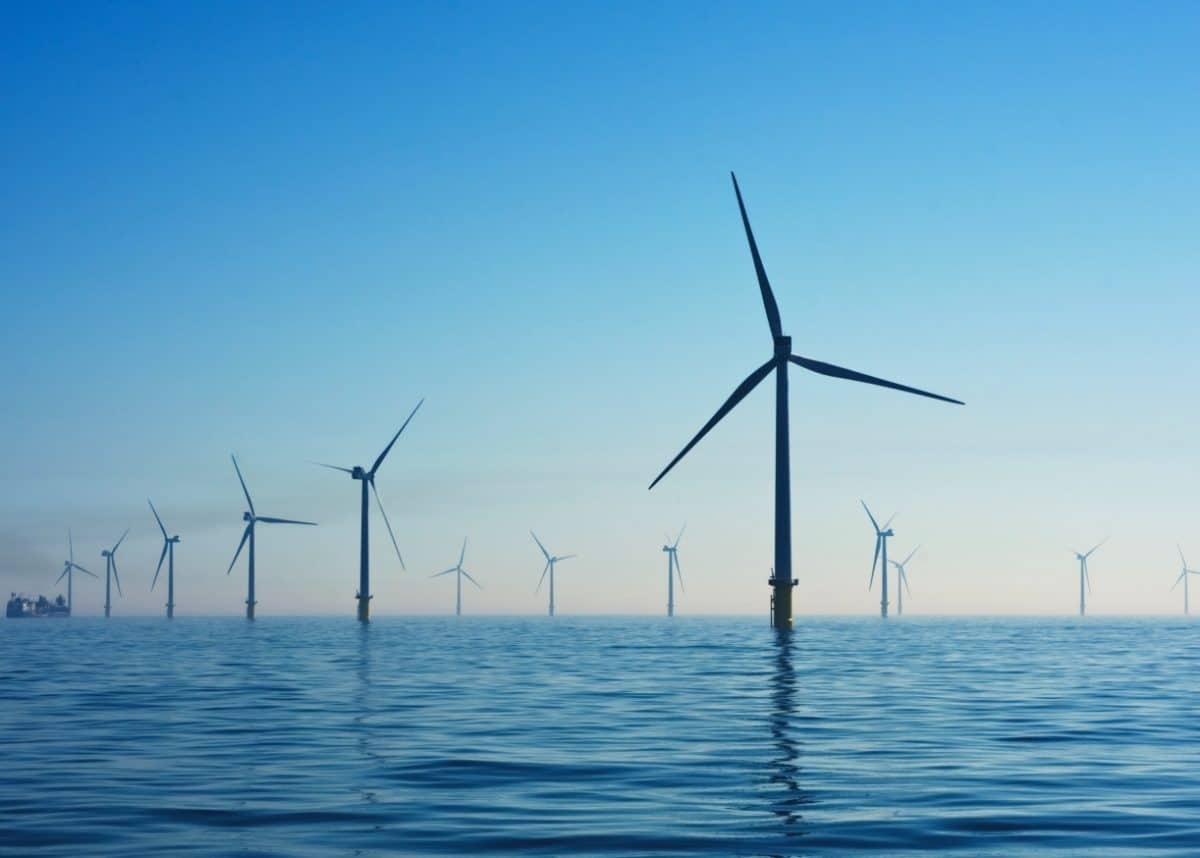
Renewable energy supply and demand during lockdown Photo by Nicholas Doherty on Unsplash

Jacopo Torriti, University of Reading; Jose Luis Ramirez-Mendiola, University of Reading, and Timur Yunusov, University of Reading

Britain generated nearly half of its electricity from renewable sources in the first three months of 2020. And then the pandemic happened, and all of a sudden, energy demand dropped dramatically as offices, shops and restaurants closed and people stayed home.

Blaskor/Shutterstock

Energy demand patterns are largely driven by our activities. Peaks in demand exist simply because, at certain times of day, there are a lot of people doing a lot of things that all require electricity.

Not all days are the same, hard though that may have been to believe during the monotony of lockdown. During “normal” times, peaks are higher on weekdays than weekends because there is more activity, with factories and shops open longer. During the lockdown, energy demand on weekdays was so much lower that it looked more like it usually does on weekends.

We wanted to know how that might have affected the amount of Britain’s electricity demand that was met by renewable energy, so we took a closer look at days during lockdown and compared them with the same period in 2019.
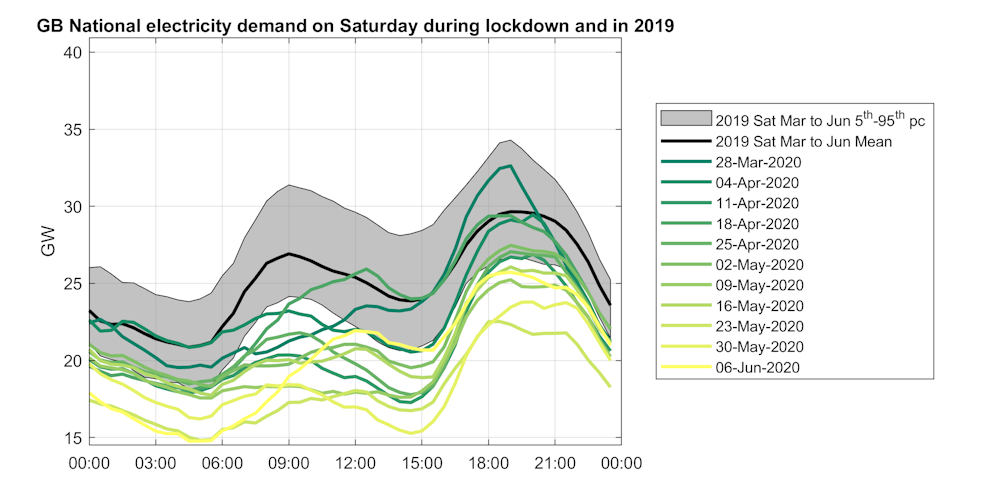
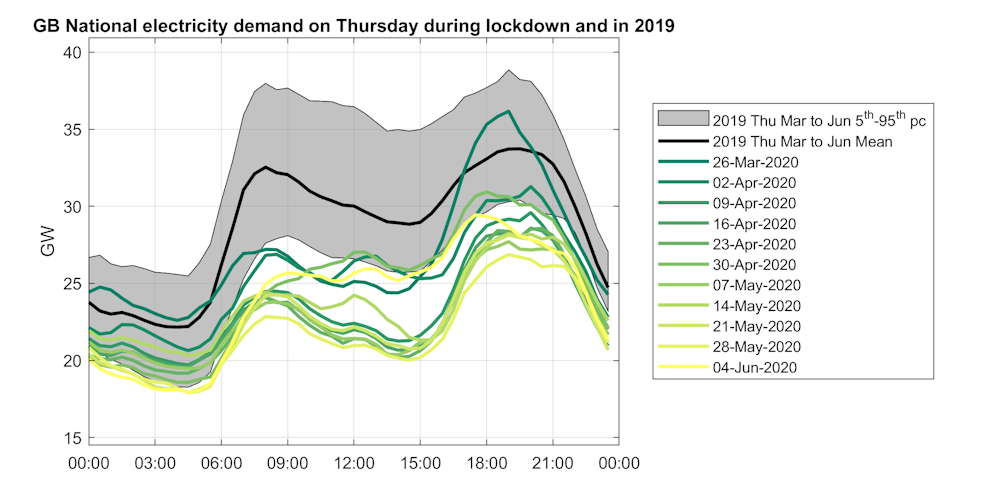
T. Yunusov; Data: National Grid ESO, Author provided

Lower demand, cleaner power

Weekday evening peaks (between 4pm and 8pm) occur because people tend to return home around the same time and switch lights on, prepare dinner and watch TV. But these evening peaks often don’t align with the times when energy from renewables – particular solar, but also wind and hydroelectric – is abundant. To meet demand at that time of day, extra power generation is needed, which is mainly supplied from fossil fuels. Using this extra generation to match peak demand results in higher carbon emissions and higher costs, which are reflected in consumer bills.

But for weekdays during lockdown, evening peaks were much lower. And the overall decrease in demand in turn reduced the need for this extra generation, meaning that the energy we consumed was cleaner, compared with pre-lockdown peaks. The larger the share of renewable energy in the supply mix, the lower the overall carbon intensity (how much CO₂ is emitted to generate a particular amount of energy) of power generation.


AlsoRead...

Common Mistakes When Buying a Telescope

Common Mistakes When Buying a Telescope — And How to Avoid Them

1 July 2025
Leading with Trust: Why Quality still wins in the AI Era

Leading with Trust: Why Quality still wins in the AI Era

5 June 2025
Energy demand and the carbon intensity of power generation at peak times during lockdown, the two months leading up to lockdown and the same period in 2019. T. Yunusov; Data: National Grid ESO, Author provided

Thanks to lower demand during lockdown, Britain’s national grid was coal-free for almost 68 days – the longest time since 1882, when the world’s first coal-fired power station opened on Holborn Viaduct in central London.

This is great news, of course, but while evening peaks were lower than during normal times, they were still present. In an ideal scenario where CO₂ emissions are close to zero, demand wouldn’t overload the grid at certain times of day, prompting back-up generation by fossil fuels to cover the shortfall. Instead, energy demand would be flexible and adapt in real time to the levels of clean power available. But how is it possible to match demand to renewable energy supply?

The best time to bake

The first (and perhaps the simplest) way to make demand more flexible is through price incentives.

Typically, our bills are based on flat tariffs, meaning we’re charged a price that averages out our use when the prices of electricity are higher at peak times and when they’re lower during off-peak periods.

But some suppliers offer flexible tariffs based on the actual cost of generating electricity at different times of day. And in some cases, this means that customers are reimbursed when prices turn negative, which usually happens when demand is low and generation by renewables is high.

Another way to increase the flexibility of energy demand is through a voluntary shift by consumers. If more of us can time our activities to moments in the day when electricity generation by renewables is highest, we can contribute to reducing emissions from the energy sector.

The shortage of flour in supermarkets during lockdown was almost certainly due to an increase in the number of people baking. What if they could choose the best time of their day to bake, based on when renewable energy generation was at its daily peak – and the carbon intensity of the grid is at its corresponding nadir?
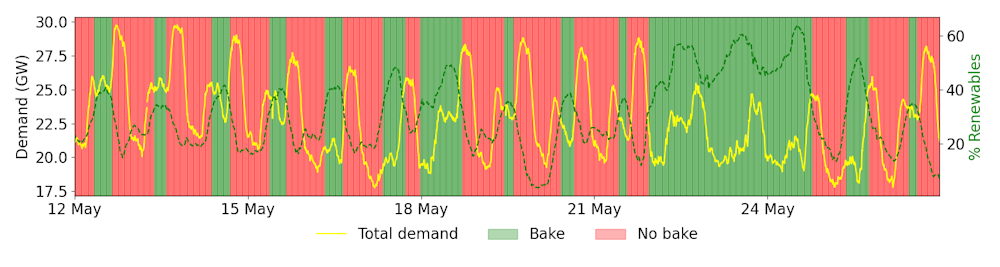
Good periods to bake in May 2020 (green area) versus bad periods to bake (red area), according to electricity demand (yellow line) and the percentage of renewable generation (green line). J. Ramirez-Mendiola

One website is trying to help people do just that, offering suggestions each day for the best times to bake.

Typically, the best times for green baking are when more than one-third of the electricity we use is being generated by renewables, which normally occurs around the middle of the day when there is plenty of sunshine and wind. But on very sunny or windy days, these greener periods in Britain’s electricity generation can extend much longer, making it even easier to be environmentally friendly, while still enjoying the conveniences that electricity offers, such as baking tasty bread, preparing a meal in a slow cooker or charging an electric car.

Every little helps, and being mindful of when green energy generation is at its daily peak could lead to bigger reductions in carbon emission in a shorter time than governments and utilities are currently working towards. So long as we don’t run out of flour, that is.

Jacopo Torriti, Professor of Energy Economics and Policy, University of Reading; Jose Luis Ramirez-Mendiola, Postdoctoral Research Fellow on Flexibility in Energy Demand, University of Reading, and Timur Yunusov, Postdoctoral Researcher on Flexibility in Energy Demand, University of Reading

This article is republished from The Conversation under a Creative Commons license. Read the original article.


Tags: SB001
DMCA.com Protection Status

SUBSCRIBE to our NEWSLETTER

[mc4wp_form id=”2384248″]

Don't Miss

The evolution of Aesthetic Surgery through the lens of Dr Kourosh Tavakoli

by Pauline Torongo
4 December 2025
The evolution of Aesthetic Surgery through the lens of Dr. Kourosh Tavakoli
Health & Wellness

As global interest in Australian cosmetic surgery continues to grow, the combination of regulation, research and emerging digital tools is...

Read moreDetails

Ryan: Building real freedom through e-commerce

by Pauline Torongo
27 November 2025
Ryan: Building real freedom through e-commerce
Business & Finance

Ryan’s greatest achievement isn’t any single business or revenue milestone — it’s the ecosystem he’s built through the Change community.

Read moreDetails

Design Australia Group: Redefining Drafting as the engine of housing growth

by Pauline Torongo
26 November 2025
Design Australia Group: Redefining Drafting as the engine of housing growth
Business & Finance

Australia is under pressure to build homes faster, but design bottlenecks slow progress. Design Australia Group is fixing this by...

Read moreDetails

Louis Guy Detata builds Global Trading Empires through autonomous systems and disciplined leadership

by Pauline Torongo
25 November 2025
Louis Guy Detata builds Global Trading Empires through autonomous systems and disciplined leadership
Business & Finance

The path from investment banking to leading a global trading platform has taught Louis Detata that sustainable success requires more...

Read moreDetails

Burning Eucalyptus Wood: Tips, Advantages, Disadvantages & Alternatives

by Fazila Olla-Logday
20 November 2025
Image Supplied
Enviroment

Learn about burning eucalyptus wood for stoves and fireplaces. Discover benefits, drawbacks, harvesting tips, and better alternative firewood options for...

Read moreDetails

Everything Parents Need to Know About Baby Soft Play and Why It’s a Game Changer

by Fazila Olla-Logday
11 November 2025
Everything Parents Need to Know About Baby Soft Play
Health & Wellness

Baby soft play is a fun, safe, and educational way for little ones to explore and grow. Discover the benefits...

Read moreDetails

WOMAD Sets Up a New Camp in Wiltshire – Australian festival fans take note!

by Kris Griffiths
11 November 2025
Kumbia Boruka brought their reggae and dancehall flavour to the Taste the World Stage at WOMAD 2024 - Credit - Mike Massaro
Entertainment

With its 2026 edition moving to Neston Park in England, WOMAD offers Aussie music lovers a chance to reconnect with global...

Read moreDetails
Load More

Copyright © Blue Sky Publications Ltd. All Rights Reserved.
australiantimes.co.uk is a division of Blue Sky Publications Ltd. Reproduction without permission prohibited. DMCA.com Protection Status

  • About us
  • Write for Us
  • Advertise
  • Contact us
  • T&Cs, Privacy and GDPR
No Result
View All Result
  • News
    • Weather
    • Sport
    • Technology
    • Business & Finance
      • Currency Zone
    • Lotto Results
      • The Lott
  • Lifestyle
    • Entertainment
    • Horoscopes
    • Health & Wellness
    • Recipes
  • Travel
  • Expat Life
  • Move to Australia

Copyright © Blue Sky Publications Ltd. All Rights Reserved.
australiantimes.co.uk is a division of Blue Sky Publications Ltd. Reproduction without permission prohibited. DMCA.com Protection Status

No Result
View All Result
  • News
    • Weather
    • Sport
    • Technology
    • Business & Finance
      • Currency Zone
    • Lotto Results
      • The Lott
  • Lifestyle
    • Entertainment
    • Horoscopes
    • Health & Wellness
    • Recipes
  • Travel
  • Expat Life
  • Move to Australia

Copyright © Blue Sky Publications Ltd. All Rights Reserved.
australiantimes.co.uk is a division of Blue Sky Publications Ltd. Reproduction without permission prohibited. DMCA.com Protection Status





