


Graham Dutfield, University of Leeds
The world eagerly awaits new vaccines and drugs to combat COVID-19. To deal with a global pandemic, the production of new treatments needs to be scaled up towards supplying the whole world – and as quickly as possible. Borderless open and collaborative science and the free exchange of knowledge and data will get us to vaccines and cures faster than by any other way.
This is why “treatment nationalism” is such a danger. The US has secured for itself the bulk of the recently approved remdesivir production for the coming months. The UK has stockpiled and banned the export of “its” product dexamethasone.
When a country uses its dominant economic position to monopolise an important drug’s supply, or ban exports of the product, the rest of the world, being largely deprived of this treatment, suffers. And it is not really a “win” for Americans and Britons either. As long as the pandemic exists, people cross borders and reinfection is possible, their safety is hardly guaranteed.
If these positions aren’t challenged, other countries and regions will feel tempted to play the same game. Developing, identifying and testing new vaccines and drug candidates is being done around the world, not just in the US or Europe.
Remdesivir and dexamethasone precedents
The US action to corner remdesivir sets a terrible precedent in the current pandemic. Remdesivir was intended originally as a treatment for hepatitis C and patented by Gilead, which then sought to identify other uses of the drug. Its development was a collaborative effort that benefited from substantial external scientific support and funding. It may belong to Gilead legally but the firm certainly did not make it by itself and with its own money.
Dexamethasone is a steroid approved nearly 60 years ago. It was tested in the UK where it was shown to save the lives of people with severe COVID-19. But it was originally developed in the US, building on hormone research conducted by scientists from Europe, North America and Japan going back to the late 19th century.


Cutting-edge science led to the approval of these medicines for COVID-19. But they are low-hanging fruit. It was obvious that existing antivirals and anti-inflammatories are worth a throw of the dice. The real innovation is yet to come.
Sir James Black, involved in the discovery of betablockers, once said: “The most fruitful basis of the discovery of a new drug is to start with an old drug.” But he did not mean to suggest that it is easy. We can only hope that there will be others, but it is not a certainty in the short term.
How then do we promote innovation optimally and get its fruits out to the world? Is nationalism the answer, or is it a barrier?
Collaborative and borderless
History and current innovation trends indicate that treatment nationalism is a barrier. One can anticipate its proponents to resort to the following defence: we invented it and funded it, so it is fair that we should get it first – besides, that’s pharmaceutical innovation for you: the winners take all, and we won; otherwise where is the incentive?
At first blush, this rationalisation for what might otherwise seem like utter selfishness might sound both plausible and reasonable.
But as a historian of pharmaceutical discovery and development, the notion that this or that scientist, university laboratory or drug company, did it all by themselves and therefore has exclusive rights to the spoils, is mythical in many if not most cases.
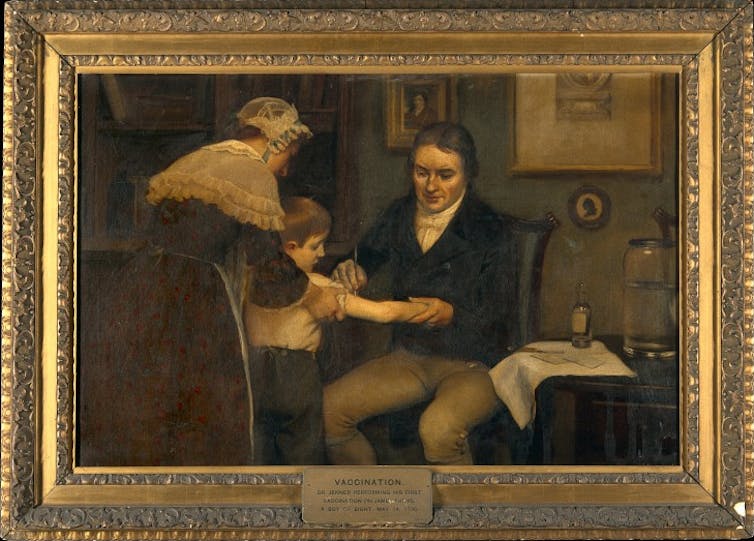
Drug origins can be surprisingly fuzzy. Edward Jenner has for long been credited with inventing the first vaccine, for smallpox. But the principle of inoculation was already well known, and Turkish peasant women were reportedly already vaccinating people against smallpox. We do not know if it was their own idea or not.
Alexander Fleming did not invent penicillin, nor did Florey and Chain turn it into a drug that saved millions of lives. That depended on the work of many unheralded scientists in various locations, mostly in the US. Despite this, many people of my parents’ generation were genuinely aggrieved at the US “theft” of a great British medical miracle.
More recently, there would have been no Glivec, one of the world’s first precision cancer drugs, had Novartis – the company that sells it – been left to develop the drug by itself. And it makes no sense whatsoever to suggest that Glivec is Swiss, as if drugs have a nationality. Medicines are, and should be seen as, global citizens.
COVID treatments
Turning this discussion back to COVID-19, it seems likely that there will be not one but several treatments. But we cannot know when, or indeed where. Probably there will not be a single and widely applicable cure for all patients old or young, with or without existing conditions, and mildly or severely ill. Rather, there will be several products serving specific medical needs.
As for a vaccine, we cannot be certain there will be one. But if there is, shouldn’t expect it to be 100% effective and for all time. Further vaccine innovation will be necessary and we are going to need the wisdom of scientists around the world and not just those of the US, the UK and other developed countries.
Medical innovation was, and still is, largely collaborative and borderless – and it works better that way. As modern medicines get more complex and expensive, this becomes even truer. Current scientific work to develop COVID-19 vaccines, discover new medicines and repurpose existing ones benefits – and indeed requires –international collaboration.
“We invented it therefore we should get it first” arguments for priority are immoral, detrimental to innovation, and harmful to global public health. Treatment nationalism is both morally unacceptable and detrimental to innovation. For all our sakes, we must oppose it.
Graham Dutfield, Professor of International Governance, University of Leeds
This article is republished from The Conversation under a Creative Commons license. Read the original article.







