

• Advertise
  • About us
  • Terms and Conditions
  • Contact us
Saturday, December 6, 2025
Australian Times News
  • News
    • Weather
    • Sport
    • Technology
    • Business & Finance
      • Currency Zone
    • Lotto Results
      • The Lott
  • Lifestyle
    • Entertainment
    • Horoscopes
    • Health & Wellness
    • Recipes
  • Travel
  • Expat Life
  • Move to Australia
No Result
View All Result
  • News
    • Weather
    • Sport
    • Technology
    • Business & Finance
      • Currency Zone
    • Lotto Results
      • The Lott
  • Lifestyle
    • Entertainment
    • Horoscopes
    • Health & Wellness
    • Recipes
  • Travel
  • Expat Life
  • Move to Australia
No Result
View All Result
Australian Times News
No Result
View All Result
Home News

What an ocean hidden under Antarctic ice reveals about our planet’s future climate

These ice shelves buttress the continent’s massive land-based ice cap and play an important role in the assessment of future sea level rise.

The Conversation by The Conversation
01-07-2020 09:17
in News
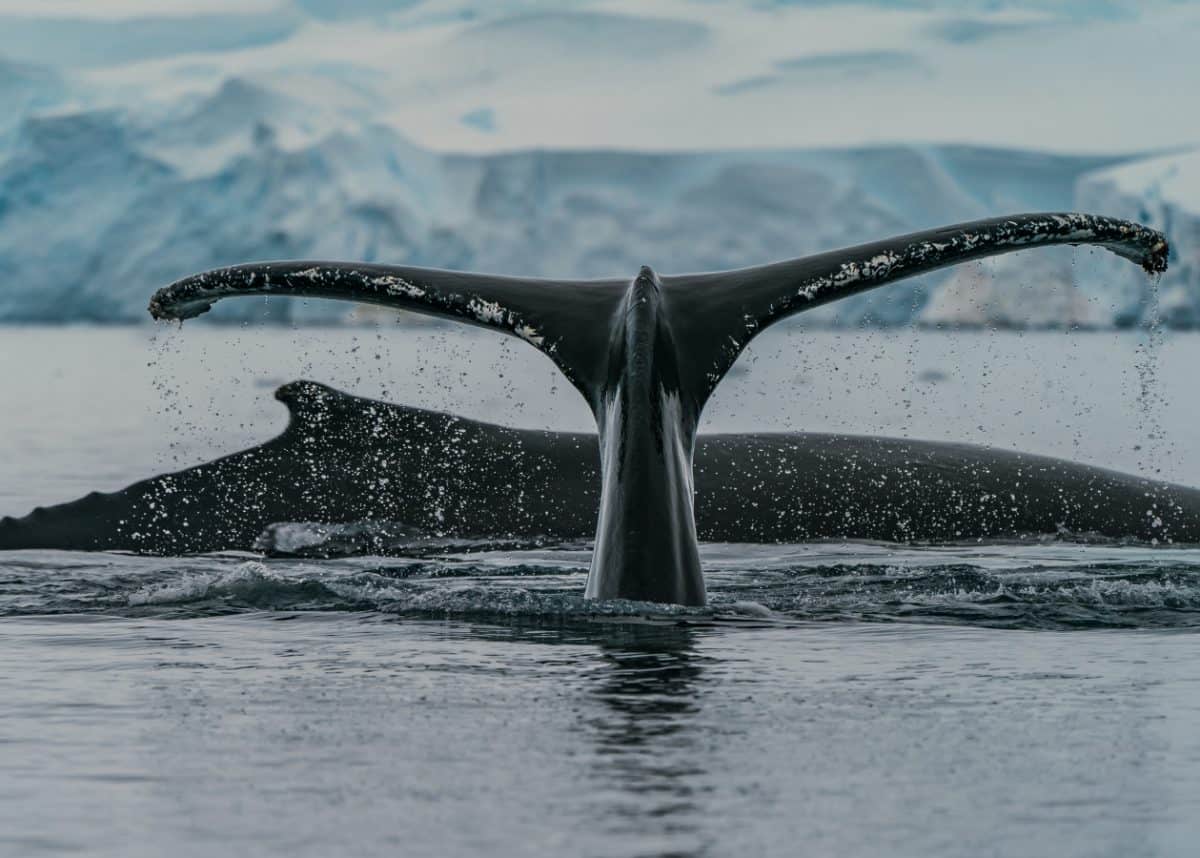
an ocean hidden under Antarctic ice

An ocean hidden under Antarctic ice Photo by Rod Long on Unsplash

Craig Stevens, National Institute of Water and Atmospheric Research and Christina Hulbe, University of Otago

Jules Verne sent his fictional submarine, the Nautilus, to the South Pole through a hidden ocean beneath a thick ice cap. Written 40 years before any explorer had reached the pole, his story was nevertheless only half fiction.
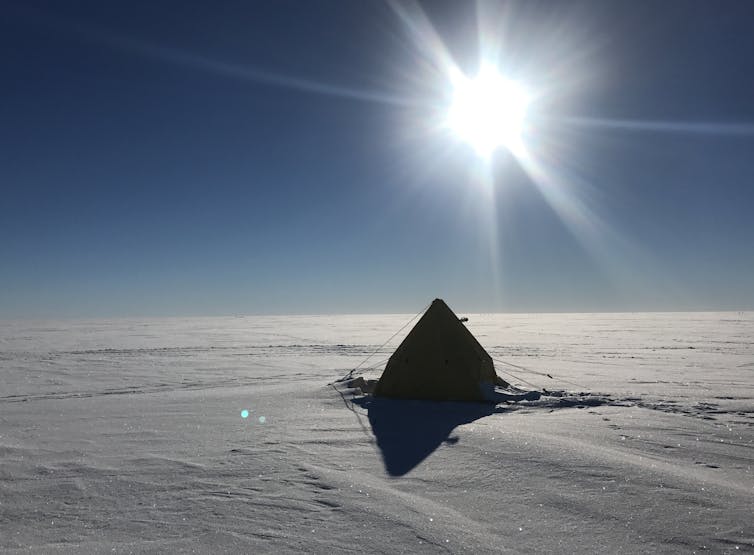
Craig Stevens, Author provided

There are indeed hidden ocean cavities around Antarctica, and our latest research explores how the ocean circulates underneath the continent’s ice shelves – large floating extensions of the ice on land that rise and fall with the tides.

These ice shelves buttress the continent’s massive land-based ice cap and play an important role in the assessment of future sea level rise. Our work sheds new light on how ocean currents contribute to melting in Antarctica, which is one of the largest uncertainties in climate model predictions.
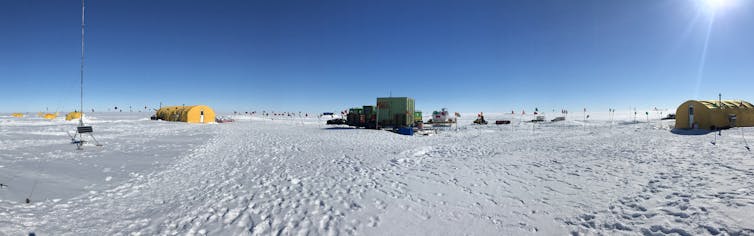
The field camp on top of the Ross Ice Shelf. Craig Stevens, Author provided

An unexplored ocean

The Ross Ice Shelf is the largest floating slab of ice on Earth, at 480,000 square kilometres. The ocean cavity it conceals extends 700km south from Antarctica’s coast and remains largely unexplored.

We know ice shelves mainly melt from below, washed by a warming ocean. But we have very little data available about how the water mixes underneath the ice. This is often overlooked in climate models, but our new measurements will help redress this.

The only other expedition to the ocean cavity underneath the central Ross Ice Shelf goes back to the 1970s and came back with intriguing results. Despite the limited technology of the time, it showed the ocean cavity was not a static bathtub. Instead, it found fine layering of water masses, with subtly different temperatures and salinities between the layers.


AlsoRead...

Ryan: Building real freedom through e-commerce

Ryan: Building real freedom through e-commerce

27 November 2025
Design Australia Group: Redefining Drafting as the engine of housing growth

Design Australia Group: Redefining Drafting as the engine of housing growth

26 November 2025

Other ocean studies have been conducted from the edges or from high above. They have provided insight into how the system works but to really understand it, we needed to take measurements directly from the ocean under hundreds of metres of ice.
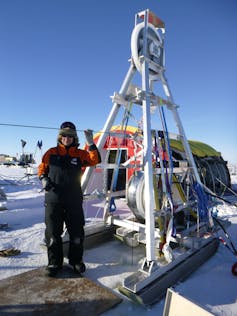
The team used a hot-water jet to drill through the ice to the ocean below. Craig Stevens, Author provided

In 2017, we used a hot-water jet, modelled on a British Antarctic Survey design, to drill through 350 metres of ice to the ocean below. We were able to keep the hole liquid long enough to make detailed ocean measurements as well as leave instruments behind to continue monitoring ocean currents and temperature. These data are still coming in via satellite.

We found the hidden ocean acts like a massive estuary with comparatively warm (2℃) seawater coming in at the seabed to cycle close to the surface in a combination of meltwater and sub-glacial freshwater squeezed out from the ice sheet and Antarctica’s hidden rocky foundation.

The hundreds of metres of ice isolate the ocean cavity from the furious winds and freezing air temperatures of Antarctica. But nothing stops the tides. Our data suggest tides push the stratified ocean back and forth past undulations on the underside of the ice and mix parts of the ocean cavity.
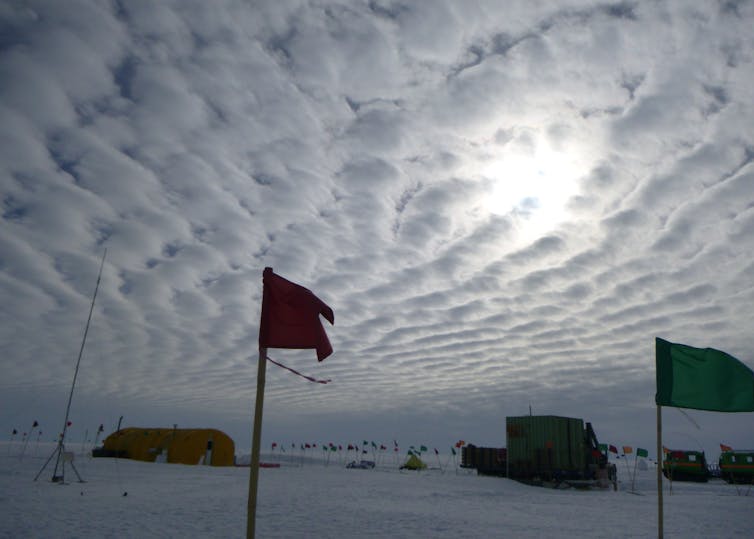
Antarctica’s ice isolates the ocean cavity from furious winds and freezing air temperatures. Craig Stevens, Author provided

Future projections

This sort of discovery is the ultimate challenge for climate science. How do we represent processes that work at daily scales in models that make projections over centuries? Our data show the daily changes can add up, so finding a solution matters.

For example, data collected outside the ocean cavity and computer models suggest that any given parcel of water spends one to six years making its way through the cavity. Our new data indicate the lower end of the range is more likely and that we should not be thinking in terms of one grand circuit anyway.

The Ross is not the ice shelf in most danger from warming oceans. But its sheer size and its relationship with the neighbouring Ross Sea means it is a vital cog in the planetary ocean system.

The importance of these ice shelves for sea level rise over the next few centuries is very apparent. Research shows that if atmospheric warming exceeds 2℃, major Antarctic ice shelves would collapse and release ice flowing from the continent’s ice cap – lifting the sea level by up to 3 metres by 2300.

What is less well understood, but also potentially a massive agent for change, is the impact of meltwater on the global thermohaline circulation, an oceanic transport loop that sees the ocean cycle from the abyss off the coast of Antarctica to tropical surface waters every 1,000 years or so.

Antarctic ice shelves are like a pit stop in this loop and so what happens in Antarctica resonates globally. Faster melting ice shelves will change the ocean stratification, with repercussions for global ocean circulation – and one result of this appears to be greater climate variability.

Craig Stevens, Associate Professor in Ocean Physics, National Institute of Water and Atmospheric Research and Christina Hulbe, Professor and Dean of the School of Surveying (glaciology specialisation), University of Otago

This article is republished from The Conversation under a Creative Commons license. Read the original article.


Tags: SB001
DMCA.com Protection Status

SUBSCRIBE to our NEWSLETTER

[mc4wp_form id=”2384248″]

Don't Miss

The evolution of Aesthetic Surgery through the lens of Dr Kourosh Tavakoli

by Pauline Torongo
4 December 2025
The evolution of Aesthetic Surgery through the lens of Dr. Kourosh Tavakoli
Health & Wellness

As global interest in Australian cosmetic surgery continues to grow, the combination of regulation, research and emerging digital tools is...

Read moreDetails

Ryan: Building real freedom through e-commerce

by Pauline Torongo
27 November 2025
Ryan: Building real freedom through e-commerce
Business & Finance

Ryan’s greatest achievement isn’t any single business or revenue milestone — it’s the ecosystem he’s built through the Change community.

Read moreDetails

Design Australia Group: Redefining Drafting as the engine of housing growth

by Pauline Torongo
26 November 2025
Design Australia Group: Redefining Drafting as the engine of housing growth
Business & Finance

Australia is under pressure to build homes faster, but design bottlenecks slow progress. Design Australia Group is fixing this by...

Read moreDetails

Louis Guy Detata builds Global Trading Empires through autonomous systems and disciplined leadership

by Pauline Torongo
25 November 2025
Louis Guy Detata builds Global Trading Empires through autonomous systems and disciplined leadership
Business & Finance

The path from investment banking to leading a global trading platform has taught Louis Detata that sustainable success requires more...

Read moreDetails

Burning Eucalyptus Wood: Tips, Advantages, Disadvantages & Alternatives

by Fazila Olla-Logday
20 November 2025
Image Supplied
Enviroment

Learn about burning eucalyptus wood for stoves and fireplaces. Discover benefits, drawbacks, harvesting tips, and better alternative firewood options for...

Read moreDetails

Everything Parents Need to Know About Baby Soft Play and Why It’s a Game Changer

by Fazila Olla-Logday
11 November 2025
Everything Parents Need to Know About Baby Soft Play
Health & Wellness

Baby soft play is a fun, safe, and educational way for little ones to explore and grow. Discover the benefits...

Read moreDetails

WOMAD Sets Up a New Camp in Wiltshire – Australian festival fans take note!

by Kris Griffiths
11 November 2025
Kumbia Boruka brought their reggae and dancehall flavour to the Taste the World Stage at WOMAD 2024 - Credit - Mike Massaro
Entertainment

With its 2026 edition moving to Neston Park in England, WOMAD offers Aussie music lovers a chance to reconnect with global...

Read moreDetails
Load More

Copyright © Blue Sky Publications Ltd. All Rights Reserved.
australiantimes.co.uk is a division of Blue Sky Publications Ltd. Reproduction without permission prohibited. DMCA.com Protection Status

  • About us
  • Write for Us
  • Advertise
  • Contact us
  • T&Cs, Privacy and GDPR
No Result
View All Result
  • News
    • Weather
    • Sport
    • Technology
    • Business & Finance
      • Currency Zone
    • Lotto Results
      • The Lott
  • Lifestyle
    • Entertainment
    • Horoscopes
    • Health & Wellness
    • Recipes
  • Travel
  • Expat Life
  • Move to Australia

Copyright © Blue Sky Publications Ltd. All Rights Reserved.
australiantimes.co.uk is a division of Blue Sky Publications Ltd. Reproduction without permission prohibited. DMCA.com Protection Status

No Result
View All Result
  • News
    • Weather
    • Sport
    • Technology
    • Business & Finance
      • Currency Zone
    • Lotto Results
      • The Lott
  • Lifestyle
    • Entertainment
    • Horoscopes
    • Health & Wellness
    • Recipes
  • Travel
  • Expat Life
  • Move to Australia

Copyright © Blue Sky Publications Ltd. All Rights Reserved.
australiantimes.co.uk is a division of Blue Sky Publications Ltd. Reproduction without permission prohibited. DMCA.com Protection Status





