


• Advertise
  • About us
  • Terms and Conditions
  • Contact us
Monday, March 23, 2026
Australian Times News
  • News
    • Weather
    • Sport
    • Technology
    • Business & Finance
      • Currency Zone
    • Lotto Results
      • The Lott
  • Lifestyle
    • Entertainment
    • Horoscopes
    • Health & Wellness
    • Recipes
  • Travel
  • Expat Life
  • Move to Australia
No Result
View All Result
  • News
    • Weather
    • Sport
    • Technology
    • Business & Finance
      • Currency Zone
    • Lotto Results
      • The Lott
  • Lifestyle
    • Entertainment
    • Horoscopes
    • Health & Wellness
    • Recipes
  • Travel
  • Expat Life
  • Move to Australia
No Result
View All Result
Australian Times News
No Result
View All Result
Home News

Planting non-native trees accelerates the release of carbon back into the atmosphere

But there is ongoing debate about whether to prioritise native or non-native plants.

The Conversation by The Conversation
17-06-2020 01:45
in News
Planting non-native trees

Planting non-native trees Photo by Devi Puspita Amartha Yahya on Unsplash

Lauren Waller and Warwick Allen, University of Canterbury

Large-scale reforestation projects such as New Zealand’s One Billion Trees programme are underway in many countries to help sequester carbon from the atmosphere.

But there is ongoing debate about whether to prioritise native or non-native plants to fight climate change. As our recent research shows, non-native plants often grow faster compared to native plants, but they also decompose faster and this helps to accelerate the release of 150% more carbon dioxide from the soil.
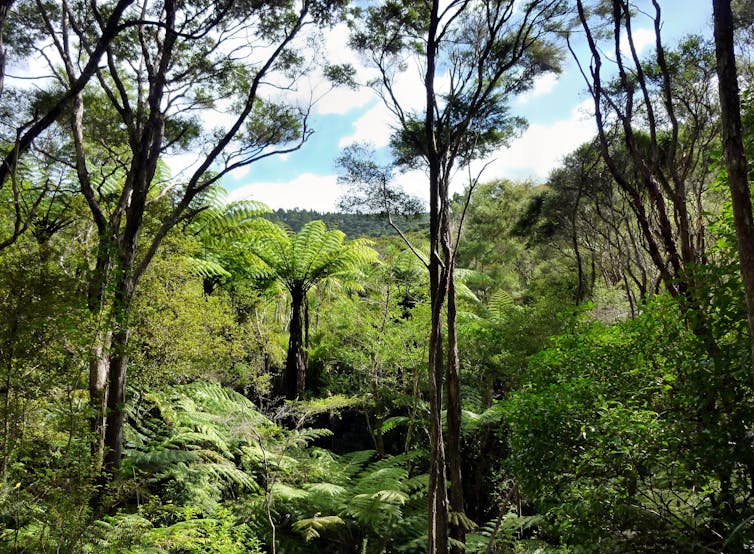
native forest.

Our results highlight a challenging gap in our understanding of carbon cycling in newly planted or regenerating forests.

It is relatively easy to measure plant biomass (how quickly a plant grows) and to estimate how much carbon dioxide it has removed from the atmosphere. But measuring carbon release is more difficult because it involves complex interactions between the plant, plant-eating insects and soil microorganisms.

This lack of an integrated carbon cycling model that includes species interactions makes predictions for carbon budgeting exceedingly difficult.

How non-native plants change the carbon cycle

There is uncertainty in our climate forecasting because we don’t fully understand how the factors that influence carbon cycling – the process in which carbon is both accumulated and lost by plants and soils – differ across ecosystems.


AlsoRead...

Design Without Compromise: Where Gutter Protection Meets Modern Architecture

Design Without Compromise: Where Gutter Protection Meets Modern Architecture

20 March 2026
The Rise of This Lead Generation Workshop Across Australia

The Rise of This Lead Generation Workshop Across Australia

13 February 2026

Carbon sequestration projects typically use fast-growing plant species that accumulate carbon in their tissues rapidly. Few projects focus on what goes on in the soil.

Non-native plants often accelerate carbon cycling. They usually have less dense tissues and can grow and incorporate carbon into their tissues faster than native plants. But they also decompose more readily, increasing carbon release back to the atmosphere.

Our research, recently published in the journal Science, shows that when non-native plants arrive in a new place, they establish new interactions with soil organisms. So far, research has mostly focused on how this resetting of interactions with soil microorganisms, herbivorous insects and other organisms helps exotic plants to invade a new place quickly, often overwhelming native species.

Invasive non-native plants have already become a major problem worldwide, and are changing the composition and function of entire ecosystems. But it is less clear how the interactions of invasive non-native plants with other organisms affect carbon cycling.

Planting non-native trees releases more carbon

We established 160 experimental plant communities, with different combinations of native and non-native plants. We collected and reared herbivorous insects and created identical mixtures which we added to half of the plots.

We also cultured soil microorganisms to create two different soils that we split across the plant communities. One soil contained microorganisms familiar to the plants and another was unfamiliar.

Herbivorous insects and soil microorganisms feed on live and decaying plant tissue. Their ability to grow depends on the nutritional quality of that food. We found that non-native plants provided a better food source for herbivores compared with native plants – and that resulted in more plant-eating insects in communities dominated by non-native plants.

Similarly, exotic plants also raised the abundance of soil microorganisms involved in the rapid decomposition of plant material. This synergy of multiple organisms and interactions (fast-growing plants with less dense tissues, high herbivore abundance, and increased decomposition by soil microorganisms) means that more of the plant carbon is released back into the atmosphere.

In a practical sense, these soil treatments (soils with microorganisms familiar vs. unfamiliar to the plants) mimic the difference between reforestation (replanting an area) and afforestation (planting trees to create a new forest).

Reforested areas are typically replanted with native species that occurred there before, whereas afforested areas are planted with new species. Our results suggest planting non-native trees into soils with microorganisms they have never encountered (in other words, afforestation with non-native plants) may lead to more rapid release of carbon and undermine the effort to mitigate climate change.

Lauren Waller, Postdoctoral Fellow and Warwick Allen, Postdoctoral fellow, University of Canterbury

This article is republished from The Conversation under a Creative Commons license. Read the original article.


Tags: SB001
DMCA.com Protection Status

SUBSCRIBE to our NEWSLETTER

[mc4wp_form id=”2384248″]

Don't Miss

Design Without Compromise: Where Gutter Protection Meets Modern Architecture

by Fazila Olla-Logday
20 March 2026
Design Without Compromise: Where Gutter Protection Meets Modern Architecture
Business & Finance

Design without compromise by integrating gutter protection seamlessly into modern architecture. Discover how innovative gutter systems enhance your home’s aesthetics...

Read moreDetails

How WageSafe Secured Australia’s Most Reputable Retail Business Among Its Premium Clients

by Fazila Olla-Logday
12 March 2026
How WageSafe Secured Australia’s Most Reputable Retail Business Among Its Premium Clients
at

Learn how WageSafe helps businesses stay compliant with payroll and wage regulations through reliable monitoring, risk management, and expert support—protecting...

Read moreDetails

Zakeke AI Agent Studio Removes the E-Commerce Content Bottleneck With Outputs in Seconds

by Fazila Olla-Logday
3 March 2026
Zakeke AI Agent Studio Removes the E-Commerce Content Bottleneck With Outputs in Seconds
at

Zakeke AI Agent Studio removes the e-commerce content bottleneck by generating product content and visuals in seconds, enabling brands to...

Read moreDetails

Empire Traveller launches to give Small and Medium Businesses Enterprise-Level Travel rates

by Pauline Torongo
20 February 2026
Empire Traveller launches to give Small and Medium Businesses Enterprise-Level Travel rates
Travel

Empire Traveller suggests the travel sector may be entering a more inclusive phase — one where advantage is shaped less...

Read moreDetails

Is Feng Shui Master Xu Really A Modern Genius?

by Fazila Olla-Logday
19 February 2026
Is Feng Shui Master Xu Really A Modern Genius?
at

Is Feng Shui Master Xu truly a modern genius, or simply a master of timeless wisdom? Blending ancient Feng Shui...

Read moreDetails

The Rise of This Lead Generation Workshop Across Australia

by Pauline Torongo
13 February 2026
The Rise of This Lead Generation Workshop Across Australia
Business & Finance

“Where U?”, is a two-day in-person lead generation workshop that teaches Australian business owners how to build their own acquisition...

Read moreDetails

Lyca Mobile Australia’s Customer-First Overhaul Pays Off with Finder Award Win

by Fazila Olla-Logday
2 February 2026
Lyca Mobile Australia's Customer-First Overhaul Pays Off with Finder Award Win
Technology

Lyca Mobile Australia’s customer-first overhaul has earned a Finder Award, recognising its improved value, service, and stronger focus on Australian...

Read moreDetails
Load More

Copyright © Blue Sky Publications Ltd. All Rights Reserved.
australiantimes.co.uk is a division of Blue Sky Publications Ltd. Reproduction without permission prohibited. DMCA.com Protection Status

  • About us
  • Write for Us
  • Advertise
  • Contact us
  • T&Cs, Privacy and GDPR
No Result
View All Result
  • News
    • Weather
    • Sport
    • Technology
    • Business & Finance
      • Currency Zone
    • Lotto Results
      • The Lott
  • Lifestyle
    • Entertainment
    • Horoscopes
    • Health & Wellness
    • Recipes
  • Travel
  • Expat Life
  • Move to Australia

Copyright © Blue Sky Publications Ltd. All Rights Reserved.
australiantimes.co.uk is a division of Blue Sky Publications Ltd. Reproduction without permission prohibited. DMCA.com Protection Status

No Result
View All Result
  • News
    • Weather
    • Sport
    • Technology
    • Business & Finance
      • Currency Zone
    • Lotto Results
      • The Lott
  • Lifestyle
    • Entertainment
    • Horoscopes
    • Health & Wellness
    • Recipes
  • Travel
  • Expat Life
  • Move to Australia

Copyright © Blue Sky Publications Ltd. All Rights Reserved.
australiantimes.co.uk is a division of Blue Sky Publications Ltd. Reproduction without permission prohibited. DMCA.com Protection Status





