


• Advertise
  • About us
  • Terms and Conditions
  • Contact us
Saturday, September 26, 2026
Australian Times News
  • News
    • Weather
    • Sport
    • Technology
    • Business & Finance
      • Currency Zone
    • Lotto Results
      • The Lott
  • Lifestyle
    • Entertainment
    • Horoscopes
    • Health & Wellness
    • Recipes
  • Travel
  • Expat Life
  • Move to Australia
No Result
View All Result
  • News
    • Weather
    • Sport
    • Technology
    • Business & Finance
      • Currency Zone
    • Lotto Results
      • The Lott
  • Lifestyle
    • Entertainment
    • Horoscopes
    • Health & Wellness
    • Recipes
  • Travel
  • Expat Life
  • Move to Australia
No Result
View All Result
Australian Times News
No Result
View All Result
Home News

Australia’s first service sector recession will be unlike those that have gone before it

Australia is on the brink of its first recession in almost 30 years

The Conversation by The Conversation
01-06-2020 09:17
in News
Australia’s first service sector recession

Australia’s first service sector recession

Isaac Gross, Monash University

Australia is on the brink of its first recession in almost 30 years.

The Australian Bureau of Statistics will deliver the official economic growth figure for the March quarter on Wednesday.

If it is negative (as is likely because of the downturn and the bushfires, but not guaranteed because of the surge in spending as Australians stocked up on essentials in March) and is then followed by another negative result in the June quarter (which is all but certain) Australia will be in what some people regard as a technical recession.

Shutterstock

But the technicalities don’t matter. Close to 20% of Australia’s labour force is either unemployed or underemployed, something that dwarfs previous recessions.

Data already released suggests it will be different in other ways; important ones with important implications.

It will be our first “service sector” recession.

AlsoRead...

How supporting Australia’s Care Workforce could strengthen care in the community

How supporting Australia’s Care Workforce could strengthen care in the community

10 September 2026
What HR Must Champion Next, According to Energy Collective Co

The Future of Work Is Changing: What HR must champion next, according to Energy Collective Co

28 August 2026

Recessions are usually defined by large falls in investment; in new cars, new houses and new businesses.

As a result, in the early 1990s recession construction and manufacturing businesses were devastated. By contrast, employment in social services, education and food services continued to grow throughout the recession.

This time will be different.

Between March 14 and May 2 some 27% of the jobs in the accommodation and food services industry vanished, 19% of the jobs in the arts and recreation industry, and 11% of the jobs in professional and technical services – all well above the 6.5% and 7% of jobs lost in construction and manufacturing.


Jobs lost by industry, March 14 to May 2 ,
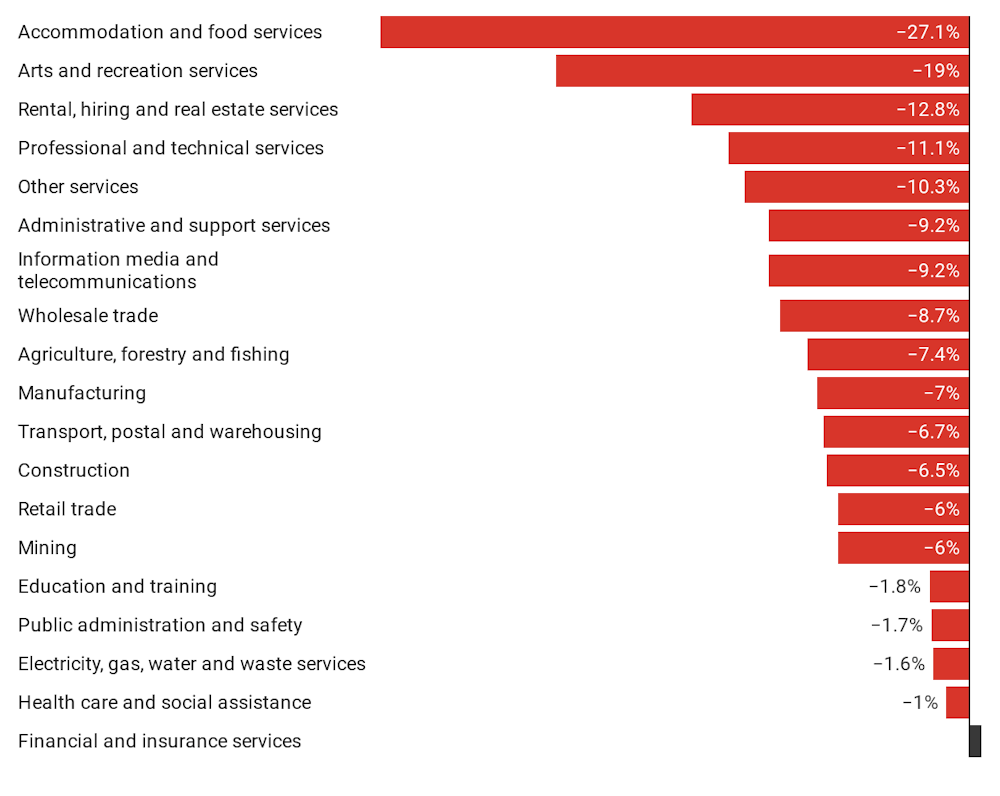
6160.0.55.001 – Weekly Payroll Jobs and Wages in Australia, Week ending 2 May 2020

The closure of Australia’s borders coupled with the ongoing fear of infection, creates the risk that service sector job losses will continue to grow.

Even when the recession is over, they won’t bounce back in the way that manufacturing and construction jobs might have.

When previous recession temporarily slowed demand for things such as cars and buildings, the pent-up demand led to a surge in sales when incomes recovered.

But services are harder to store over time. Someone who skips the hairdresser for a year won’t buy a year’s worth of haircuts when conditions improve.

Nor will someone who stops going to pubs (probably) buy six months worth of drinks when pubs reopen.

It means most service sector businesses can’t expect a quick rebound. Four out of every five employed Australians work in services.

Not your grandparent’s recession

The usual playbook for dealing with a recession is to target the sectors most affected. This has meant rolling out big infrastructure projects that can hire newly-unemployed construction workers, and cutting taxes to encourage businesses to expand and hire.

But that strategy won’t be as effective this time. The tour guides and massage therapists whose service sector jobs have been destroyed are ill-suited to building high-speed trains.

And a lot of infrastructure programs are designed on the basis that Australia’s population would continue to expand. With almost two thirds of Australia’s population growth driven by overseas migration and borders now closed, that is no longer certain. Many projects that were previously considered worthwhile may no longer stack up.

The government will have to focus its recovery programs on those sectors hardest hit. For some, this will be straightforward.

The government already plays a large role in the education industry. Universities could have their funding boosted to make up for the shortfall of international students, and domestic students should be encouraged to enrol in virtual courses to improve their skills.

For some other service industries, the government should extend JobKeeper to provide continuing assistance after it is due to end in September. Social distancing requirements are likely to limit the operations of businesses such as cinemas and theatres some time. Tourism will also remain depressed as long as our borders remains closed.

Despite the focus on mining and manufacturing in our economic discourse, Australia’s economy is overwhelmingly dominated by services.

If the government wants to stop this recession from turning into a depression, it will have to redirect its policy playbook toward services.

Isaac Gross, Lecturer, Monash University

This article is republished from The Conversation under a Creative Commons license. Read the original article.


Tags: SB001
DMCA.com Protection Status

SUBSCRIBE to our NEWSLETTER

[mc4wp_form id=”2384248″]

Don't Miss

How supporting Australia’s Care Workforce could strengthen care in the community

by Pauline Torongo
10 September 2026
How supporting Australia’s Care Workforce could strengthen care in the community
News

Australian care funding faces growing scrutiny after a 2025 ANAO report found NDIS losses from fraud, non-compliance, and payment errors...

Read moreDetails

The Future of Work Is Changing: What HR must champion next, according to Energy Collective Co

by Pauline Torongo
28 August 2026
What HR Must Champion Next, According to Energy Collective Co
Business & Finance

Energy Collective Co examines the root causes of performance by considering how work is designed, how leadership is enacted and...

Read moreDetails

From Empathy Burnout to Body-Led Recovery: What Heidi Jane of Intuition Co. learned by living through what she teaches

by Pauline Torongo
25 August 2026
What Heidi Jane of Intuition Co. learned by living through what she teaches
Lifestyle

Recognising emotional exhaustion is only the first step. While supportive habits such as rest, time in nature, hydration, and reduced...

Read moreDetails

Why Smarter Fleet Management Is For All Modern Business Options

by Fazila Olla-Logday
29 July 2026
Smarter Fleet Management
Motoring

Operating a business that relies on vehicles is harder than ever.

Read moreDetails

Animal Communication Goes Beyond What Science Can Currently Measure: Zoologist and Spiritual teacher Artemis, the heart whisperer on what the textbooks don’t teach

by Australian Times
7 July 2026
Animal Communication Goes Beyond What Science Can Currently Measure
Lifestyle

Animal communication classes and formal training can be valuable, providing tools, structure, and guidance.

Read moreDetails

Managing Aussie Share Portfolios Abroad: Tips for Growth

by Fazila Olla-Logday
2 July 2026
Managing Aussie Share Portfolios Abroad: Tips for Growth
at

Unlock the secrets to optimizing your Aussie share portfolios abroad. Discover essential tips for growth and navigate the global market...

Read moreDetails

The New Meaning of Luxury: Lessons from Entrepreneur Chloe Hardy

by Pauline Torongo
2 July 2026
The New Meaning of Luxury: Lessons from Entrepreneur Chloe Hardy
Business & Finance

Chloe Hardy, the founder and CEO of Dupes & Co established an Australian-made beauty brand focused on affordability and product...

Read moreDetails
Load More

Copyright © Blue Sky Publications Ltd. All Rights Reserved.
australiantimes.co.uk is a division of Blue Sky Publications Ltd. Reproduction without permission prohibited. DMCA.com Protection Status

  • About us
  • Write for Us
  • Advertise
  • Contact us
  • T&Cs, Privacy and GDPR
No Result
View All Result
  • News
    • Weather
    • Sport
    • Technology
    • Business & Finance
      • Currency Zone
    • Lotto Results
      • The Lott
  • Lifestyle
    • Entertainment
    • Horoscopes
    • Health & Wellness
    • Recipes
  • Travel
  • Expat Life
  • Move to Australia

Copyright © Blue Sky Publications Ltd. All Rights Reserved.
australiantimes.co.uk is a division of Blue Sky Publications Ltd. Reproduction without permission prohibited. DMCA.com Protection Status

No Result
View All Result
  • News
    • Weather
    • Sport
    • Technology
    • Business & Finance
      • Currency Zone
    • Lotto Results
      • The Lott
  • Lifestyle
    • Entertainment
    • Horoscopes
    • Health & Wellness
    • Recipes
  • Travel
  • Expat Life
  • Move to Australia

Copyright © Blue Sky Publications Ltd. All Rights Reserved.
australiantimes.co.uk is a division of Blue Sky Publications Ltd. Reproduction without permission prohibited. DMCA.com Protection Status






