


• Advertise
  • About us
  • Terms and Conditions
  • Contact us
Friday, December 5, 2025
Australian Times News
  • News
    • Weather
    • Sport
    • Technology
    • Business & Finance
      • Currency Zone
    • Lotto Results
      • The Lott
  • Lifestyle
    • Entertainment
    • Horoscopes
    • Health & Wellness
    • Recipes
  • Travel
  • Expat Life
  • Move to Australia
No Result
View All Result
  • News
    • Weather
    • Sport
    • Technology
    • Business & Finance
      • Currency Zone
    • Lotto Results
      • The Lott
  • Lifestyle
    • Entertainment
    • Horoscopes
    • Health & Wellness
    • Recipes
  • Travel
  • Expat Life
  • Move to Australia
No Result
View All Result
Australian Times News
No Result
View All Result
Home Technology

Internet traffic is growing 25% each year. We created a fingernail-sized chip that can help the NBN keep up

Our internet connections have never been more important to us, nor have they been under such strain

The Conversation by The Conversation
23-05-2020 18:13
in Technology
Growing internet traffic

Growing internet traffic Image by Pete Linforth from Pixabay

Bill Corcoran, Monash University

As the COVID-19 pandemic has made remote working, remote socialisation, and online entertainment the norm, we have seen an unprecedented spike in society’s demand for data.

Singapore’s prime minister declared broadband to be essential infrastructure. The European Union asked streaming services to limit their traffic. Video conferencing service Zoom was suddenly unavoidable. Even my parents have grown used to reading to my four-year-old over Skype.
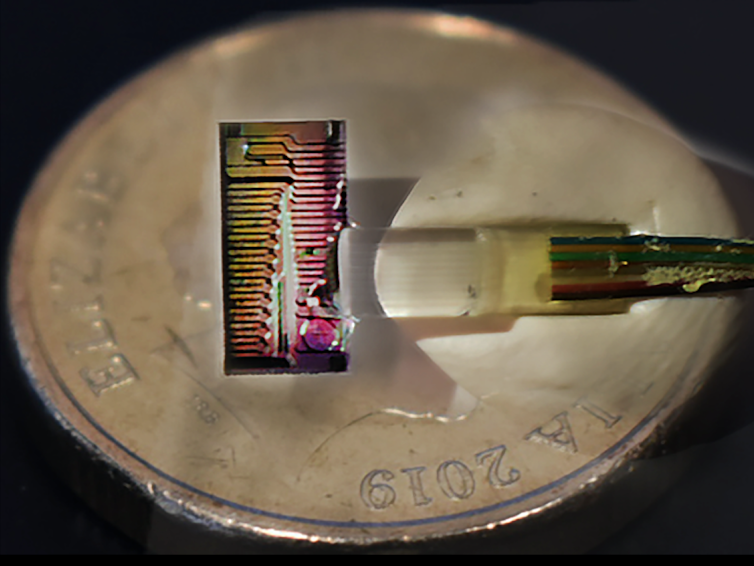
This tiny micro-comb chip produces a precision rainbow of light that can support transmission of 40 terabits of data per second in standard optic fibres. Corcoran et al., N.Comms., 2020, CC BY-SA

In Australia telecommunications companies have supported this growth, with Telstra removing data caps on users and the National Broadband Network (NBN) enabling ISPs to expand their network capacity. In fact, the NBN saw its highest ever peak capacity of 13.8 terabits per second (or Tbps) on April 8 this year. A terabit is one trillion bits, and 1 Tbps is the equivalent of about 40,000 standard NBN connections.

This has given us a glimpse of the capacity crunch we could be facing in the near future, as high-speed 5G wireless connections, self-driving cars and the internet of things put more stress on our networks. Internet traffic is growing by 25% each year as society becomes increasingly connected.

We need new technological solutions to expand data infrastructure, without breaking the bank. The key to this is making devices that can transmit and receive massive amounts of data using the optical fibre infrastructure we have already spent time and money putting into the ground.

A high-speed rainbow

Fortunately, such a device is at hand. My colleagues and I have demonstrated a new fingernail-sized chip that can transmit data at 40 Tbps through a single optical fibre connection of the same kind used in the NBN. That’s about three times the record data rate for the entire NBN network and about 100 times the speed of any single device currently used in Australian fibre networks.


AlsoRead...

Common Mistakes When Buying a Telescope

Common Mistakes When Buying a Telescope — And How to Avoid Them

1 July 2025
Leading with Trust: Why Quality still wins in the AI Era

Leading with Trust: Why Quality still wins in the AI Era

5 June 2025

The chip uses an “optical micro-comb” to create a rainbow of infrared light that allows data to be transmitted with many frequencies of light at the same time. Our results are published in Nature Communications today.

This collaboration, between Monash, RMIT and Swinburne universities in Melbourne, and international partners (INRS, CIOPM Xi’an, CityU Hong Kong), is the first “field-trial” of an optical micro-comb system, and a record capacity for such a device.

The internet runs on light

Optical fibres have formed the backbone of our communication systems since the late 1980s. The fibres that link the world together carry light signals that are periodically boosted by optical amplifiers which can transmit light with a huge range of wavelengths.

To make the most of this range of wavelengths, different information is sent using signals of different infrared “colours” of light. If you’ve ever seen a prism split up white light into separate colours, you’ve got an insight into how this works – we can add a bunch of these colours together, send the combined signal through a single optical fibre, then split it back up again into the original colours at the other end.

Making powerful rainbows from tiny chips

Optical micro-combs are tiny gadgets that in essence use a single laser, a temperature-controlled chip, and a tiny ring called an optical resonator to send out signals using many different wavelengths of light.

(left) Micrograph of the optical ring resonator on the chip. Launching light from a single laser into this chip generates over 100 new laser lines (right). We use 80 lines in the optical C-band (right, green shaded) for our communications system demonstration. Corcoran et al, N.Comms, 2020

Optical combs have had a major impact on a massive range of research in optics and photonics. Optical micro–combs are miniature devices that can produce optical combs, and have been used in a wide range of exciting demonstrations, including optical communications.

The key to micro-combs are optical resonator structures, tiny rings (see picture above) that when hit with enough light convert the incoming single wavelength into a precise rainbow of wavelengths.

The demonstration
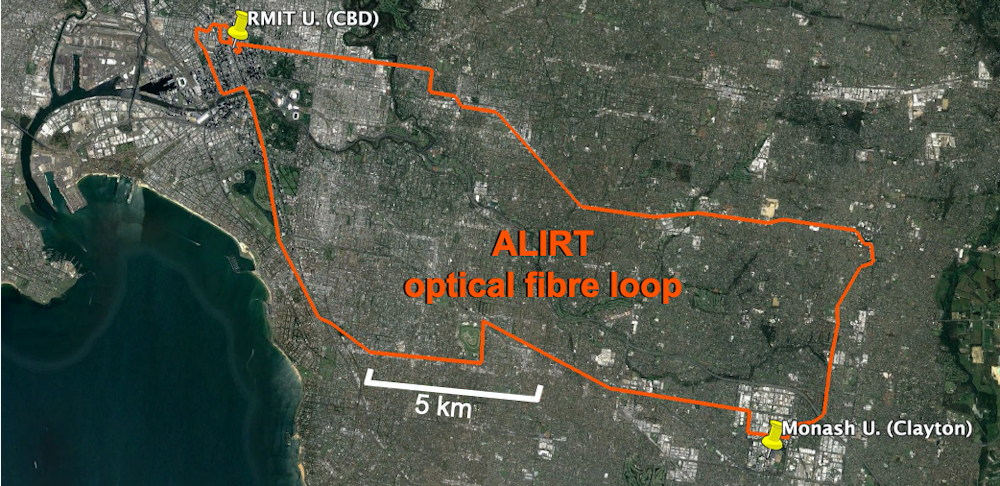
The test was carried out on a 75-km optical fibre loop in Melbourne.

For our demonstration transmitting data at 40 Tbps, we used a novel kind of micro-comb called a “soliton crystal” that produces 80 separate wavelengths of light that can carry different signals at the same time. To prove the micro-comb could be used in a real-world environment, we transmitted the data through installed optical fibres in Melbourne (provided by AARNet) between RMIT’s City campus and Monash’s Clayton campus and back, for a round trip of 75 kilometres.

This shows that the optical fibres we have in the ground today can handle huge capacity growth, simply by changing what we plug into those fibres.

What’s next?

There is more work to do! Monash and RMIT are working together to make the micro-comb devices more flexible and simpler to run.

Putting not only the micro-comb, but also the modulators that turn an electrical signal into an optical signal, on a single chip is a tremendous technical challenge.

There are new frontiers of optical communications to explore with these micro-combs, looking at using parallel paths in space, improving data rates for satellite communications, and in making “light that thinks”: artificial optical neural networks. The future is bright for these tiny rainbows.


We gratefully acknowledge support from Australia’s Academic Research Network (AARNet) for supporting our access to the field-trial cabling through the Australian Lightwave Infrastructure Research Testbed (ALIRT), and in particular Tim Rayner, John Nicholls, Anna Van, Jodie O’Donohoe and Stuart Robinson.

Bill Corcoran, Lecturer & Research Fellow, Monash Photonic Communications Lab & InPAC, Monash University

This article is republished from The Conversation under a Creative Commons license. Read the original article.


Tags: SB001
DMCA.com Protection Status

SUBSCRIBE to our NEWSLETTER

[mc4wp_form id=”2384248″]

Don't Miss

The evolution of Aesthetic Surgery through the lens of Dr Kourosh Tavakoli

by Pauline Torongo
4 December 2025
The evolution of Aesthetic Surgery through the lens of Dr. Kourosh Tavakoli
Health & Wellness

As global interest in Australian cosmetic surgery continues to grow, the combination of regulation, research and emerging digital tools is...

Read moreDetails

Ryan: Building real freedom through e-commerce

by Pauline Torongo
27 November 2025
Ryan: Building real freedom through e-commerce
Business & Finance

Ryan’s greatest achievement isn’t any single business or revenue milestone — it’s the ecosystem he’s built through the Change community.

Read moreDetails

Design Australia Group: Redefining Drafting as the engine of housing growth

by Pauline Torongo
26 November 2025
Design Australia Group: Redefining Drafting as the engine of housing growth
Business & Finance

Australia is under pressure to build homes faster, but design bottlenecks slow progress. Design Australia Group is fixing this by...

Read moreDetails

Louis Guy Detata builds Global Trading Empires through autonomous systems and disciplined leadership

by Pauline Torongo
25 November 2025
Louis Guy Detata builds Global Trading Empires through autonomous systems and disciplined leadership
Business & Finance

The path from investment banking to leading a global trading platform has taught Louis Detata that sustainable success requires more...

Read moreDetails

Burning Eucalyptus Wood: Tips, Advantages, Disadvantages & Alternatives

by Fazila Olla-Logday
20 November 2025
Image Supplied
Enviroment

Learn about burning eucalyptus wood for stoves and fireplaces. Discover benefits, drawbacks, harvesting tips, and better alternative firewood options for...

Read moreDetails

Everything Parents Need to Know About Baby Soft Play and Why It’s a Game Changer

by Fazila Olla-Logday
11 November 2025
Everything Parents Need to Know About Baby Soft Play
Health & Wellness

Baby soft play is a fun, safe, and educational way for little ones to explore and grow. Discover the benefits...

Read moreDetails

WOMAD Sets Up a New Camp in Wiltshire – Australian festival fans take note!

by Kris Griffiths
11 November 2025
Kumbia Boruka brought their reggae and dancehall flavour to the Taste the World Stage at WOMAD 2024 - Credit - Mike Massaro
Entertainment

With its 2026 edition moving to Neston Park in England, WOMAD offers Aussie music lovers a chance to reconnect with global...

Read moreDetails
Load More

Copyright © Blue Sky Publications Ltd. All Rights Reserved.
australiantimes.co.uk is a division of Blue Sky Publications Ltd. Reproduction without permission prohibited. DMCA.com Protection Status

  • About us
  • Write for Us
  • Advertise
  • Contact us
  • T&Cs, Privacy and GDPR
No Result
View All Result
  • News
    • Weather
    • Sport
    • Technology
    • Business & Finance
      • Currency Zone
    • Lotto Results
      • The Lott
  • Lifestyle
    • Entertainment
    • Horoscopes
    • Health & Wellness
    • Recipes
  • Travel
  • Expat Life
  • Move to Australia

Copyright © Blue Sky Publications Ltd. All Rights Reserved.
australiantimes.co.uk is a division of Blue Sky Publications Ltd. Reproduction without permission prohibited. DMCA.com Protection Status

No Result
View All Result
  • News
    • Weather
    • Sport
    • Technology
    • Business & Finance
      • Currency Zone
    • Lotto Results
      • The Lott
  • Lifestyle
    • Entertainment
    • Horoscopes
    • Health & Wellness
    • Recipes
  • Travel
  • Expat Life
  • Move to Australia

Copyright © Blue Sky Publications Ltd. All Rights Reserved.
australiantimes.co.uk is a division of Blue Sky Publications Ltd. Reproduction without permission prohibited. DMCA.com Protection Status





