



Globally, women’s football fandom is on the rise, with women comprising around 40% of worldwide television audiences for the 2014 men’s football World Cup. Couple this with the growing prominence of the women’s World Cup – to be held again next year in France – and it’s clear that football mega-events are no longer just for men.
Yet, if you Google the terms “World Cup” and “women fans”, what appears is a constellation of international beauties, draped in their nation’s colours and flags – a sea of long hair, short shorts and cropped jerseys.
Why do these stereotypes about women sport fans persist and why are they so popular?
Research I conducted into online content featuring women at the last men’s World Cup in Brazil confirms that sexiness rules. My study sampled over 100 pictures from mainstream media reports and found the most popular stories and images about women focused on young and slender fans in the stands who combined sexual empowerment with national allegiance.
In many of the images, women pose provocatively for the photojournalist’s camera. Followers pout playfully with lips painted in team colours. A Brazilian fan holds up her national flag to reveal a wide smile and a sequinned bikini.
These portrayals of football fans offer examples of the new ways in which sexism in sport media works. Ideas about women as passive objects for male consumption have given way to images of women “choosing” to present themselves in sexualised ways. “Sexy fandom” is celebrated as a form of individual expression and personal style, reinforcing the wider cultural expectations for young women to present themselves in sport contexts in ways that do not threaten men’s primacy.
Despite widespread criticism of sexism in sport media, and initiatives to counter sexualised images of women sport fans, the stereotype of the sexy supporter continues to flourish. For women fans who don’t look this way, or choose not to, the cost is media invisibility.


Dominant imagery
Part of the reason for this is the way search engine algorithms rank information. Algorithms determine preferences according to users’ previous online searches, as well as the searches of users deemed demographically similar. When women are “ranked” by these algorithms according to perceived levels of attractiveness, as opposed to their sporting interest or team commitments, it sends a clear message about the way women in sporting environments are valued.
Type the words “male sport fans” into a search engine and you get a different picture. The only scantily clad bodies on show are covered in colourful body paint. The criteria for being a male sport fan in the online domain appear to have little to do with physical attractiveness.
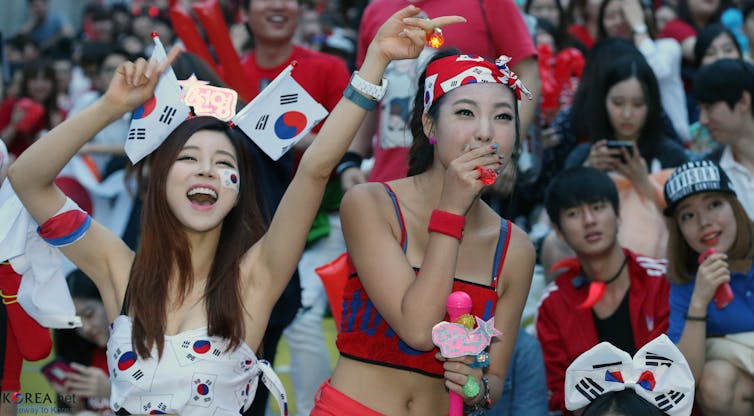
Korean Culture and Information Service/Wikimedia Commons
The gender composition of newsrooms is another factor impacting the way women fans are portrayed. Photographers and editors select which pictures of women spectators they take and make available to audiences. Increasing the number of women with decision-making power about news content can lead to a wider variety of online images of women in sport.
Stereotypes enforced by national rivalries
These media depictions of women fans as simultaneously sexy and serious about sport also serve a valuable function for global sport organisations like FIFA, which are increasingly seeking ways to boost the global market share of their events by courting women as fans and players.
In a somewhat ironic twist, these images become a form of proof that the football fraternity, known for its poor record of gender equality, is welcoming and inclusive of all types of women – even those who might not look like “typical” sport fans.
They are also used as part of the global sport spectacle to enhance the profile of the countries these women support, and to reinforce ideas of national rivalry and competition. When sexualised images of women supporters appear under news headings like “England does us proud” and “Giving their boys some Dutch courage – The fans of the Netherlands”, women’s bodies become co-opted as part of the masculine sporting competition.
The popularity of these images tell us much about enduring societal perceptions of women sport fans and the terms women are expected to meet to be visible in the male-dominated sport media. In granting visibility to women in the stands who most closely conform to the male-defined ideal, and framing women’s displays of sexiness as personal choice, the sport media does little to challenge hierarchies of gender difference in sport.
To break these stereotypes, a more diverse representation of women football fans is needed in media coverage of the World Cup – and other sport events. Newsrooms can take a cue from grassroots social media campaigns, like This Fan Girl, which is devoted to the women fans who show up week after week, in the worst of weather, to support club teams in the UK.
Then, perhaps, we can finally change the images emanating from the stands during the world’s most popular sporting event. Fewer short shorts, more diversity of fans.
________________________________________
By Kim Toffoletti, Associate Professor of Sociology, Deakin University
This article was originally published on The Conversation. Read the original article.
TOP IMAGE: Sexualised images of women persist in sport media, despite the changing demographics of fans. (By Srdjan Suki/EPA/The Conversation)







