• Advertise
  • About us
  • Terms and Conditions
  • Contact us
Friday, December 5, 2025
Australian Times News
  • News
    • Weather
    • Sport
    • Technology
    • Business & Finance
      • Currency Zone
    • Lotto Results
      • The Lott
  • Lifestyle
    • Entertainment
    • Horoscopes
    • Health & Wellness
    • Recipes
  • Travel
  • Expat Life
  • Move to Australia
No Result
View All Result
  • News
    • Weather
    • Sport
    • Technology
    • Business & Finance
      • Currency Zone
    • Lotto Results
      • The Lott
  • Lifestyle
    • Entertainment
    • Horoscopes
    • Health & Wellness
    • Recipes
  • Travel
  • Expat Life
  • Move to Australia
No Result
View All Result
Australian Times News
No Result
View All Result
Home Technology

Australian cities are quiet during lockdown. Earthquake scientists are making the most of it

Seismometers are sensitive scientific instruments used to detect earthquakes, volcanic eruptions and nuclear tests, by recording the movement of the ground.

The Conversation by The Conversation
17-07-2020 22:03
in Technology
Australian cities are quiet during lockdown

Australian cities are quiet during lockdown Photo by Andrew Buchanan on Unsplash

Meghan S. Miller, Australian National University and Louis Moresi, Australian National University

Our responses to the COVID-19 pandemic have dramatically changed human activity all over the world. People are working from home, schools are closed in many places, travel is restricted, and in some cases only essential shops and businesses are open.

Scientists see signs of these changes wherever they look. Carbon dioxide emissions are down, air quality has improved, and there is less traffic.

The drop in activity has also been a surprising boon for earthquake scientists like us. Our sensitive instruments are detecting far less of the noise and vibration produced by humans in motion — which means we have a unique opportunity to listen in on tiny earthquakes we might never have detected otherwise.

The seismic hum of humans

Seismometers are sensitive scientific instruments used to detect earthquakes, volcanic eruptions and nuclear tests, by recording the movement of the ground. They often detect mining activity and can even pick out crowds responding to football games — so-called “footyquakes”.

On top of this, everyday human activity creates a high-frequency seismic “hum” that is stronger during the day and weaker at night. This is particularly evident in urban environments, but is also observed in rural or unpopulated areas.

The decrease in this noise signature was first identified in March by Belgian scientists as lockdown measures were introduced in Europe. These early results, computer codes and data were widely shared on Twitter, sparking an enthusiastic collaboration of seismologists around the world who found this change in signal everywhere they looked.


AlsoRead...

Common Mistakes When Buying a Telescope

Common Mistakes When Buying a Telescope — And How to Avoid Them

1 July 2025
Leading with Trust: Why Quality still wins in the AI Era

Leading with Trust: Why Quality still wins in the AI Era

5 June 2025

Schoolyard sounds

In Australia, the change in human behaviour was most dramatically observed in the data recorded by the Australian Seismometers in Schools (AuSiS) network. These instruments are research-quality seismometers that are maintained by school students — our next generation of geophysicists.

The usual happy schoolyard sounds and hubbub disappeared at many schools, as they shut and most or all students stayed home. The usual hum of the children (and teachers) during the school day, observed in the movement between classrooms, and during lunchtimes or Saturday morning sports, abruptly stopped at locations such as Ulladulla High School on the south coast of New South Wales and Keysborough Secondary College in suburban Melbourne.
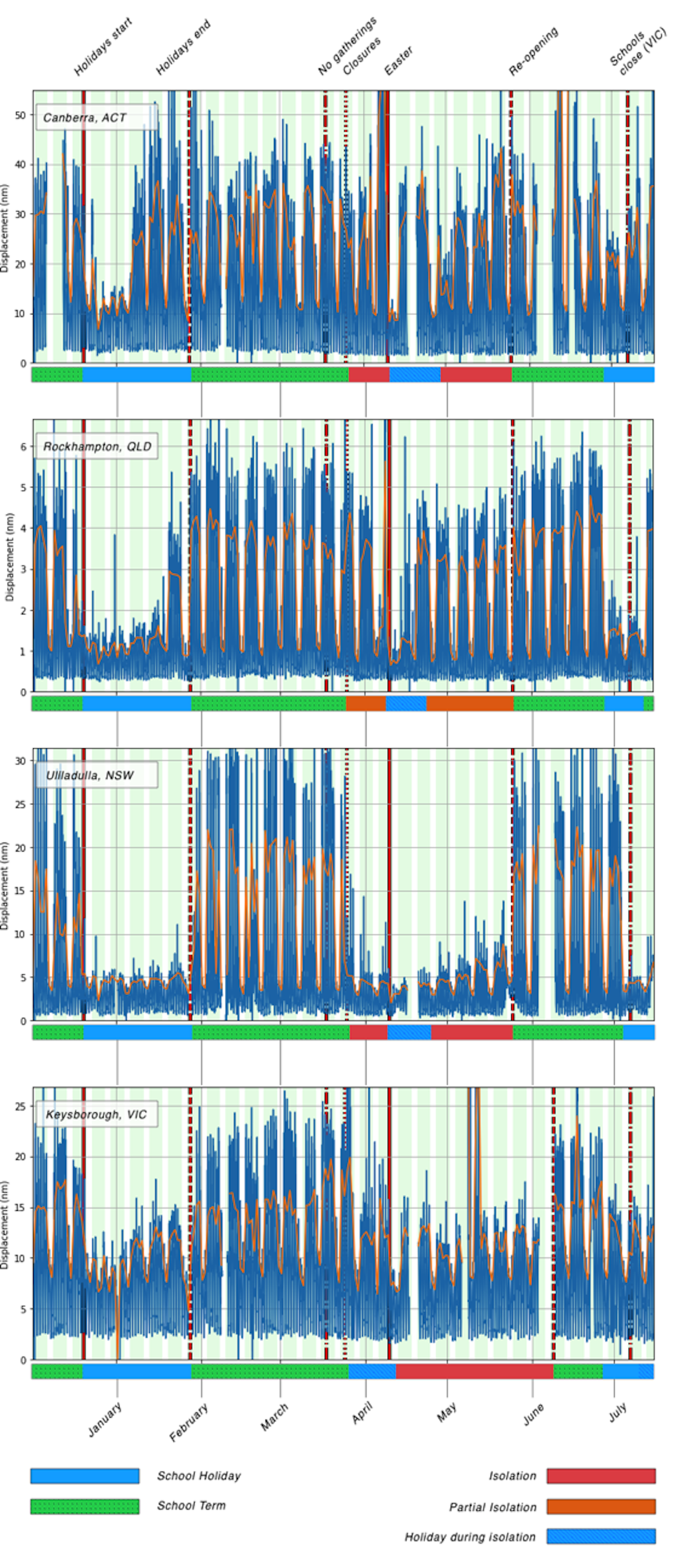
The heartbeat of four schools from December 1 2019 to July 15 2020. The summer holiday and the school closedown period are eerily quiet. AuSiS, Author provided

At other schools, such as Daramalan College in Canberra, there was only a small decrease in human noise, with the school seismometer recording people commuting to work in essential public services and government offices that continued to operate throughout the initial lockdown. The seismometer at North Rockhampton State High School in Queensland also saw less of the effect, as the students were still able to attend classes.

The level of noise recorded across Australia during lockdown compares to the Christmas week. When restrictions began easing, the signal was similar to the annual January pattern when schools are closed, most businesses are open but many people are away on holiday. As schools reopened across Australia in mid to late May, noise levels were mostly back to “normal” except for what is usually observed for Saturday morning sports.

Lockdown 2.0
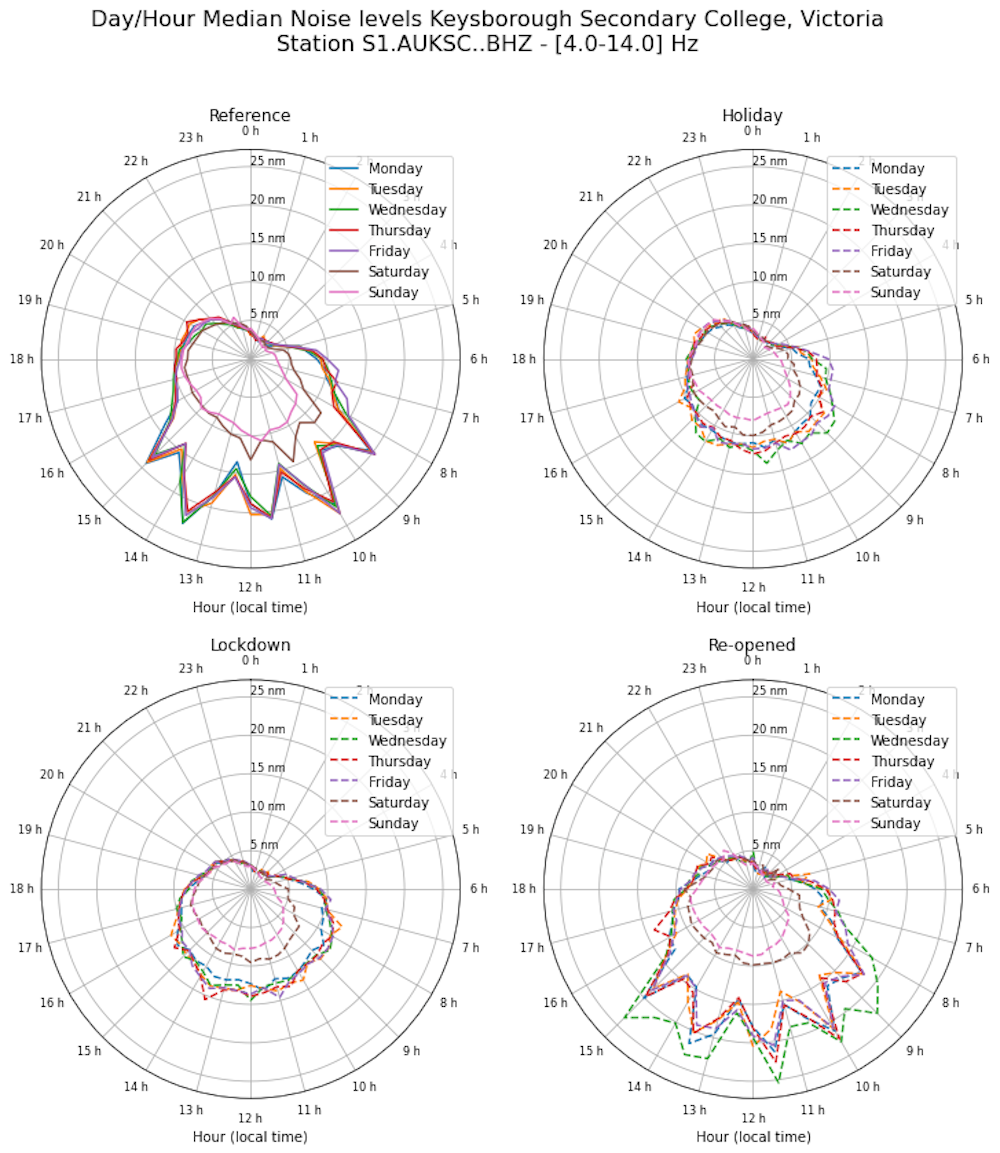
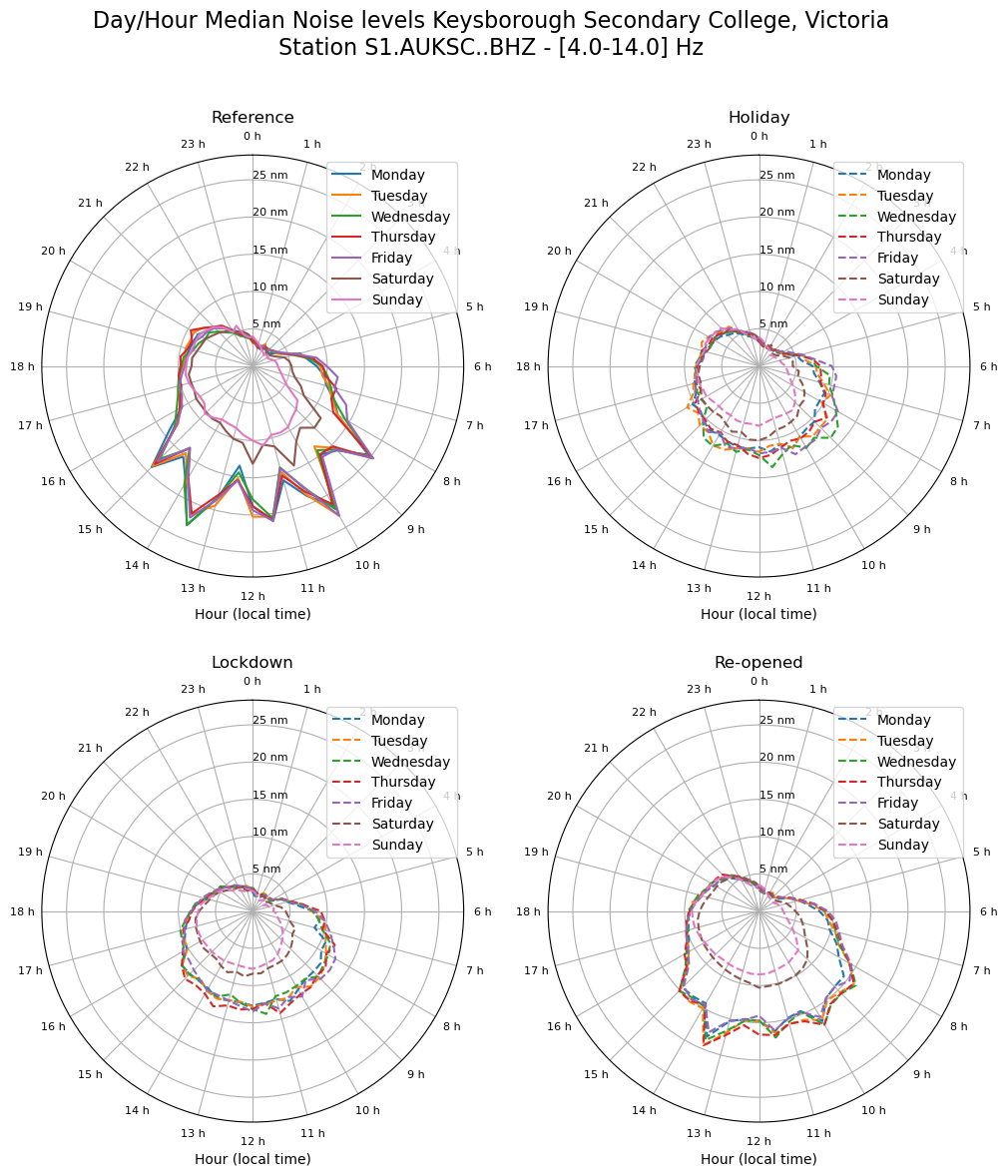
At Keysborough Secondary College in Victoria, school hours, especially between lessons, are bustling and noisy. Weekends and night-times are quiet enough to use these instruments for seismological research. AuSiS, Author provided

However, regional differences became even more pronounced as metropolitan Melbourne reinstated stay-at-home restrictions on July 8. As a second spike of COVID-19 cases was detected in Victoria and then ramped up in late June, the level of movement began to drop again.

In the seismic noise signal from Keysborough Secondary College, we can see the school holiday quiet period becoming quieter still as further restrictions to school activity were enforced.

Earthquake detection

The low level of background noise from humans recorded in the seismic data during lockdown gives us a window of opportunity to study smaller earthquakes. Detection of small earthquakes or motion on fault lines is essential for seismic hazard assessment.

Small events are typically identified by looking at changes in amplitudes of signals, but very small events have small amplitude signals and these cannot be observed because they are drowned out by the background noise.

This time of quiescence in seismic noise due to the COVID-19 emergency provides a unique opportunity to learn more about small earthquakes occurring in previously unidentified locations.

Meghan S. Miller, Associate Professor; Program Director AuScope Earth Imaging, Australian National University and Louis Moresi, Professor of Geophysics, Australian National University

This article is republished from The Conversation under a Creative Commons license. Read the original article.


Tags: SB001
DMCA.com Protection Status

SUBSCRIBE to our NEWSLETTER

[mc4wp_form id=”2384248″]

Don't Miss

The evolution of Aesthetic Surgery through the lens of Dr Kourosh Tavakoli

by Pauline Torongo
4 December 2025
The evolution of Aesthetic Surgery through the lens of Dr. Kourosh Tavakoli
Health & Wellness

As global interest in Australian cosmetic surgery continues to grow, the combination of regulation, research and emerging digital tools is...

Read moreDetails

Ryan: Building real freedom through e-commerce

by Pauline Torongo
27 November 2025
Ryan: Building real freedom through e-commerce
Business & Finance

Ryan’s greatest achievement isn’t any single business or revenue milestone — it’s the ecosystem he’s built through the Change community.

Read moreDetails

Design Australia Group: Redefining Drafting as the engine of housing growth

by Pauline Torongo
26 November 2025
Design Australia Group: Redefining Drafting as the engine of housing growth
Business & Finance

Australia is under pressure to build homes faster, but design bottlenecks slow progress. Design Australia Group is fixing this by...

Read moreDetails

Louis Guy Detata builds Global Trading Empires through autonomous systems and disciplined leadership

by Pauline Torongo
25 November 2025
Louis Guy Detata builds Global Trading Empires through autonomous systems and disciplined leadership
Business & Finance

The path from investment banking to leading a global trading platform has taught Louis Detata that sustainable success requires more...

Read moreDetails

Burning Eucalyptus Wood: Tips, Advantages, Disadvantages & Alternatives

by Fazila Olla-Logday
20 November 2025
Image Supplied
Enviroment

Learn about burning eucalyptus wood for stoves and fireplaces. Discover benefits, drawbacks, harvesting tips, and better alternative firewood options for...

Read moreDetails

Everything Parents Need to Know About Baby Soft Play and Why It’s a Game Changer

by Fazila Olla-Logday
11 November 2025
Everything Parents Need to Know About Baby Soft Play
Health & Wellness

Baby soft play is a fun, safe, and educational way for little ones to explore and grow. Discover the benefits...

Read moreDetails

WOMAD Sets Up a New Camp in Wiltshire – Australian festival fans take note!

by Kris Griffiths
11 November 2025
Kumbia Boruka brought their reggae and dancehall flavour to the Taste the World Stage at WOMAD 2024 - Credit - Mike Massaro
Entertainment

With its 2026 edition moving to Neston Park in England, WOMAD offers Aussie music lovers a chance to reconnect with global...

Read moreDetails
Load More

Copyright © Blue Sky Publications Ltd. All Rights Reserved.
australiantimes.co.uk is a division of Blue Sky Publications Ltd. Reproduction without permission prohibited. DMCA.com Protection Status

  • About us
  • Write for Us
  • Advertise
  • Contact us
  • T&Cs, Privacy and GDPR
No Result
View All Result
  • News
    • Weather
    • Sport
    • Technology
    • Business & Finance
      • Currency Zone
    • Lotto Results
      • The Lott
  • Lifestyle
    • Entertainment
    • Horoscopes
    • Health & Wellness
    • Recipes
  • Travel
  • Expat Life
  • Move to Australia

Copyright © Blue Sky Publications Ltd. All Rights Reserved.
australiantimes.co.uk is a division of Blue Sky Publications Ltd. Reproduction without permission prohibited. DMCA.com Protection Status

No Result
View All Result
  • News
    • Weather
    • Sport
    • Technology
    • Business & Finance
      • Currency Zone
    • Lotto Results
      • The Lott
  • Lifestyle
    • Entertainment
    • Horoscopes
    • Health & Wellness
    • Recipes
  • Travel
  • Expat Life
  • Move to Australia

Copyright © Blue Sky Publications Ltd. All Rights Reserved.
australiantimes.co.uk is a division of Blue Sky Publications Ltd. Reproduction without permission prohibited. DMCA.com Protection Status