



Nicholas Steyn, University of Auckland and Michael Plank, University of Canterbury
With the opening of a quarantine-free travel corridor between New Zealand and Australia this week, it’s easy to forget COVID-19 is still spreading globally, faster than ever, with more than three million deaths recorded worldwide.
Within a day of the travel bubble opening, a fully vaccinated border worker who cleans planes coming from countries with high rates of COVID-19, tested positive and was transferred to a quarantine facility.
Such cases show why it remains absolutely essential to maintain strict border measures to keep the virus out of the trans-Tasman bubble.
Since January 1 2021, 397 international arrivals in New Zealand have tested positive for the virus. Most have been contained in managed isolation and quarantine (MIQ) facilities.
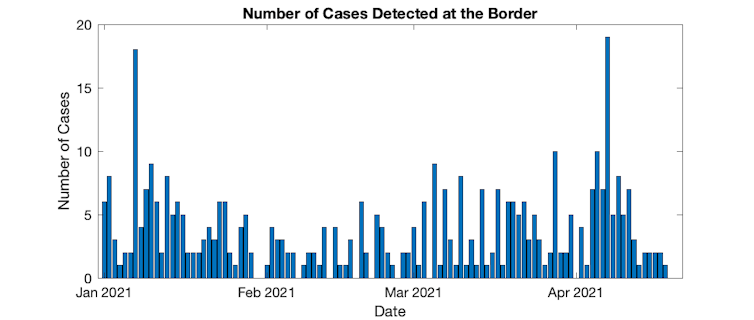
But we have seen some cases leak out from the border. These fall into two main categories: returnees leaving managed isolation while still infectious and frontline border workers becoming infected with the virus.
To consider the effectiveness of various border policies, we pulled together data on transmission of COVID-19 and rates of false negative test results into a mathematical model. The research, published today, allowed us to quantify the risk of community outbreaks under different quarantine and testing regimes.


Managing risk from international arrivals
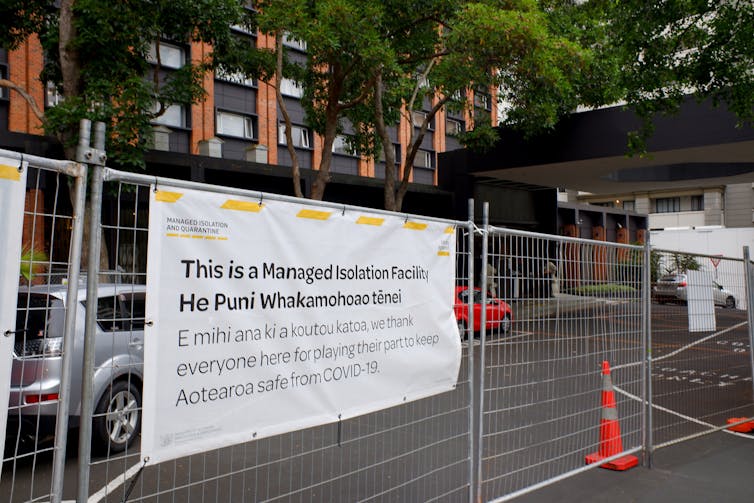
Our research shows that a 14-day stay in managed isolation, with tests on day three and day 12, is highly effective in stopping international arrivals from re-introducing COVID-19 into the community. Under this regime, most border cases are either detected and isolated until recovery, or are no longer infectious by the end of their 14-day stay.
By comparison, reducing the time spent in managed isolation would greatly increase the risk. We found that with a five-day stay, around 25% of cases would still be infectious when they entered the community.
Given recent arrival numbers, this would mean multiple border-related cases in the community every week. Sooner or later a major outbreak like Auckland’s August cluster would be inevitable.
Managing risk from frontline border workers
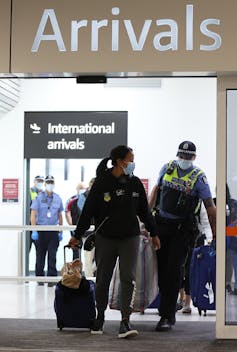
The research also looked at various testing regimes for frontline border workers. We found that weekly routine testing roughly doubles the chance an infection will be detected while it still has a clear link to the border.
The recent case of a worker at the Grand Millenium MIQ facility was an example of this.
When we find a case with a clear link to the border, typically only a small number of people are infected. The outbreak can usually be contained through contact tracing without the need to raise the alert level.
On the other hand, if border workers are not tested regularly, it increases the chance the outbreak could spread into the community. This means a large number of people could be infected by the time the outbreak is detected. This is why, when we find a new case with no clear link to the border, it tends to prompt a more serious response.
Overall, our results show regular routine testing of border workers is essential in minimising the risk of community outbreaks and reducing the need for lockdowns to control them.
Stopping spread within managed isolation facilities
Transmission of the virus between people staying in managed isolation creates a risk that returnees could catch the virus there and remain infectious when they complete their stay. An example of this happened at the Pullman Hotel in January, when a woman who had recently left the facility tested positive.
Genome sequencing then showed she had been infected by another guest at the Pullman sometime during their stay.
To minimise transmission within managed isolation, it’s important we detect cases as early as possible. The data we analysed showed that prior to November, we were picking up around 70% of cases in the first week after arrival. Since January, this has increased to around 85%, helped by the introduction of day 0/1 tests.
But our systems are still not perfect, as recent cases in two MIQ facilities have shown. Emptying out these facilities to allow a thorough check of the ventilation systems is a good move. We know that poorly ventilated corridors allow the virus to linger in the air, which has led to transmission between guests in adjacent rooms in the past.
Vaccination of border workers
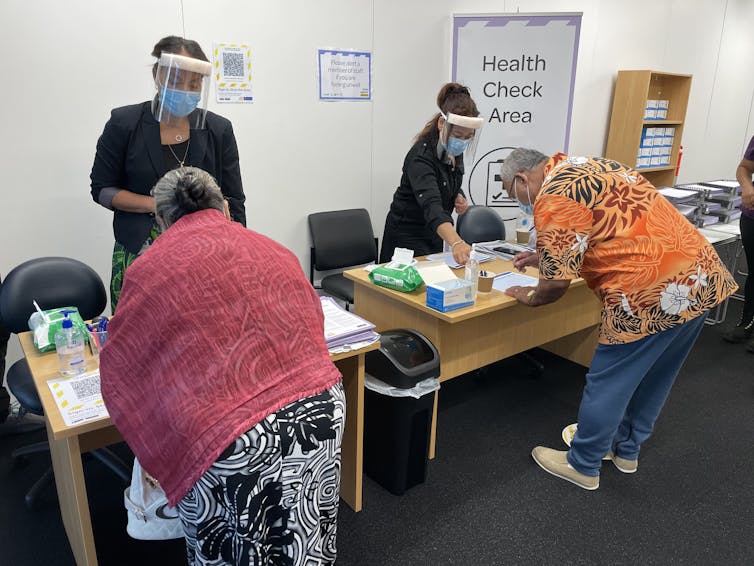
Most border staff have now been vaccinated. This will reduce the health risks for this group, which has the highest exposure to COVID-19 of anyone in New Zealand.
The Pfizer/BioNTech vaccine being used in New Zealand looks to be highly effective in reducing transmission as well as disease. Vaccinating frontline workers will therefore also provide an additional layer of defence at the border.
But since the rest of the population is mostly unvaccinated, we still need to guard against the real risk of a major outbreak if the virus does get out into the community.
Our other (not yet peer reviewed) research shows that regular testing remains crucial even after border workers are vaccinated. This is because even the best vaccines aren’t perfect.
There is a risk vaccinated workers could be asymptomatic but still transmit the virus to others. And the only way to pick up asymptomatic infections is routine testing.
The virus that causes COVID-19 is tricky and evolving. We are still learning about new transmission routes and need to constantly evaluate and improve our border systems to minimise the risks of returnees spreading the virus to others.
Until the majority of New Zealand’s population is vaccinated, the border will continue to be our main line of defence. Effective border processes will allow New Zealanders to return home safely while minimising the risk of COVID-19 to our communities.
Nicholas Steyn, Research assistant, University of Auckland and Michael Plank, Professor in Applied Mathematics, University of Canterbury
This article is republished from The Conversation under a Creative Commons license. Read the original article.







