


Jason Potts, RMIT University and Kelsie Nabben, RMIT University
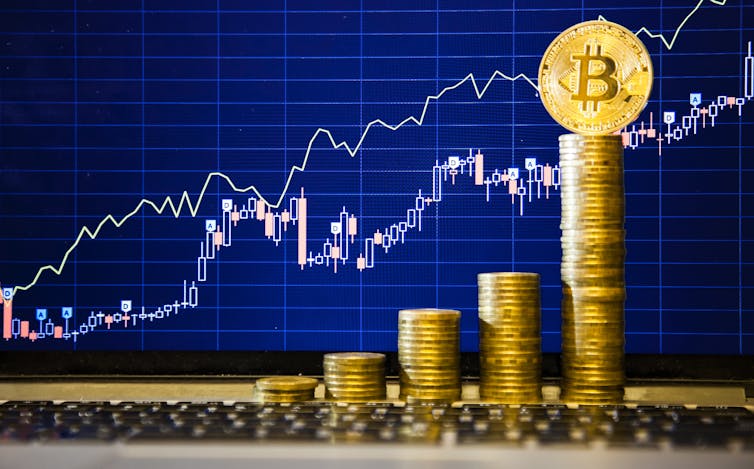
Bitcoin continues to trade close to its all-time high reached this month. Its price is now around US $34,000 — up about 77% over the past month and 305% over the past year.
First launched in 2009 as a digital currency, Bitcoin was for a while used as digital money on the fringes of the economy.
It has since become mainstream. Today, it’s used almost exclusively as a kind of “digital gold”. That is to say, a scarce digital asset.
In response to the risk of economic collapse due to COVID, governments around the world have flooded global markets with money created by central banks, in order to boost spending and help save the economy.
But increasing the supply of money erodes its value and leads people to look for inflation-resistant assets to hold. In this climate, Bitcoin has become a hedge against looming inflation and poor returns on other types of assets.
What is Bitcoin?
Bitcoin, the world’s largest cryptocurrency by market capitalisation, has a current circulating supply of 18,590,300 bitcoins and a maximum supply of 21,000,000.


This limit is hard-coded into the Bitcoin protocol and can’t be changed. It creates artificial scarcity, which ensures the digital money increases in value over time.
Whereas government-issued currencies such as the Australian dollar can have their supply increased at will by central banks, Bitcoin has a fixed supply that can’t be inflated by political decisions.
Bitcoin is predominantly traded on online cryptocurrency exchanges, but can also be sent, received and stored in “digital wallets” on specific hardware or smartphone applications.
But perhaps the most groundbreaking aspect of the Bitcoin network is that it draws on the work of cryptographers and computer scientists to exist as a blockchain-based digital currency.
A public blockchain is an “immutable” database, which means the record of transaction history can’t be changed.
A functional and decentralised digital currency
Bitcoin is “decentralised”. In other words, it functions via a dispersed peer-to-peer network, rather than through a central authority such as a central bank.
And it does this through the participation of Bitcoin “miners”. This is anyone who chooses to run software to validate Bitcoin transactions on the blockchain. Typically, these people are actively engaged with cryptocurrency.
They are rewarded with bitcoins, more of which are created every ten minutes. But the reward paid to miners halves every four years.
This gradual reduction was encoded into the network by creator Satoshi Nakamoto, who designed it this way to mimic the process of extracting actual gold — easier at first, but harder with time.

Bitocoin miners today earn 6.25 bitcoins for every block mined, down from 50 bitcoins in the early years. This creates an incentive to get involved early, as scarcity increases with time.
Because of this, the price is expected to rise to meet demand. But because future scarcity is known in advance (predictable at four-year intervals), the halving events tend to already be priced in.
Therefore, massive surges and falls in price typically reflect changing demand conditions, such as a growing number of new institutional investors. More and more public companies are now investing in bitcoin.
But what function does Bitcoin provide for society that has people so invested?
Why does Bitcoin matter?
There are a few possible explanations as to why Bitcoin is now deemed significant by so many people.
- It’s a “safe” asset
In the face of global uncertainty, buying bitcoins is a way for people to diversify their assets. Its market value can be compared to that of another go-to asset that shines in times of trouble: gold.
Amid the turmoil of a global pandemic, an unconventional US presidential handover and geopolitical power shifts the world over, it’s possible more people view gold and Bitcoin as better alternatives to dollars.
- It ties into privacy-oriented ideologies
Bitcoin (and cryptocurrency in general) is not politically and ideologically neutral. It was born of the internet era, one plagued with grave concerns for privacy.
Bitcoin’s intellectual and ideological origins are in the “cypherpunk” movement of the 1990s and early 2000s.
Records of online forums show it was advocated for as an anonymous digital currency that allowed people to interact online without being tracked by governments or corporations, offering an alternative for anyone who distrusts the Federal central banking system.
Perhaps the overt rise of digital surveillance in response to the COVID pandemic has further stoked fears about online privacy and security — again piquing the public’s interest in Bitcoin’s potential.
Why is Bitcoin booming?
Bitcoin’s recent boom in value comes down to a combination of three factors: ideology, social sentiment and hope.
But although these are variable factors, this doesn’t discredit the significance of the digital economy, interest in the technology as it matures and the influence of institutional investors in cryptocurrency, including Bitcoin.
Bitcoin is in an upward market trend, also known as “bull market” territory.
It was designed to increase in value over time through the rules Nakamoto wrote into its software code — which Bitcoin’s most outspoken advocates, known as “maximalists”, vehemently defend.

Imagining new futures
From a larger frame of reference, decentralised cryptocurrencies allow new ways to coordinate without the need for a central arbiter.
And decentralised blockchain-based networks don’t just enable digital money. Similar to ordinary smartphone apps, software developers around the world are building decentralised applications (DApps) on top of Bitcoin and other blockchain protocols.
They have introduced other cryptocurrencies, such as Ethereum, which are also open platforms for the public.
Other DApps include decentralised financial (DeFi) tools for prediction markets, cryptocurrency borrowing and lending, investing and crowd-funding.
Nakamoto’s audacious experiment in digital currency is working as intended. And what really deserves attention now is what this means for our digital, physical and social futures.
Jason Potts, Professor of Economics, RMIT University and Kelsie Nabben, Researcher / PhD Candidate, RMIT Blockchain Innovation Hub / Digital Ethnography Research Centre, RMIT University
This article is republished from The Conversation under a Creative Commons license. Read the original article.







