

• Advertise
  • About us
  • Terms and Conditions
  • Contact us
Thursday, February 5, 2026
Australian Times News
  • News
    • Weather
    • Sport
    • Technology
    • Business & Finance
      • Currency Zone
    • Lotto Results
      • The Lott
  • Lifestyle
    • Entertainment
    • Horoscopes
    • Health & Wellness
    • Recipes
  • Travel
  • Expat Life
  • Move to Australia
No Result
View All Result
  • News
    • Weather
    • Sport
    • Technology
    • Business & Finance
      • Currency Zone
    • Lotto Results
      • The Lott
  • Lifestyle
    • Entertainment
    • Horoscopes
    • Health & Wellness
    • Recipes
  • Travel
  • Expat Life
  • Move to Australia
No Result
View All Result
Australian Times News
No Result
View All Result
Home News

We discovered a new fossil species of horseshoe crab (and named it after David Attenborough)

There are only four known species of horseshoe crabs alive today. But the fossil record shows that hundreds of millions of years ago they came in a huge range of shapes and sizes.

The Conversation by The Conversation
04-07-2021 01:53
in News
Photo by Gabi Scott on Unsplash

Photo by Gabi Scott on Unsplash

Russell Dean Christopher Bicknell, University of New England

There are only four known species of horseshoe crabs alive today. But the fossil record shows that hundreds of millions of years ago they came in a huge range of shapes and sizes.

In our research, published today in the open-access journal PeerJ, we describe one of these extinct species — Attenborolimulus superspinosus — for the first time.

We named this fossil crab after the famous naturalist and documentary host Sir David Attenborough, in honour of his contributions to conservation and science communication.

When life peaked for horseshoe crabs

Today’s horseshoe crabs live along the east coast of North America, as well as the coasts of China, India, Indonesia and Japan. But despite this distribution, the four species are only minutely different from each other.

During the Triassic period, however, between 250 million and 200 million years ago, a whole host of bizarre horseshoe crabs had evolved. We call these austrolimulids.

They lived alongside horseshoe crabs that look broadly similar to limulids — the curious critters we see along the beaches of the United States and Asia today.


AlsoRead...

Brandon Willington: The Marketing Entrepreneur turning heads across Australia

Brandon Willington: The Marketing Entrepreneur Turning Heads Across Australia

8 January 2026
How Turnkey Building Group Is Restoring Trust In An Industry Known For Customer Disappointment

How Turnkey Building Group Is Restoring Trust In An Industry Known For Customer Disappointment

17 December 2025

The concurrence of two major horseshoe crab groups reflected a recovery from the end-Permian extinction. This event defined the end of the Paleozoic and the beginning of the Triassic, and 95% of marine organisms died out during it!

The newly described animal in our study comes from the early part of the Middle Triassic. We think Attenborolimulus superspinosus lived in marginal marine to freshwater conditions. This is in contrast with modern horseshoe crabs, which are almost exclusively marine animals.


A new austrolimulid from Russia

During research trips to the Ural Mountains of Russia that spanned 2018 and 2019, a team of Russian fossil collectors, palaeontologists and geologists collected fossils from a rock section thought to represent a Triassic-aged floodplain.

One particular group of fossil-rich rocks had preserved a host of animals, including the very rare specimens we examined and published on today.

A fossil of the newly described species.

Attenborolimulus superspinosus is a unique austrolimulid as it has very developed spines on its head section (called “genal spines”), but notably rounded and somewhat reduced spines on other sections of its segmented body.

This condition of overdeveloping and reducing spines, as well as other body sections, is observed in other austrolimulids. However, the combination of spine size, shape and structure in the new material was unique enough to warrant a new genus and species.

Attenborolimulus superspinosus was over an order of magnitude smaller than modern horseshoe crabs. It was likely a bottom-dwelling organism that fed on whatever it could get into its mouth, which is effectively how modern horseshoe crabs feed today.

What’s rather interesting about some of the fossils we studied is evidence of worms and other arthropods having lived on top of the horseshoe crabs. This tells us they may have been hosts for other parts of their ecosystem, effectively becoming “micro-habitats” for other species in the Triassic floodplain.
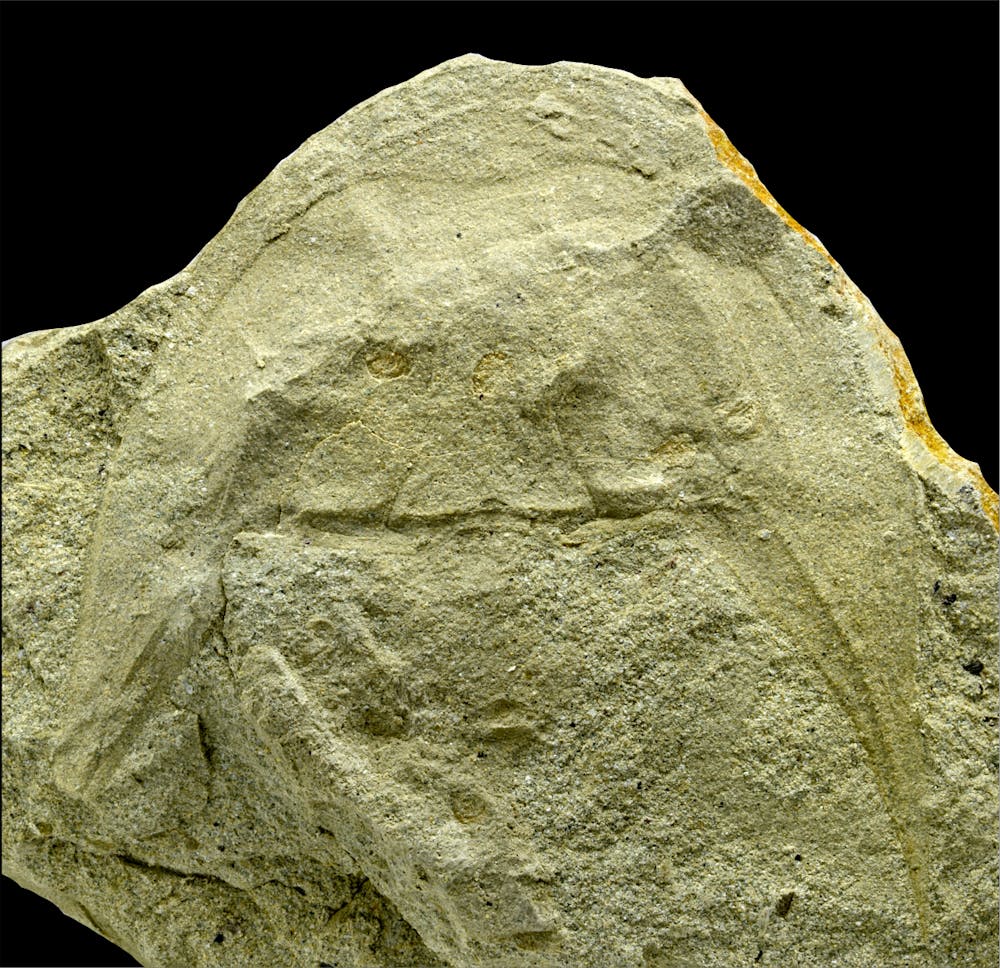
The head section of another Attenborolimulus superspinosus specimen.

We don’t really know why austrolimulids didn’t make it into modern ecosystems. But the best explanation relates to how the group inhabited conditions that were closer to freshwater than marine (saltwater) environments.

They may have been outmatched by the resilience of other animals that arose as Jurassic ecosystems developed. This would suggest austrolimulids were simply not very well adapted for the ecosystems that flourished during the Jurassic.

In honour of the great naturalist

We named the new genus after Sir David Attenborough, who has influenced generations of people from all walks of life to understand the natural world and the importance of conservation.

This is especially important for horseshoe crabs now, as two of the four living species are considered endangered. And this is due to negative interactions with humans, including habitat modification and harvesting for their blood (which has applications in modern medicine).


Attenborolimulus superspinosus is one of more than 12 animals named after Sir David Attenborough, who has dedicated his life to helping us appreciate the beauty and vitality of the natural world. https://www.youtube.com/embed/cfpeyALO03c?wmode=transparent&start=0 This BBC documentary clip details some of the physical traits and breeding habits of modern horseshoe crabs.

Russell Dean Christopher Bicknell, Post-doctoral researcher in Palaeobiology, University of New England

This article is republished from The Conversation under a Creative Commons license. Read the original article.


Tags: SB001
DMCA.com Protection Status

SUBSCRIBE to our NEWSLETTER

[mc4wp_form id=”2384248″]

Don't Miss

Lyca Mobile Australia’s Customer-First Overhaul Pays Off with Finder Award Win

by Fazila Olla-Logday
2 February 2026
Lyca Mobile Australia's Customer-First Overhaul Pays Off with Finder Award Win
Technology

Lyca Mobile Australia’s customer-first overhaul has earned a Finder Award, recognising its improved value, service, and stronger focus on Australian...

Read moreDetails

From Driveway to Dream Court: The Rise of High-Performance Hoops at Home in 2026

by Fazila Olla-Logday
20 January 2026
The Rise of High-Performance Hoops at Home in 2026
Sport

High-performance home basketball hoops are gaining momentum in 2026, as more homeowners invest in durable, professional-grade systems that combine advanced...

Read moreDetails

Brandon Willington: The Marketing Entrepreneur Turning Heads Across Australia

by Pauline Torongo
8 January 2026
Brandon Willington: The Marketing Entrepreneur turning heads across Australia
Business & Finance

Brandon Willington, founder of “Where U?” is changing the narrative for Australian businesses tired of inconsistent leads and empty promises.

Read moreDetails

How Turnkey Building Group Is Restoring Trust In An Industry Known For Customer Disappointment

by Fazila Olla-Logday
17 December 2025
How Turnkey Building Group Is Restoring Trust In An Industry Known For Customer Disappointment
Business & Finance

Turnkey Building Group is changing the narrative in an industry often associated with missed deadlines and broken promises. By prioritizing...

Read moreDetails

Risk Awareness for International Travellers – What Australians Should Know Before Entering Multi-State Regions

by Fazila Olla-Logday
10 December 2025
Schengen
Travel

This guide helps Australian travellers understand cross-border requirements, assess political and environmental risks, manage health and safety considerations, and prepare...

Read moreDetails

The evolution of Aesthetic Surgery through the lens of Dr Kourosh Tavakoli

by Pauline Torongo
4 December 2025
The evolution of Aesthetic Surgery through the lens of Dr. Kourosh Tavakoli
Health & Wellness

As global interest in Australian cosmetic surgery continues to grow, the combination of regulation, research and emerging digital tools is...

Read moreDetails

Ryan: Building real freedom through e-commerce

by Pauline Torongo
27 November 2025
Ryan: Building real freedom through e-commerce
Business & Finance

Ryan’s greatest achievement isn’t any single business or revenue milestone — it’s the ecosystem he’s built through the Change community.

Read moreDetails
Load More

Copyright © Blue Sky Publications Ltd. All Rights Reserved.
australiantimes.co.uk is a division of Blue Sky Publications Ltd. Reproduction without permission prohibited. DMCA.com Protection Status

  • About us
  • Write for Us
  • Advertise
  • Contact us
  • T&Cs, Privacy and GDPR
No Result
View All Result
  • News
    • Weather
    • Sport
    • Technology
    • Business & Finance
      • Currency Zone
    • Lotto Results
      • The Lott
  • Lifestyle
    • Entertainment
    • Horoscopes
    • Health & Wellness
    • Recipes
  • Travel
  • Expat Life
  • Move to Australia

Copyright © Blue Sky Publications Ltd. All Rights Reserved.
australiantimes.co.uk is a division of Blue Sky Publications Ltd. Reproduction without permission prohibited. DMCA.com Protection Status

No Result
View All Result
  • News
    • Weather
    • Sport
    • Technology
    • Business & Finance
      • Currency Zone
    • Lotto Results
      • The Lott
  • Lifestyle
    • Entertainment
    • Horoscopes
    • Health & Wellness
    • Recipes
  • Travel
  • Expat Life
  • Move to Australia

Copyright © Blue Sky Publications Ltd. All Rights Reserved.
australiantimes.co.uk is a division of Blue Sky Publications Ltd. Reproduction without permission prohibited. DMCA.com Protection Status





