



Louise Curran, TBS Business School and Jappe Eckhardt, University of York
The UK government has begun negotiations to join the Comprehensive and Progressive Agreement for Trans-Pacific Partnership (CPTPP), suggesting that joining this trade pact is a positive result of Brexit.
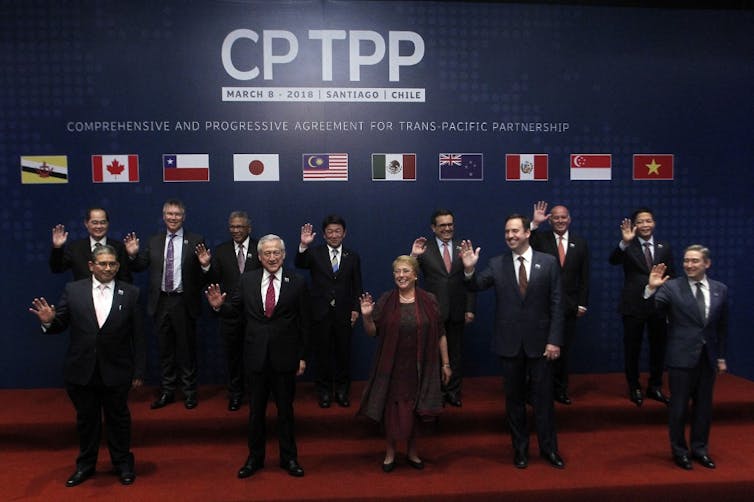
CPTPP, as the name implies, is an agreement on trade (and related issues) between eleven countries which border the Pacific – Australia, Brunei, Canada, Chile, Japan, Malaysia, Mexico, New Zealand, Peru, Singapore and Vietnam. It is the result of the revision of a prior agreement, the Trans Pacific Partnership (TPP), after the Trump administration withdrew the US from negotiations and scuppered the fledgling deal.
It’s highly unlikely that joining the CPTPP will make a significant difference to the UK’s post-Brexit economic prospects. Joining this mega-trade agreement will require the UK to make the kind of difficult compromises that it frequently objected to when an EU member.
It will also bring UK exporters very limited additional benefits, both in the absolute and compared to EU competitors, and risks drawing the UK into increasingly complex Asia Pacific geopolitical dynamics.
New deals
Since it left the European Union, the UK has ostensibly been signing trade deals thick and fast.
However, these early agreements, with countries like Vietnam, Japan and Norway were “grandfathered” deals – renegotiations with countries with whom the country already had market access agreements by virtue of EU membership. As trade within these relationships was already quite free, negotiating such deals was much less complex than entirely new agreements, which require additional concessions.


CPTPP is different from the other UK trade deals because the EU is not a member of the pact. Nor has it ever expressed any interest in becoming one. However, the EU has already signed bilateral deals with many of the countries which are also members of the deal: Mexico, Chile, Peru, Singapore, Canada, Japan and Vietnam.
The EU is also in active negotiations with Australia and New Zealand, where progress has been encouraging and the mood music is positive.
The only members of CPTPP with whom the EU doesn’t have an existing or potential free trade agreement are Malaysia and Brunei. Although the latter is one of the richest countries in the region, it has less than half a million consumers. Malaysia’s 32 million consumers do represent an interesting potential market and their trade negotiations with the EU have stalled.
So joining CPTPP could potentially bring economic benefits: reducing the cost of trade usually increases flows and the common language that the UK shares with several signatories is a factor that traditionally favours trade. It would also result in better market access for UK companies to the markets of Malaysia and Brunei than EU competitors.
But even the positive economic impacts of increased trade with these markets are likely to be limited because of “gravity”.
Like two planets floating in space, the attraction of one economy for another is a function of their size and distance between them – a country’s closest trading partner is more often than not its neighbour. The gravity model of trade is one of the most robust in economics. It is gravity, as much as politics, that explains why less than 8% of the UK’s exports go to CPTPP countries and that tiny Ireland has consistently been a more important market for UK companies than China.
The UK is simply not a Pacific nation and opening markets, such as Malaysia, which are more than 10,000 km away, is unlikely to result in major increases in trade.
Negotiating costs
So, although there may be economic benefits from joining CPTPP, they are limited. In addition, negotiating access to these new trade opportunities will involve significant costs. All free trade agreements involve tit for tat exchanges of access for key products of interest to the other side.
The UK has argued that, freed from its EU partners, it will be easy for them to agree new free trade agreements, as they no longer have to worry about other members’ “pet” industries, such as French agriculture. But the UK also has sensitive industries, worried about the impact of increased competition and varying product standards on their livelihoods.
UK farmers are already up in arms at the reported willingness of the government to provide free access to agricultural products produced to less exacting standards in a recently agreed trade deal with Australia. CPTPP will magnify those concerns and broaden the number of sectors with good reason to resist free market access.
Meanwhile, modern trade agreements go far beyond tariffs. The CPTPP has extensive chapters on standards, including in the controversial agricultural sector. Joining the pact risks increasing regulatory divergence with the EU in sectors such as meat and dairy, as well as industrial goods, thus complicating the UK’s far more important exports to EU markets. CPTPP text makes frequent reference to regional standards and initiatives. The region in question is obviously the Asia-Pacific, not Europe.
Complicated geopolitics
There is another risk attached to joining this agreement with a faraway and complex region. CPTPP very much reflects the changing geo-political power dynamics emerging in the Asia Pacific. The US was one of the chief instigators of the CPTPP’s predecessor, the TPP, and Trump’s withdrawal from the deal left a power vacuum in the region. The other TPP members, wary of China’s ambitions to fill this vacuum, decided to move forward without the US and sign CPTPP. The new US trade representative, Katherine Tai, has expressed caution about the possibility that the United States could rejoin the agreement.
The other key regional agreement – the Regional Comprehensive Economic Partnership (RCEP) – includes some CPTPP members and China. For its part, China has also recently expressed an interest in joining CPTPP. This might not be an addition which the UK would find desirable, given their complicated bilateral relationship and the controversy around human rights in Hong Kong and Xinjiang.
Becoming a party to this agreement will draw the UK into a power play between regional powers and may complicate other important alliances, including with India, which chose to stay out of both the CPTPP and RCEP.
The rush to join CPTPP therefore seems both economically peculiar and potentially geopolitically dangerous. It is perhaps not surprising that the UK government is in no hurry to publish its impact assessment.
Louise Curran, Professor of International Business, TBS Business School and Jappe Eckhardt, Senior Lecturer in International Political Economy, University of York
This article is republished from The Conversation under a Creative Commons license. Read the original article.







