


• Advertise
  • About us
  • Terms and Conditions
  • Contact us
Saturday, December 6, 2025
Australian Times News
  • News
    • Weather
    • Sport
    • Technology
    • Business & Finance
      • Currency Zone
    • Lotto Results
      • The Lott
  • Lifestyle
    • Entertainment
    • Horoscopes
    • Health & Wellness
    • Recipes
  • Travel
  • Expat Life
  • Move to Australia
No Result
View All Result
  • News
    • Weather
    • Sport
    • Technology
    • Business & Finance
      • Currency Zone
    • Lotto Results
      • The Lott
  • Lifestyle
    • Entertainment
    • Horoscopes
    • Health & Wellness
    • Recipes
  • Travel
  • Expat Life
  • Move to Australia
No Result
View All Result
Australian Times News
No Result
View All Result
Home News

The success of Iceland’s ‘four-day week’ trial has been greatly overstated

While even highly reputable media outlets such as the BBC have reported on the “overwhelming success” of large-scale trials of a four-day week in Iceland from 2015 to 2019, that’s not actually the case.

The Conversation by The Conversation
14-07-2021 18:09
in News
Photo by Tom Podmore on Unsplash

Photo by Tom Podmore on Unsplash

Anthony Veal, University of Technology Sydney

It almost seems too good to be true: a major trial in Iceland shows that cutting the standard five-day week to four days for the same pay needn’t cost employers a cent (or, to be accurate, a krona).

Unfortunately it is too good to be true.

While even highly reputable media outlets such as the BBC have reported on the “overwhelming success” of large-scale trials of a four-day week in Iceland from 2015 to 2019, that’s not actually the case.

The truth is less spectacular — interesting and important enough in its own right, but not quite living up to the media spin, including that these trials have led to the widespread adoption of a four-day work week in Iceland.

Four hours at best

The media reports are based on a report co-published by Iceland’s Alda (Association for Democracy and Sustainability) and Britain’s Autonomy think tank about two trials involving Reykjavík City Council and the Icelandic government. The trials covered 66 workplaces and about 2,500 workers.

They did not involve a four-day work week. This is indicated by the report’s title – Going Public: Iceland’s journey to a shorter working week. In fact the document of more 80 pages refers to a four-day week just twice, in its first two paragraphs, and only then as a reference point for what the trials were actually about:


AlsoRead...

Ryan: Building real freedom through e-commerce

Ryan: Building real freedom through e-commerce

27 November 2025
Design Australia Group: Redefining Drafting as the engine of housing growth

Design Australia Group: Redefining Drafting as the engine of housing growth

26 November 2025

In recent years, calls for shorter working hours without a reduction in pay — often framed in terms of a ‘four-day week’ — have become increasingly prominent across Europe.
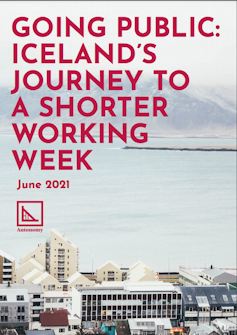
Going Public: Iceland's Journey to a Shorter Working Week, June 2021.
Going Public: Iceland’s Journey to a Shorter Working Week, June 2021. https://autonomy.work/portfolio/icelandsww/

Read on to the third paragraph and you’ll learn the study “involved two large-scale trials of shorter working hours — in which workers moved from a 40-hour to a 35- or 36-hour week, without reduced pay”.

A four-day week trial would have involved reducing the working week by seven to eight hours. Instead the maximum reduction in these trials was just four hours. In 61 of the 66 workplaces it was one to three hours.

Which is not to say the results – no adverse effect on output or services delivered – is unimpressive. Nor is the upshot. As a result of the trials, unions and employers have formalised country-wide agreements to make reduced working hours permanent.

But these have provided for a reduction of just 35 minutes a week in the private sector and 65 minutes in the public sector (though larger reductions are available for shift workers). That’s a long way from making a four-day week the norm.


The ‘Hawthorn effect’

In interpreting the results of such studies, we always need to be cautious.

In regard to this and similar experiments, it is always possible the “Hawthorne effect” might have been at work. This effect refers to 1930s experiments with factory workers in the US that showed how their awareness of being the subject of experiments affected their behaviour, and hence productivity levels.

Could this have been at work in the Iceland trials? The work units involved volunteers to take part in the experiments and so might well have been motivated to make them work as intended. This may not be replicated in more widespread changed working arrangements.

Workers could, of course, be expected to enjoy reduced working hours, but would they replicate the working practices required to maintain productivity levels?

This depends on the nature of these changed working practices and their sustainability. This in turn may depend on whether enhancements in productivity are achieved by harder or more intensive working or by “smarter” working and/or improved equipment. This all calls for further research.

Furthermore, in service-industry settings such as the Iceland examples, a control sample of similar workplaces should ideally be monitored to be sure of the reliability of the conclusions drawn.

A four-day week won’t come easy

Despite these words of caution, there is still a strong case to be made for a four-day week. It’s a case I’ve argued previously in my book Whatever Happened to the Leisure Society? (Routledge, 2019).

There is no reason why the long-term march towards reduced working hours should stop at the arbitrary “standard” figure of five days and 40 hours established in the post-World War II period.


Experiments will continue. I’ve written previously in The Conversation about some of these in Japan and New Zealand. The Autonomy think tank has counted a dozen, most of them by smallish “creative” agencies but also by consulting heavyweight KPMG.

But I don’t think widespread adoption of the four-day week will come easily or necessarily all in one go. Instead it’s going to have to come incrementally.

It took half of the 20th century and a great deal of campaigning against concerted employer opposition for workers in Western industrial societies to reduce their standard working week from 60 hours over six days to 40 hours over five days.

It’s just not likely to come as effortlessly as these misleading reports suggest.

Anthony Veal, Adjunct Professor, Business School, University of Technology Sydney

This article is republished from The Conversation under a Creative Commons license. Read the original article.


Tags: SB001
DMCA.com Protection Status

SUBSCRIBE to our NEWSLETTER

[mc4wp_form id=”2384248″]

Don't Miss

The evolution of Aesthetic Surgery through the lens of Dr Kourosh Tavakoli

by Pauline Torongo
4 December 2025
The evolution of Aesthetic Surgery through the lens of Dr. Kourosh Tavakoli
Health & Wellness

As global interest in Australian cosmetic surgery continues to grow, the combination of regulation, research and emerging digital tools is...

Read moreDetails

Ryan: Building real freedom through e-commerce

by Pauline Torongo
27 November 2025
Ryan: Building real freedom through e-commerce
Business & Finance

Ryan’s greatest achievement isn’t any single business or revenue milestone — it’s the ecosystem he’s built through the Change community.

Read moreDetails

Design Australia Group: Redefining Drafting as the engine of housing growth

by Pauline Torongo
26 November 2025
Design Australia Group: Redefining Drafting as the engine of housing growth
Business & Finance

Australia is under pressure to build homes faster, but design bottlenecks slow progress. Design Australia Group is fixing this by...

Read moreDetails

Louis Guy Detata builds Global Trading Empires through autonomous systems and disciplined leadership

by Pauline Torongo
25 November 2025
Louis Guy Detata builds Global Trading Empires through autonomous systems and disciplined leadership
Business & Finance

The path from investment banking to leading a global trading platform has taught Louis Detata that sustainable success requires more...

Read moreDetails

Burning Eucalyptus Wood: Tips, Advantages, Disadvantages & Alternatives

by Fazila Olla-Logday
20 November 2025
Image Supplied
Enviroment

Learn about burning eucalyptus wood for stoves and fireplaces. Discover benefits, drawbacks, harvesting tips, and better alternative firewood options for...

Read moreDetails

Everything Parents Need to Know About Baby Soft Play and Why It’s a Game Changer

by Fazila Olla-Logday
11 November 2025
Everything Parents Need to Know About Baby Soft Play
Health & Wellness

Baby soft play is a fun, safe, and educational way for little ones to explore and grow. Discover the benefits...

Read moreDetails

WOMAD Sets Up a New Camp in Wiltshire – Australian festival fans take note!

by Kris Griffiths
11 November 2025
Kumbia Boruka brought their reggae and dancehall flavour to the Taste the World Stage at WOMAD 2024 - Credit - Mike Massaro
Entertainment

With its 2026 edition moving to Neston Park in England, WOMAD offers Aussie music lovers a chance to reconnect with global...

Read moreDetails
Load More

Copyright © Blue Sky Publications Ltd. All Rights Reserved.
australiantimes.co.uk is a division of Blue Sky Publications Ltd. Reproduction without permission prohibited. DMCA.com Protection Status

  • About us
  • Write for Us
  • Advertise
  • Contact us
  • T&Cs, Privacy and GDPR
No Result
View All Result
  • News
    • Weather
    • Sport
    • Technology
    • Business & Finance
      • Currency Zone
    • Lotto Results
      • The Lott
  • Lifestyle
    • Entertainment
    • Horoscopes
    • Health & Wellness
    • Recipes
  • Travel
  • Expat Life
  • Move to Australia

Copyright © Blue Sky Publications Ltd. All Rights Reserved.
australiantimes.co.uk is a division of Blue Sky Publications Ltd. Reproduction without permission prohibited. DMCA.com Protection Status

No Result
View All Result
  • News
    • Weather
    • Sport
    • Technology
    • Business & Finance
      • Currency Zone
    • Lotto Results
      • The Lott
  • Lifestyle
    • Entertainment
    • Horoscopes
    • Health & Wellness
    • Recipes
  • Travel
  • Expat Life
  • Move to Australia

Copyright © Blue Sky Publications Ltd. All Rights Reserved.
australiantimes.co.uk is a division of Blue Sky Publications Ltd. Reproduction without permission prohibited. DMCA.com Protection Status





