• Advertise
  • About us
  • Terms and Conditions
  • Contact us
Monday, March 23, 2026
Australian Times News
  • News
    • Weather
    • Sport
    • Technology
    • Business & Finance
      • Currency Zone
    • Lotto Results
      • The Lott
  • Lifestyle
    • Entertainment
    • Horoscopes
    • Health & Wellness
    • Recipes
  • Travel
  • Expat Life
  • Move to Australia
No Result
View All Result
  • News
    • Weather
    • Sport
    • Technology
    • Business & Finance
      • Currency Zone
    • Lotto Results
      • The Lott
  • Lifestyle
    • Entertainment
    • Horoscopes
    • Health & Wellness
    • Recipes
  • Travel
  • Expat Life
  • Move to Australia
No Result
View All Result
Australian Times News
No Result
View All Result
Home News

The S&P 500 nears its all-time high. Here’s why stock markets are defying economic reality

This old and playful maxim is typically not true: often the stock market is a good proxy for the economy and a very good indication of what will happen to it.

The Conversation by The Conversation
11-08-2020 09:17
in News
The S&P 500 nears its all-time high

The S&P 500 nears its all-time high Photo by Roberto Júnior on Unsplash

James Doran, UNSW

The stock market is not the economy.

This old and playful maxim is typically not true: often the stock market is a good proxy for the economy and a very good indication of what will happen to it.

But it aptly captures the current divergence between stock markets and the worst economic crisis in a century.

In the United States the NASDAQ (which include tech stocks such as Amazon, Apple, eBay, Microsoft and Google’s parent company Alphabet Inc) is now 10% higher than before COVID-19 fears crashed global markets between late February and late March.

The benchmark S&P 500 index is now on the verge of an all-time high. Last week it closed at 3,349 points, just 1% lower than its February 19 high of 3,386.
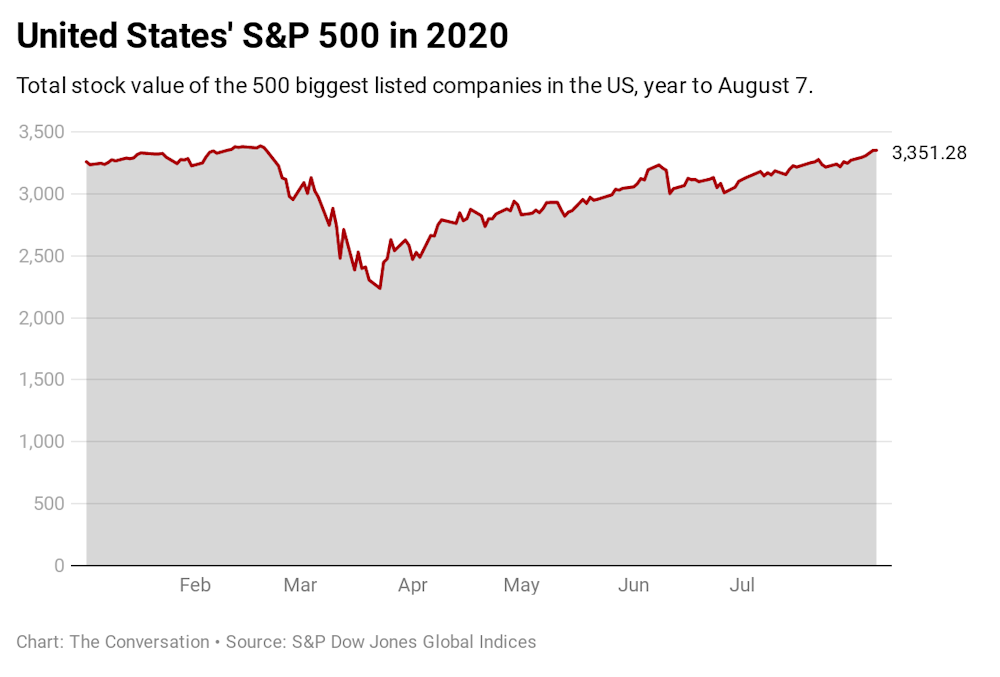

S&P 500 index, year to August 7, 2020.
CC BY-SA

Compare this reversal of fotune to the S&P 500’s trajectory after the Global Financial Crisis of 2007-8. Then it took about five years for the index to claw back its losses.


AlsoRead...

Design Without Compromise: Where Gutter Protection Meets Modern Architecture

Design Without Compromise: Where Gutter Protection Meets Modern Architecture

20 March 2026
The Rise of This Lead Generation Workshop Across Australia

The Rise of This Lead Generation Workshop Across Australia

13 February 2026

And this despite the US economy now being in a much worse position than during the GFC, with an unemployment rate of more than 10%, a muddled federal government response and Congress unable to agree on a new economic stimulus package.

Other national stock markets have had similar if less exuberant rebounds. From their pre-COVID highs, Britain’s FTSE 100 is still down about 20%, Japan’s Nikkei 225 about 6.5% and Australia’s S&P/ASX 200 index about 15%. Nonetheless their recoveries are still remarkable.
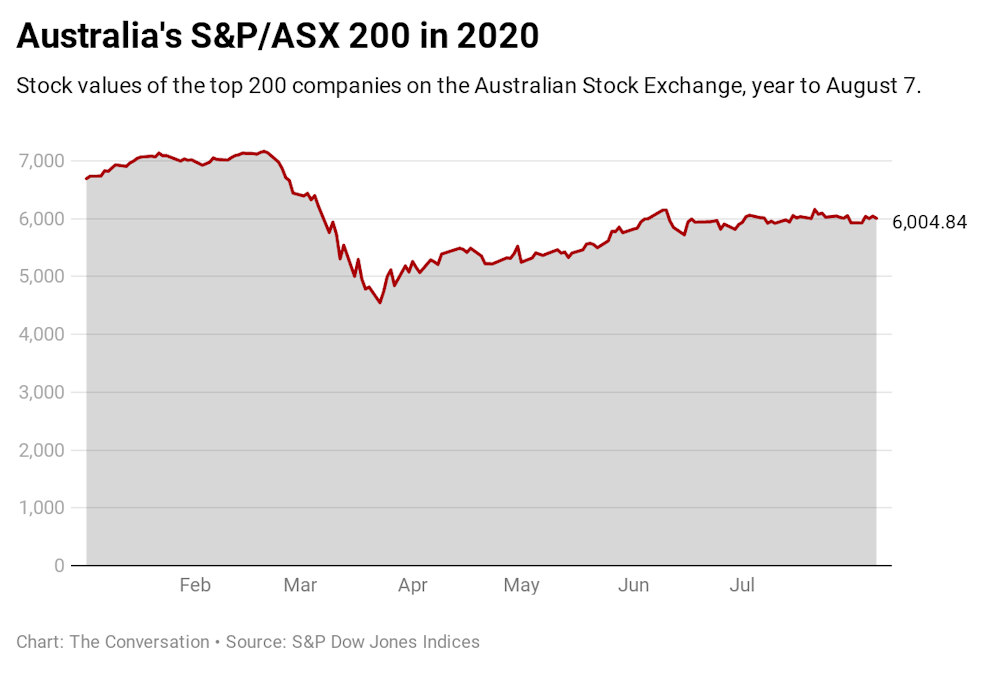

Australia's S&P/ASX 200 index, year to August 7 2020.
CC BY-SA

The least worst best

Normally stock markets tell us a lot about the economy. Buying and selling shares is a near-instant response to new information. The aggregation of those best guesses is generally an accurate indicator of the way things are going.

This time there might be a structural reason why the markets appear divorced from reality.

Investors could be bidding up stock prices because they have to put their money somewhere, and stocks are the least worst bet.

Broadly speaking, investors can put money to work in five places: stocks; property; commodities; bonds or money in the bank.

Property investment has become extremely risky. Values remain high due to temporary support schemes, and significant falls are likely.

Commodities are generic tradeable items such as oil, wheat and coffee beans.

Like all tradeable items, their prices rise and fall, and the pandemic has been driving them down. In April the World Bank’s Commodity Markets Outlook warned the risks to forecasts were “large in both directions”.

Bonds are paying less and less

What about bonds – the ultrasafe investment offered by governments?

Their attractiveness depends on the interest they pay, and that depends on expectations about interest rates and inflation.

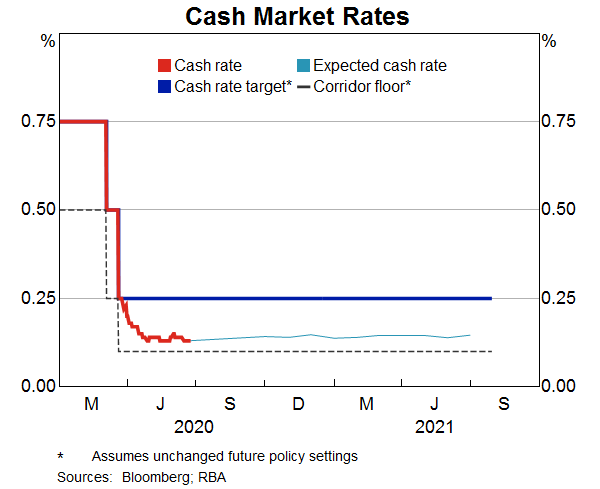
Both were going downhill before the pandemic, and COVID-19 has pushed them down further. In March the US Federal Reserve cut its interest-rate target range to 0-0.25%. The Reserve Bank of Australia cut its target to 0.25% but has in practice been prepared to accept a cash rate closer to zero.

The interest rates that influence bonds also affect returns on bank deposits.

That leaves stocks.

A notable feature of the stock market’s buoyancy has been the influx of retail (at the expense of professional or institutional) investors.

Since the market peaked in late February they have become net buyers of stocks, while professional institutional investors have become net sellers.


Cumulative net buying (A$ billion)
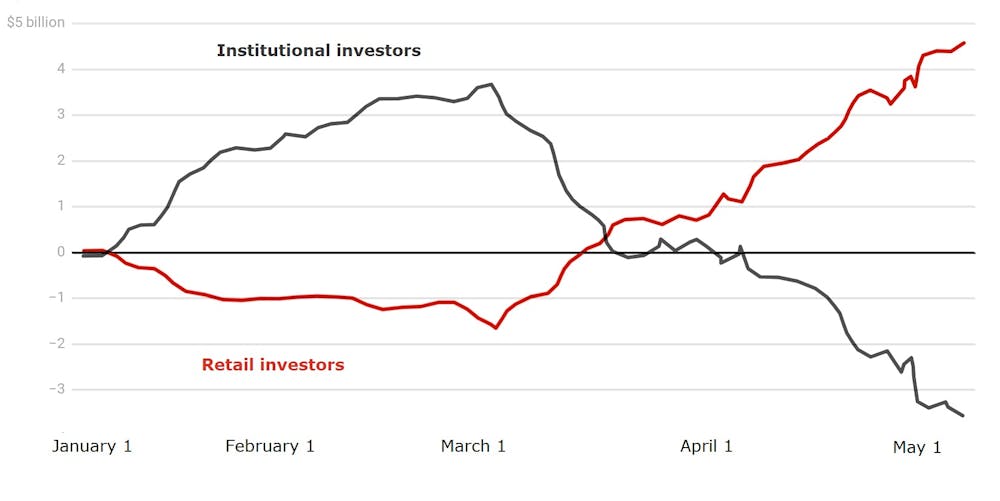
S&P/ASX 300, January to mid-May 2020. Author’s calculations

Researchers Carole Comerton-Forde and Zhou Zhong suggest this might be due to people having fewer other spending opportunities, and more time on their hands – the so-called boredom markets hypothesis.

Governments have helped with programs to prop up businesses, among them the US$659 billion Paycheck Protection Program and Australia’s A$86 bllion JobKeeper and A$40 billion Coronavirus Small and Medium Enterprises Guarantee programs.

In April and May this year Australian government spending jumped 11% on the same months last year. In April, May and June US government spending more than doubled. It’s likely some of that money has flowed thorough to people who have used it to play the stock market.

Detached from reality

In the past the stock markets have fallen just before unemployment rose, heralding what was to come.

This happened in the US recession at the start of the 2000s and the Great Recession during in the Global Financial Crisis, as the following graph shows.


US unemployment rate and S&P 500
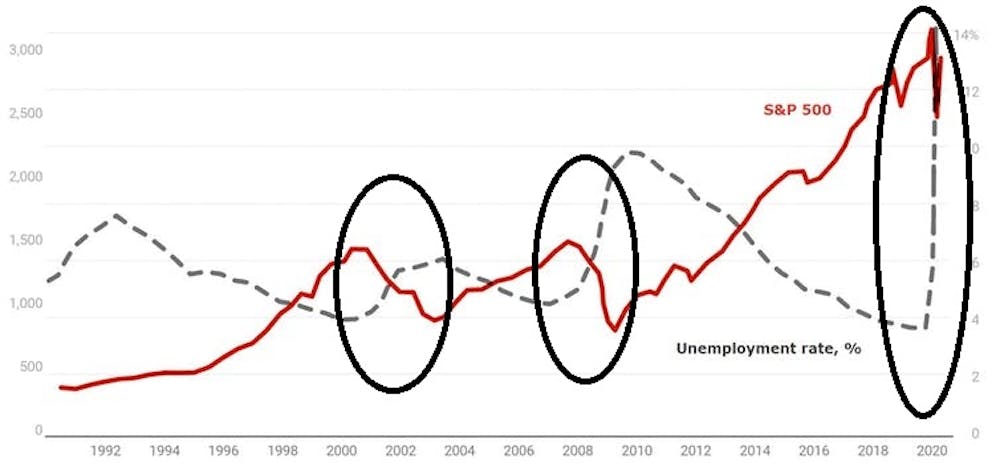

What’s notable is that the stock market didn’t fall just before unemployment rate climbed this time.

Now, more than ever before, the stock market tells us little about where the economy is heading.

James Doran, Associate professor/Deputy head of school, UNSW

This article is republished from The Conversation under a Creative Commons license. Read the original article.


Tags: SB001
DMCA.com Protection Status

SUBSCRIBE to our NEWSLETTER

[mc4wp_form id=”2384248″]

Don't Miss

Design Without Compromise: Where Gutter Protection Meets Modern Architecture

by Fazila Olla-Logday
20 March 2026
Design Without Compromise: Where Gutter Protection Meets Modern Architecture
Business & Finance

Design without compromise by integrating gutter protection seamlessly into modern architecture. Discover how innovative gutter systems enhance your home’s aesthetics...

Read moreDetails

How WageSafe Secured Australia’s Most Reputable Retail Business Among Its Premium Clients

by Fazila Olla-Logday
12 March 2026
How WageSafe Secured Australia’s Most Reputable Retail Business Among Its Premium Clients
at

Learn how WageSafe helps businesses stay compliant with payroll and wage regulations through reliable monitoring, risk management, and expert support—protecting...

Read moreDetails

Zakeke AI Agent Studio Removes the E-Commerce Content Bottleneck With Outputs in Seconds

by Fazila Olla-Logday
3 March 2026
Zakeke AI Agent Studio Removes the E-Commerce Content Bottleneck With Outputs in Seconds
at

Zakeke AI Agent Studio removes the e-commerce content bottleneck by generating product content and visuals in seconds, enabling brands to...

Read moreDetails

Empire Traveller launches to give Small and Medium Businesses Enterprise-Level Travel rates

by Pauline Torongo
20 February 2026
Empire Traveller launches to give Small and Medium Businesses Enterprise-Level Travel rates
Travel

Empire Traveller suggests the travel sector may be entering a more inclusive phase — one where advantage is shaped less...

Read moreDetails

Is Feng Shui Master Xu Really A Modern Genius?

by Fazila Olla-Logday
19 February 2026
Is Feng Shui Master Xu Really A Modern Genius?
at

Is Feng Shui Master Xu truly a modern genius, or simply a master of timeless wisdom? Blending ancient Feng Shui...

Read moreDetails

The Rise of This Lead Generation Workshop Across Australia

by Pauline Torongo
13 February 2026
The Rise of This Lead Generation Workshop Across Australia
Business & Finance

“Where U?”, is a two-day in-person lead generation workshop that teaches Australian business owners how to build their own acquisition...

Read moreDetails

Lyca Mobile Australia’s Customer-First Overhaul Pays Off with Finder Award Win

by Fazila Olla-Logday
2 February 2026
Lyca Mobile Australia's Customer-First Overhaul Pays Off with Finder Award Win
Technology

Lyca Mobile Australia’s customer-first overhaul has earned a Finder Award, recognising its improved value, service, and stronger focus on Australian...

Read moreDetails
Load More

Copyright © Blue Sky Publications Ltd. All Rights Reserved.
australiantimes.co.uk is a division of Blue Sky Publications Ltd. Reproduction without permission prohibited. DMCA.com Protection Status

  • About us
  • Write for Us
  • Advertise
  • Contact us
  • T&Cs, Privacy and GDPR
No Result
View All Result
  • News
    • Weather
    • Sport
    • Technology
    • Business & Finance
      • Currency Zone
    • Lotto Results
      • The Lott
  • Lifestyle
    • Entertainment
    • Horoscopes
    • Health & Wellness
    • Recipes
  • Travel
  • Expat Life
  • Move to Australia

Copyright © Blue Sky Publications Ltd. All Rights Reserved.
australiantimes.co.uk is a division of Blue Sky Publications Ltd. Reproduction without permission prohibited. DMCA.com Protection Status

No Result
View All Result
  • News
    • Weather
    • Sport
    • Technology
    • Business & Finance
      • Currency Zone
    • Lotto Results
      • The Lott
  • Lifestyle
    • Entertainment
    • Horoscopes
    • Health & Wellness
    • Recipes
  • Travel
  • Expat Life
  • Move to Australia

Copyright © Blue Sky Publications Ltd. All Rights Reserved.
australiantimes.co.uk is a division of Blue Sky Publications Ltd. Reproduction without permission prohibited. DMCA.com Protection Status