Kerstin Enflo, Lund University; Jakob Molinder, Lund University, and Tobias Karlsson, Lund University
About a century ago, a poor country in northern Europe made a big leap into modernity. Using new technology, engineers built hydroelectric dams to harness the energy in Sweden’s roaring rivers, generating electricity which would, for the first time, find practical use in homes, factories, railways and agriculture.
Taking place decades after Sweden’s nineteenth-century mechanisation, this electrification was the country’s second industrial revolution. It brought with it powerful forces of change that swept through civilian life, stoking tensions between employers and workers as evidenced by a huge increase in strike action at the time.
But here’s where the narrative takes a surprising turn. Unlike the famous machine-breaking Luddites of Britain’s first industrial revolution, Sweden’s protesting workers didn’t seem anxious or angry about the technological change taking place in their factories. Instead of fearing for their jobs, our recent study found that the vast majority of Sweden’s strikers were simply demanding higher wages.
Today, we’re living through a fourth industrial revolution, marked by advances in computing power and breakthroughs in artificial intelligence. It has provoked its own backlash – some call it a “techlash” – and has caused some workers to fear that new machines will take their jobs.
Sweden’s workers expressed no such sentiment during the country’s electrification, suggesting that revolutionary technologies can empower workers rather than leaving them feeling vulnerable or exploited – a lesson we could apply to today’s innovations and the anxieties that have accompanied them.
Technological revolution
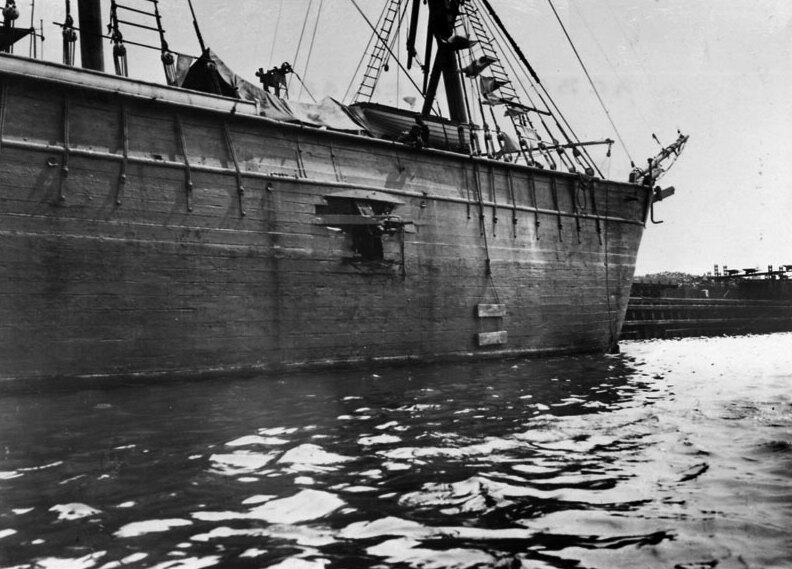
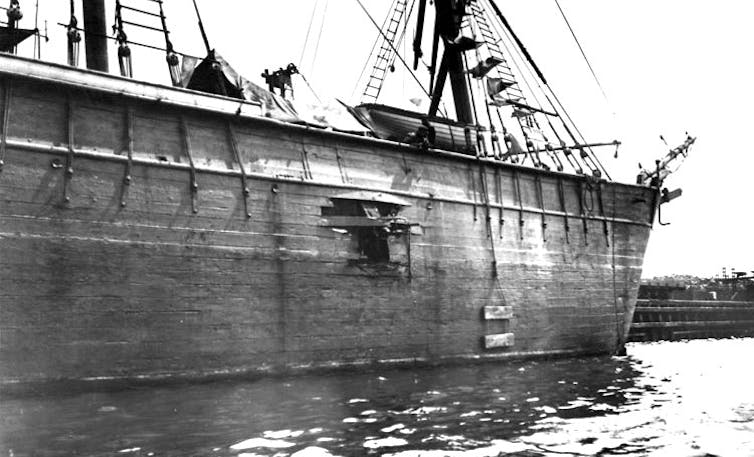
For some decades around the turn of the 20th century, Sweden experienced a period of upheaval. Workers had begun to form unions and perform strikes. Strike action became increasingly audacious, leading to the placing of a bomb on a ship named Amalthea in 1908, which had carried British strikebreakers to the docks of Malmö. The explosion killed one and wounded 23.


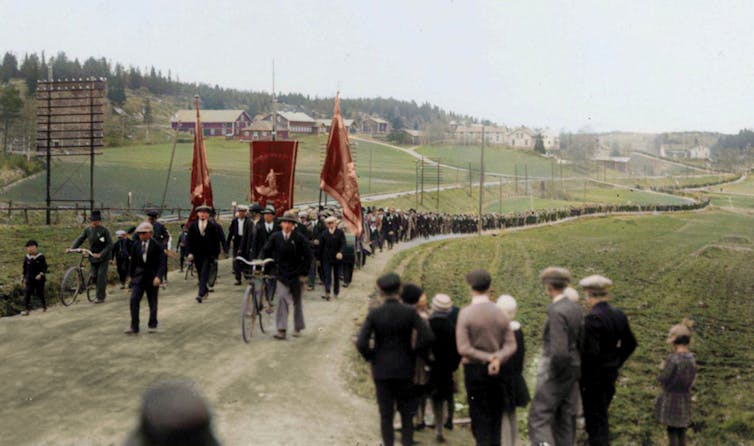
A year later, organised labour and capital met in a great showdown of strikes and lockouts. Employers would eventually come out on top. But protests continued through the first world war, with ordinary men and women taking to the streets to protest soaring food prices. Revolution was in the air, forcing politicians to finally take moves to extend voting rights for working-class people.
This was a formative phase for Sweden’s institutions and the social contract between citizens and the state. It also happens to have been a time when Sweden was busily building a national grid, powering homes and factories with electricity generated by its new hydropower plants.
For workers, this meant change. Electricity enabled owners to do away with the single coal-fired engines that drove machines via a series of belts, using instead a number of smaller motors for each machine. This provided firms with a more reliable source of energy, increasing the pace and continuity of production. This in turn made some jobs obsolete – though it also created new ones.
It’s tempting to assume that these forces – technological change and labour conflicts – were related. The narrative close to hand is that workers went on strike to block the new technology and to save their jobs.
We know that was often the case in Britain during the first industrial revolution, when some workers torched their own mills and destroyed their newly mechanised looms. During the Napoleonic Wars, the secret Luddite movement continued in the same spirit and later, in the 1830s, agricultural workers protested the introduction of threshing machines in the so-called Swing Riots.
For our research, we searched the records of over 8,000 work stoppages recorded by Swedish authorities between 1863 and 1927. Among these events, we were surprised not to find a single strike with the declared purpose of protesting electrification, and just a handful of strikes that were described as attempts to reverse mechanisation more generally.
To see if there were more subtle links between technology and labour conflict, we then conducted a more rigorous analysis, consulting maps of the early electricity grid and comparing them against census data on Sweden’s parishes at the time.
Before electrification, the parishes didn’t differ all that much. But as the grid materialised, those parishes that were supplied electricity suddenly experienced radical changes, including a sharp increase in strikes. So while workers didn’t directly relate their strike action to electrification, our findings suggest the two were indeed linked.
Fourth industrial revolution
We know that the strikes increased among Sweden’s industrial workers, whose skills were in high demand, but not for agricultural workers, whose jobs were disappearing. We see the same kind of pattern today: high-demand Google workers have formed a union and have been on strike, but workers in declining industries have lost their bargaining power and their collective voice.
But unlike Sweden’s experience of electrification, today’s industrial revolution features a strong fear of automation, with some researchers predicting that 47% of jobs in the US could be at risk of technological replacement. This fear has only been exacerbated by the economic uncertainty caused by the pandemic.
We can understand today’s automation anxiety with reference to our study of Swedish workers. Technological revolutions often produce suspicion and anxiety, but we found no such response from the unions and strikers we researched. Instead, it’s clear that new technologies can also empower workers – but only when they recognise that they ought to enjoy a share of the increased productivity delivered by technological change.
Kerstin Enflo, Professor of Growth, technological change, and inequality, Lund University; Jakob Molinder, Postdoctoral Researcher, Economic History, Lund University, and Tobias Karlsson, Senior Lecturer in Historical Labour Markets, Lund University
This article is republished from The Conversation under a Creative Commons license. Read the original article.