

• Advertise
  • About us
  • Terms and Conditions
  • Contact us
Sunday, December 7, 2025
Australian Times News
  • News
    • Weather
    • Sport
    • Technology
    • Business & Finance
      • Currency Zone
    • Lotto Results
      • The Lott
  • Lifestyle
    • Entertainment
    • Horoscopes
    • Health & Wellness
    • Recipes
  • Travel
  • Expat Life
  • Move to Australia
No Result
View All Result
  • News
    • Weather
    • Sport
    • Technology
    • Business & Finance
      • Currency Zone
    • Lotto Results
      • The Lott
  • Lifestyle
    • Entertainment
    • Horoscopes
    • Health & Wellness
    • Recipes
  • Travel
  • Expat Life
  • Move to Australia
No Result
View All Result
Australian Times News
No Result
View All Result
Home News

Support for Biden’s $1.9 trillion coronavirus relief package may not be as broad as it seems – it’s all a matter of perspective

The federal government routinely spends amounts in the millions, billions and, more recently, trillions, yet these numbers are far beyond what individuals encounter on a daily basis, making it hard for most people – and probably lawmakers – to wrap their heads around them.

The Conversation by The Conversation
07-03-2021 09:17
in News
Government spending bills that cost billions or trillions of dollars can seem abstract. Siri Stafford/DigitalVision via Getty Images

Government spending bills that cost billions or trillions of dollars can seem abstract. Siri Stafford/DigitalVision via Getty Images

Aaron Saiewitz, University of Nevada, Las Vegas and M. David Piercey, University of Massachusetts Amherst
CC BY-NC-ND

Congress is on the verge of spending US$1.9 trillion to provide additional coronavirus relief to Americans, including $1,400 direct payments and extended unemployment benefits. Opinion polls show the bill has strong support, even among Republican voters.

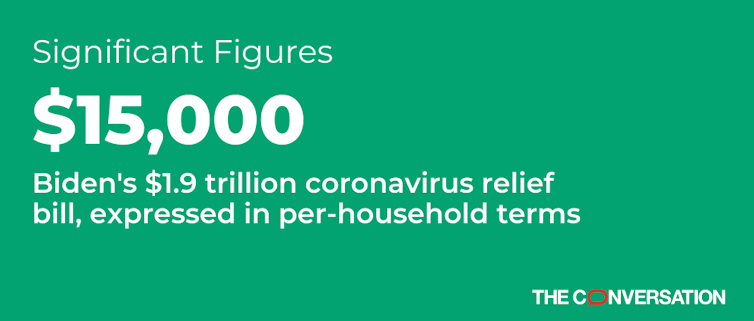
But what if you were told that this spending level represents about $15,000 for every household in the U.S.? Would that make you less likely to support it even if you like its provisions?

We are accounting professors who research how the presentation of financial information affects individual judgments. Our recent work suggests it would lessen most people’s support for the spending bill.

Making sense of big numbers

In the Spring 2020 issue of Behavioral Research in Accounting, we published a study investigating whether individuals comprehend the large numbers involved in government spending.

The federal government routinely spends amounts in the millions, billions and, more recently, trillions, yet these numbers are far beyond what individuals encounter on a daily basis, making it hard for most people – and probably lawmakers – to wrap their heads around them.

We hypothesized that presenting the cost of government spending in per-household terms would make these amounts easier for individuals to understand and evaluate.


AlsoRead...

Ryan: Building real freedom through e-commerce

Ryan: Building real freedom through e-commerce

27 November 2025
Design Australia Group: Redefining Drafting as the engine of housing growth

Design Australia Group: Redefining Drafting as the engine of housing growth

26 November 2025

In our study, we conducted an experiment in which people evaluated a hypothetical federal spending proposal that included provisions like job training, unemployment benefits and infrastructure spending. Half the participants were presented with a plan that would cost $718 million, while the other half saw the same proposal at a cost of $718 billion. Participants were randomly told either the full cost of the proposal or the tally in per-household terms. That is, $5,744 for the $718 billion version and $5.74 for the $718 million one.

We found no difference in the level of support expressed by people who saw the $718 million proposal versus people who saw the $718 billion proposal, even though it’s 1,000 times larger. But the people who saw the per-household amount expressed significantly less support for the version with the larger price tag. Additionally, we then showed the participants who were given the total figures the per-household expression and found a similar drop in support for the more expensive proposal.

Thus, we concluded that the per-household presentation made individuals cost sensitive to government spending.

Interestingly, although liberals were on average more likely to support the spending proposal than conservatives, both groups became more cost sensitive when government spending was presented in per-household terms.

What it means

This is not to suggest the U.S. should or shouldn’t spend $1.9 trillion on coronavirus relief.

Our point is that it’s important to make these large numbers relatable to voters, allowing them to put the overall cost into context and then make up their own minds on whether the spending is worth it. And it may mean, were voters told the per-household cost of the $1.9 billion bill, they’d offer less support.

One caveat to this is that putting government spending in per-household terms may lead voters to incorrectly think they are personally responsible for that amount. Most – though not all – government funding comes from individual taxpayers, and not all households pay an equal share.

However, we also found that participants didn’t have increased cost sensitivity because they felt personally liable, but because they simply understood the magnitude of the spending better.

Aaron Saiewitz, Associate Professor of Accounting, University of Nevada, Las Vegas and M. David Piercey, John F. Kennedy Endowed Professor of Accounting, University of Massachusetts Amherst

This article is republished from The Conversation under a Creative Commons license. Read the original article.


Tags: SB001
DMCA.com Protection Status

SUBSCRIBE to our NEWSLETTER

[mc4wp_form id=”2384248″]

Don't Miss

The evolution of Aesthetic Surgery through the lens of Dr Kourosh Tavakoli

by Pauline Torongo
4 December 2025
The evolution of Aesthetic Surgery through the lens of Dr. Kourosh Tavakoli
Health & Wellness

As global interest in Australian cosmetic surgery continues to grow, the combination of regulation, research and emerging digital tools is...

Read moreDetails

Ryan: Building real freedom through e-commerce

by Pauline Torongo
27 November 2025
Ryan: Building real freedom through e-commerce
Business & Finance

Ryan’s greatest achievement isn’t any single business or revenue milestone — it’s the ecosystem he’s built through the Change community.

Read moreDetails

Design Australia Group: Redefining Drafting as the engine of housing growth

by Pauline Torongo
26 November 2025
Design Australia Group: Redefining Drafting as the engine of housing growth
Business & Finance

Australia is under pressure to build homes faster, but design bottlenecks slow progress. Design Australia Group is fixing this by...

Read moreDetails

Louis Guy Detata builds Global Trading Empires through autonomous systems and disciplined leadership

by Pauline Torongo
25 November 2025
Louis Guy Detata builds Global Trading Empires through autonomous systems and disciplined leadership
Business & Finance

The path from investment banking to leading a global trading platform has taught Louis Detata that sustainable success requires more...

Read moreDetails

Burning Eucalyptus Wood: Tips, Advantages, Disadvantages & Alternatives

by Fazila Olla-Logday
20 November 2025
Image Supplied
Enviroment

Learn about burning eucalyptus wood for stoves and fireplaces. Discover benefits, drawbacks, harvesting tips, and better alternative firewood options for...

Read moreDetails

Everything Parents Need to Know About Baby Soft Play and Why It’s a Game Changer

by Fazila Olla-Logday
11 November 2025
Everything Parents Need to Know About Baby Soft Play
Health & Wellness

Baby soft play is a fun, safe, and educational way for little ones to explore and grow. Discover the benefits...

Read moreDetails

WOMAD Sets Up a New Camp in Wiltshire – Australian festival fans take note!

by Kris Griffiths
11 November 2025
Kumbia Boruka brought their reggae and dancehall flavour to the Taste the World Stage at WOMAD 2024 - Credit - Mike Massaro
Entertainment

With its 2026 edition moving to Neston Park in England, WOMAD offers Aussie music lovers a chance to reconnect with global...

Read moreDetails
Load More

Copyright © Blue Sky Publications Ltd. All Rights Reserved.
australiantimes.co.uk is a division of Blue Sky Publications Ltd. Reproduction without permission prohibited. DMCA.com Protection Status

  • About us
  • Write for Us
  • Advertise
  • Contact us
  • T&Cs, Privacy and GDPR
No Result
View All Result
  • News
    • Weather
    • Sport
    • Technology
    • Business & Finance
      • Currency Zone
    • Lotto Results
      • The Lott
  • Lifestyle
    • Entertainment
    • Horoscopes
    • Health & Wellness
    • Recipes
  • Travel
  • Expat Life
  • Move to Australia

Copyright © Blue Sky Publications Ltd. All Rights Reserved.
australiantimes.co.uk is a division of Blue Sky Publications Ltd. Reproduction without permission prohibited. DMCA.com Protection Status

No Result
View All Result
  • News
    • Weather
    • Sport
    • Technology
    • Business & Finance
      • Currency Zone
    • Lotto Results
      • The Lott
  • Lifestyle
    • Entertainment
    • Horoscopes
    • Health & Wellness
    • Recipes
  • Travel
  • Expat Life
  • Move to Australia

Copyright © Blue Sky Publications Ltd. All Rights Reserved.
australiantimes.co.uk is a division of Blue Sky Publications Ltd. Reproduction without permission prohibited. DMCA.com Protection Status





