

• Advertise
  • About us
  • Terms and Conditions
  • Contact us
Sunday, December 7, 2025
Australian Times News
  • News
    • Weather
    • Sport
    • Technology
    • Business & Finance
      • Currency Zone
    • Lotto Results
      • The Lott
  • Lifestyle
    • Entertainment
    • Horoscopes
    • Health & Wellness
    • Recipes
  • Travel
  • Expat Life
  • Move to Australia
No Result
View All Result
  • News
    • Weather
    • Sport
    • Technology
    • Business & Finance
      • Currency Zone
    • Lotto Results
      • The Lott
  • Lifestyle
    • Entertainment
    • Horoscopes
    • Health & Wellness
    • Recipes
  • Travel
  • Expat Life
  • Move to Australia
No Result
View All Result
Australian Times News
No Result
View All Result
Home News

Stay in the doughnut, not the hole: how to get out of the crisis with both our economy and environment intact

The recovery provides a rare opportunity to do things differently; to rebuild a better economy that can support living standards without irretrievably damaging the environment.

The Conversation by The Conversation
31-12-2020 22:07
in News
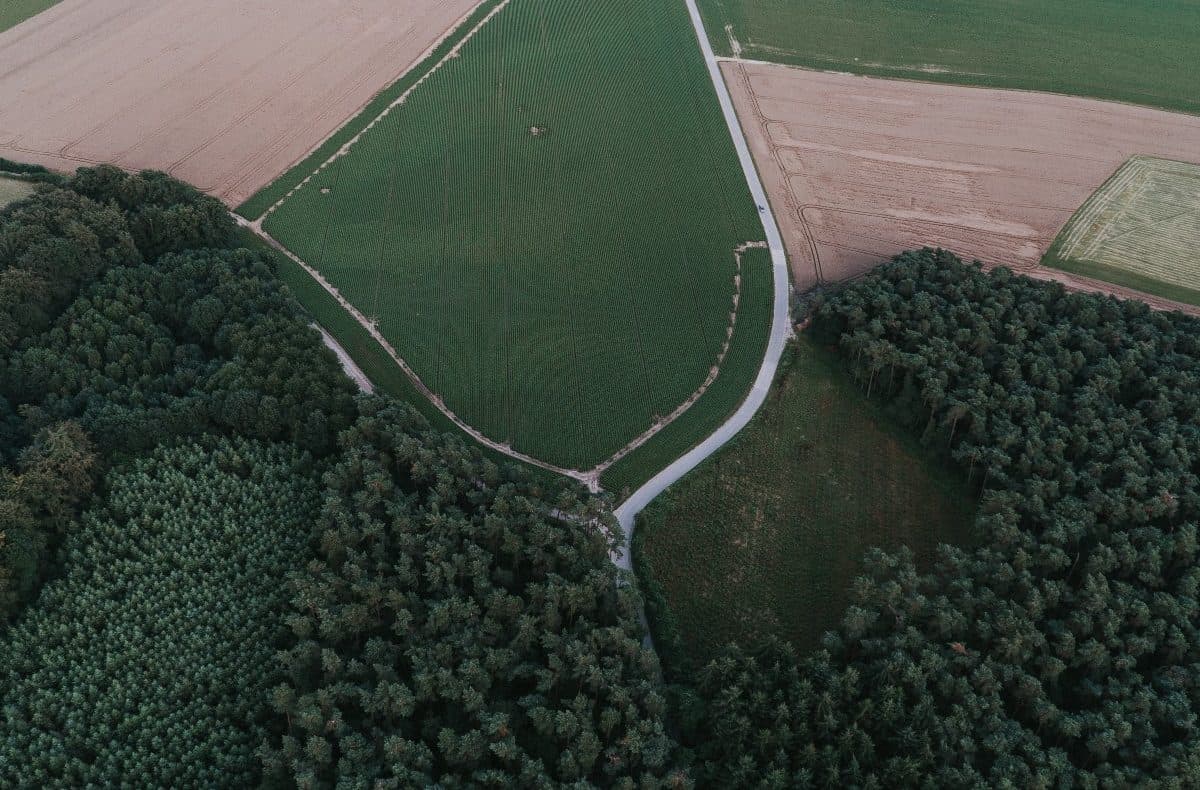
The challenge is to remain within the doughnut

The challenge is to remain within the doughnut Photo by Antoine Pirard on Unsplash

Warwick Smith, University of Melbourne

Before the recession we were on a collision course with environmental disaster.
pxfuel, CC BY

The recovery provides a rare opportunity to do things differently; to rebuild a better economy that can support living standards without irretrievably damaging the environment.

The closer we get to irreversible climate change, the harder that will become.
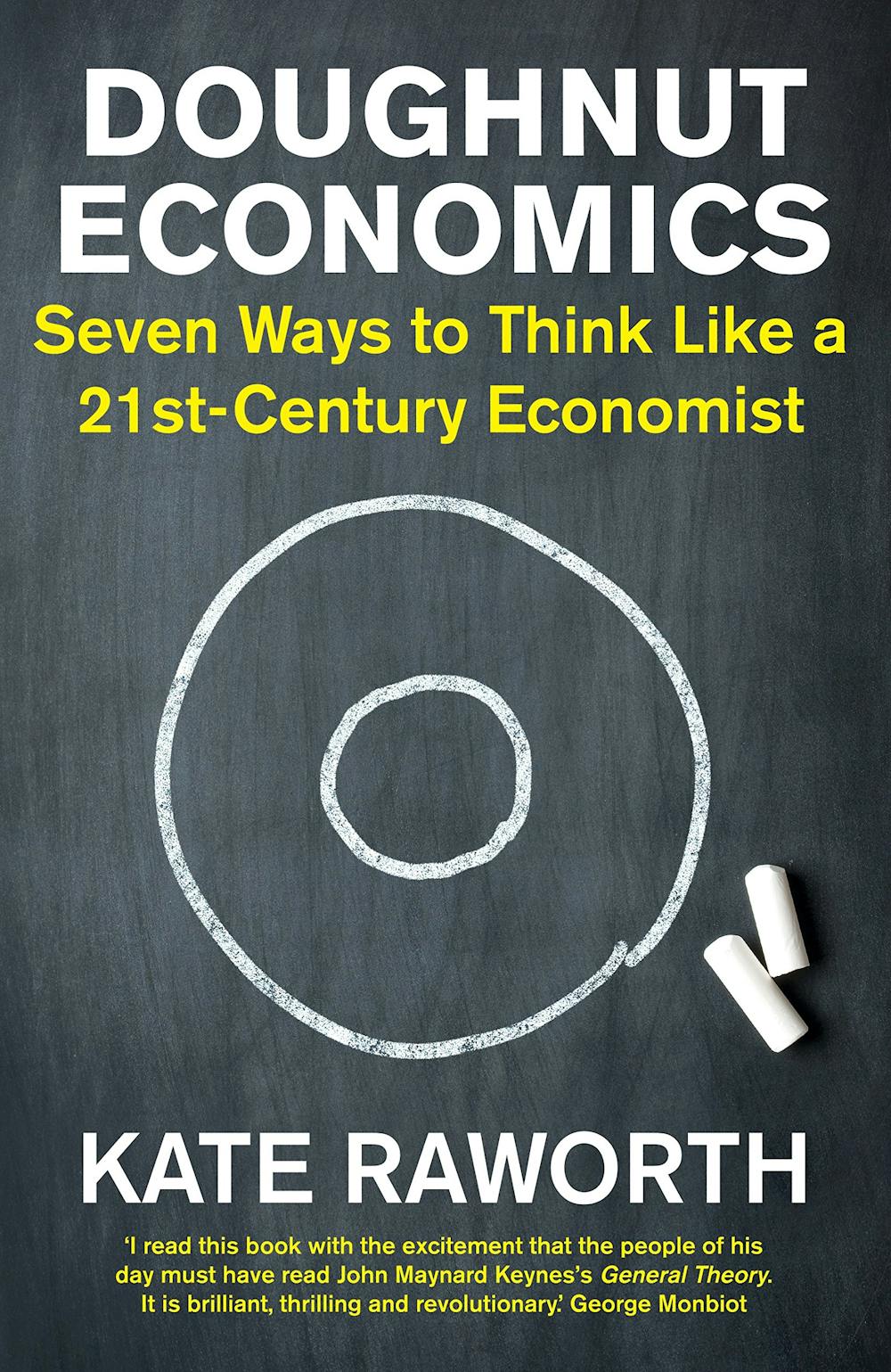
kateraworth.com

Doughnut economics, a concept principally developed by UK economist Kate Raworth, provides an intuitive way of thinking about it.

The ideas outlined in her book, subtitled Seven Ways to Think Like a 21st-Century Economist, are increasingly being used around the world, including by a new collaboration Regen Melbourne, that’s looking at ways to making Melbourne a better, more socially-just and environmentally-responsible city.

The image to keep in mind is that of a doughnut, on the inside of which is economic and social freefall.


AlsoRead...

Ryan: Building real freedom through e-commerce

Ryan: Building real freedom through e-commerce

27 November 2025
Design Australia Group: Redefining Drafting as the engine of housing growth

Design Australia Group: Redefining Drafting as the engine of housing growth

26 November 2025

We need a certain amount of economic and social/political development to ensure everybody can live a good, healthy life with full social and political participation.
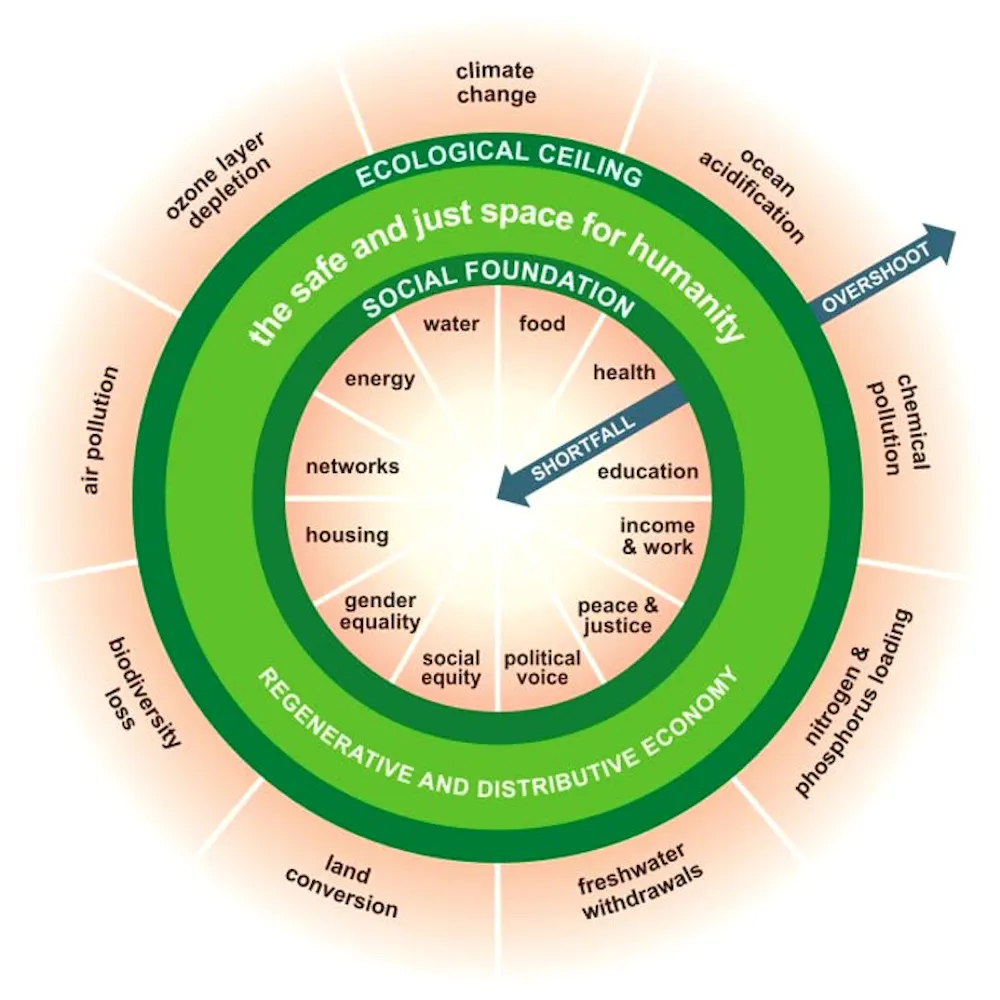
doughnuteconomics.org

On the outside of the doughnut is an unsustainable impact on the environment.

The sweet spot, the “safe and just space for humanity” is, of course, in the doughnut itself. Mmm… doughnuts.

Conceptually it’s pretty straightforward. Practically, it is challenging.

Economics is traditionally defined as the study of the way societies allocate scarce resources. But in the modern world the reality is that, for rich countries such as Australia, there is no overall scarcity.

The challenge is to remain within the doughnut

Such countries have homeless and hungry people, for sure. But the also have enough resources, homes and food to provide for them. That they don’t is a question of distribution rather than scarcity.

In terms of the diagram, we already use enough resources to ensure nobody need be left in the hole on the inside of the doughnut. The danger is that we use too many resources and move beyond the outer edge of the doughnut into climate and ecological breakdown.


Here’s another diagram.

For quite some time amongst economists there’s been faith in what’s called the Environmental Kuznets Curve, where increasing consumption is said to lead to increased environmental degradation up to a point.

Beyond that point, as a society becomes post-industrial, extra consumption is said to lead to less environmental degradation as people become more environmentally conscious and use their wealth to buy different things – more services (such as yoga classes) and fewer goods (such as hamburgers).
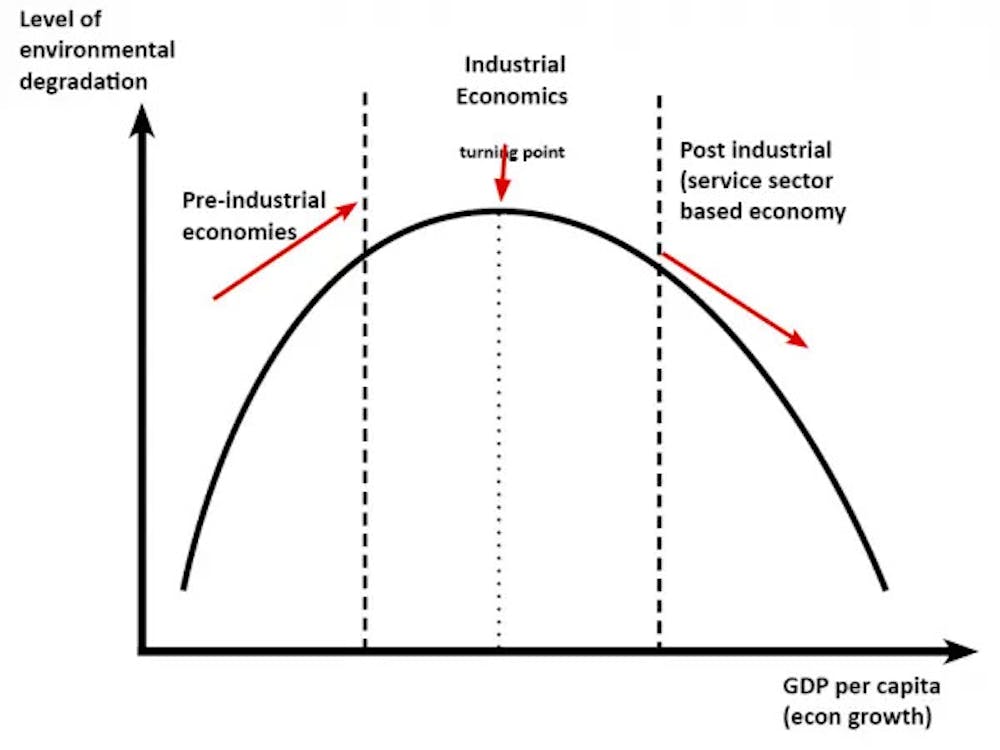
economicshelp.org

While the Environmental Kuznets Curve does indeed appear to be real, there is every indication that the global peak in environmental impact is far higher than the biosphere can withstand, which means a diagram like this:
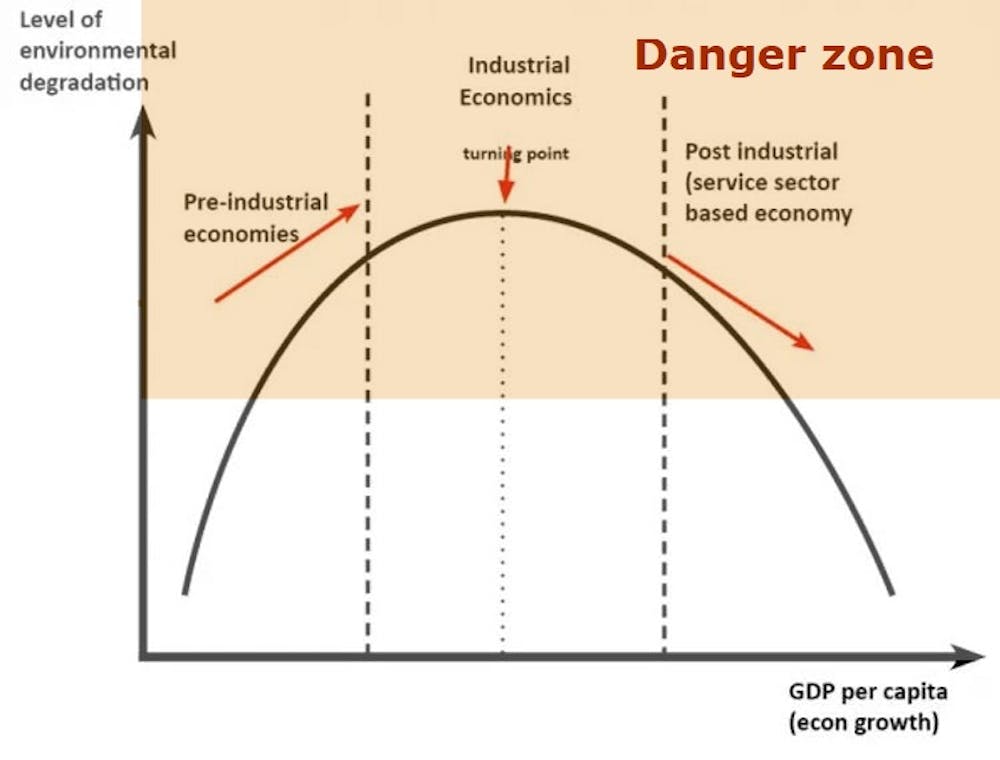
We will need to bring the peak down, and that will be difficult for precisely the same reasons that people remain poor amid extraordinary wealth.

One is the capacity of deep-pocketed interests to influence regulators and governments to maximise profits. The other is the extent to which neoliberal economic thinking permeates social and political structures.

The modern neoliberal thinking tells us the best outcomes are achieved when markets are “free” without government “interference”.


Government attempts to tax, fine or charge for environmental damage are portrayed as interference, rather than protecting the environment.

This is easy because each individual hectare of vegetation that’s cleared doesn’t, by itself, do much damage to the environment, just as each tonne of carbon dioxide that’s released doesn’t do much damage to the climate.

It’s possible to introduce a carbon price or a carbon tax, but its easy to lobby against. Australia’s lasted two years, and governments are frightened to have another go.

The pandemic has expanded what’s possible

The pandemic has shown us that it’s possible to overcome that fear.

Environmental campaigner George Monbiot points out that for 10 years the number of people living – and dying – on Britain’s streets had climbed year by year. There wasn’t enough money to house them.

Then suddenly when the pandemic hit, and they were seen as potential carriers, the money could be found.

He says for decades government and industry had claimed that people would never give up international holidays and business flights. When humanity’s future was seen to be on the line, they did.

It was possible to embrace shift to “private sufficiency and public luxury”.

This is a challenge not only to economics but also to individual economists.

For better or worse, our discipline has a lot of power in the modern world and our views carry disproportionate weight.

We need the best of our economic minds helping us to build frameworks that will keep us in the doughnut. The future of our species depends on it.

Warwick Smith, Research economist, University of Melbourne

This article is republished from The Conversation under a Creative Commons license. Read the original article.


Tags: SB001
DMCA.com Protection Status

SUBSCRIBE to our NEWSLETTER

[mc4wp_form id=”2384248″]

Don't Miss

The evolution of Aesthetic Surgery through the lens of Dr Kourosh Tavakoli

by Pauline Torongo
4 December 2025
The evolution of Aesthetic Surgery through the lens of Dr. Kourosh Tavakoli
Health & Wellness

As global interest in Australian cosmetic surgery continues to grow, the combination of regulation, research and emerging digital tools is...

Read moreDetails

Ryan: Building real freedom through e-commerce

by Pauline Torongo
27 November 2025
Ryan: Building real freedom through e-commerce
Business & Finance

Ryan’s greatest achievement isn’t any single business or revenue milestone — it’s the ecosystem he’s built through the Change community.

Read moreDetails

Design Australia Group: Redefining Drafting as the engine of housing growth

by Pauline Torongo
26 November 2025
Design Australia Group: Redefining Drafting as the engine of housing growth
Business & Finance

Australia is under pressure to build homes faster, but design bottlenecks slow progress. Design Australia Group is fixing this by...

Read moreDetails

Louis Guy Detata builds Global Trading Empires through autonomous systems and disciplined leadership

by Pauline Torongo
25 November 2025
Louis Guy Detata builds Global Trading Empires through autonomous systems and disciplined leadership
Business & Finance

The path from investment banking to leading a global trading platform has taught Louis Detata that sustainable success requires more...

Read moreDetails

Burning Eucalyptus Wood: Tips, Advantages, Disadvantages & Alternatives

by Fazila Olla-Logday
20 November 2025
Image Supplied
Enviroment

Learn about burning eucalyptus wood for stoves and fireplaces. Discover benefits, drawbacks, harvesting tips, and better alternative firewood options for...

Read moreDetails

Everything Parents Need to Know About Baby Soft Play and Why It’s a Game Changer

by Fazila Olla-Logday
11 November 2025
Everything Parents Need to Know About Baby Soft Play
Health & Wellness

Baby soft play is a fun, safe, and educational way for little ones to explore and grow. Discover the benefits...

Read moreDetails

WOMAD Sets Up a New Camp in Wiltshire – Australian festival fans take note!

by Kris Griffiths
11 November 2025
Kumbia Boruka brought their reggae and dancehall flavour to the Taste the World Stage at WOMAD 2024 - Credit - Mike Massaro
Entertainment

With its 2026 edition moving to Neston Park in England, WOMAD offers Aussie music lovers a chance to reconnect with global...

Read moreDetails
Load More

Copyright © Blue Sky Publications Ltd. All Rights Reserved.
australiantimes.co.uk is a division of Blue Sky Publications Ltd. Reproduction without permission prohibited. DMCA.com Protection Status

  • About us
  • Write for Us
  • Advertise
  • Contact us
  • T&Cs, Privacy and GDPR
No Result
View All Result
  • News
    • Weather
    • Sport
    • Technology
    • Business & Finance
      • Currency Zone
    • Lotto Results
      • The Lott
  • Lifestyle
    • Entertainment
    • Horoscopes
    • Health & Wellness
    • Recipes
  • Travel
  • Expat Life
  • Move to Australia

Copyright © Blue Sky Publications Ltd. All Rights Reserved.
australiantimes.co.uk is a division of Blue Sky Publications Ltd. Reproduction without permission prohibited. DMCA.com Protection Status

No Result
View All Result
  • News
    • Weather
    • Sport
    • Technology
    • Business & Finance
      • Currency Zone
    • Lotto Results
      • The Lott
  • Lifestyle
    • Entertainment
    • Horoscopes
    • Health & Wellness
    • Recipes
  • Travel
  • Expat Life
  • Move to Australia

Copyright © Blue Sky Publications Ltd. All Rights Reserved.
australiantimes.co.uk is a division of Blue Sky Publications Ltd. Reproduction without permission prohibited. DMCA.com Protection Status





