

• Advertise
  • About us
  • Terms and Conditions
  • Contact us
Sunday, December 7, 2025
Australian Times News
  • News
    • Weather
    • Sport
    • Technology
    • Business & Finance
      • Currency Zone
    • Lotto Results
      • The Lott
  • Lifestyle
    • Entertainment
    • Horoscopes
    • Health & Wellness
    • Recipes
  • Travel
  • Expat Life
  • Move to Australia
No Result
View All Result
  • News
    • Weather
    • Sport
    • Technology
    • Business & Finance
      • Currency Zone
    • Lotto Results
      • The Lott
  • Lifestyle
    • Entertainment
    • Horoscopes
    • Health & Wellness
    • Recipes
  • Travel
  • Expat Life
  • Move to Australia
No Result
View All Result
Australian Times News
No Result
View All Result
Home News

Solar panels in Sahara could boost renewable energy but damage the global climate – here’s why

The world’s most forbidding deserts could be the best places on Earth for harvesting solar power – the most abundant and clean source of energy we have.

The Conversation by The Conversation
12-02-2021 22:25
in News
Wadstock/Shutterstock

Wadstock/Shutterstock

Zhengyao Lu, Lund University and Benjamin Smith, Western Sydney University

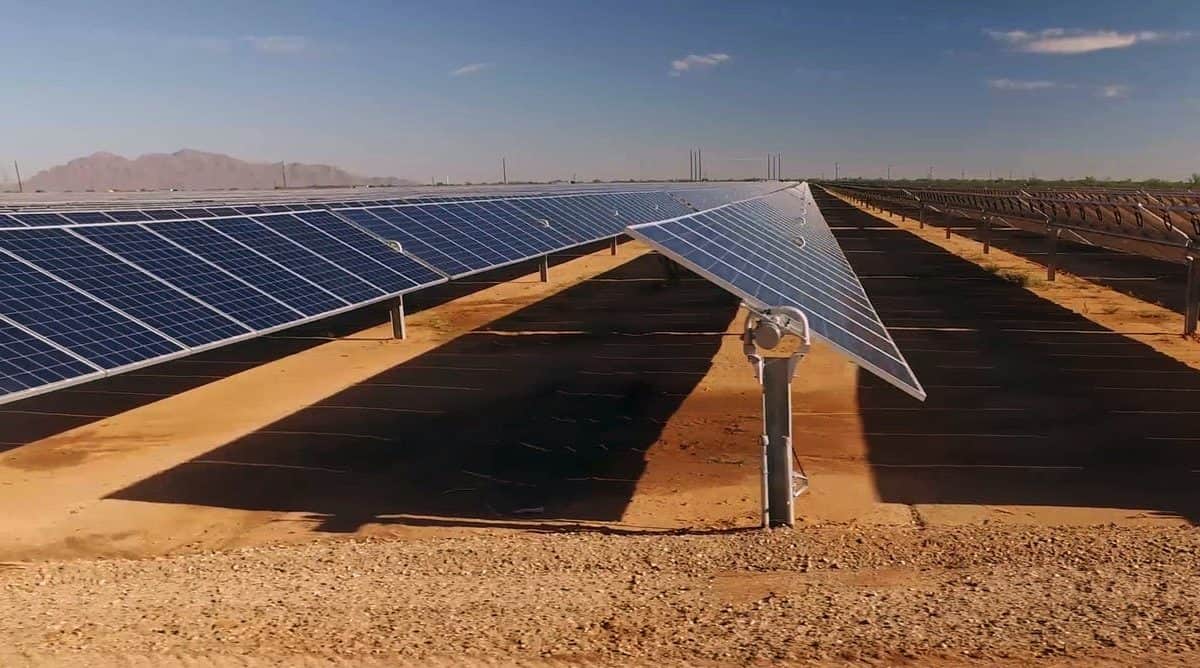
The world’s most forbidding deserts could be the best places on Earth for harvesting solar power – the most abundant and clean source of energy we have. Deserts are spacious, relatively flat, rich in silicon – the raw material for the semiconductors from which solar cells are made — and never short of sunlight. In fact, the ten largest solar plants around the world are all located in deserts or dry regions.

Researchers imagine it might be possible to transform the world’s largest desert, the Sahara, into a giant solar farm, capable of meeting four times the world’s current energy demand. Blueprints have been drawn up for projects in Tunisia and Morocco that would supply electricity for millions of households in Europe.

While the black surfaces of solar panels absorb most of the sunlight that reaches them, only a fraction (around 15%) of that incoming energy gets converted to electricity. The rest is returned to the environment as heat. The panels are usually much darker than the ground they cover, so a vast expanse of solar cells will absorb a lot of additional energy and emit it as heat, affecting the climate.

If these effects were only local, they might not matter in a sparsely populated and barren desert. But the scale of the installations that would be needed to make a dent in the world’s fossil energy demand would be vast, covering thousands of square kilometres. Heat re-emitted from an area this size will be redistributed by the flow of air in the atmosphere, having regional and even global effects on the climate.
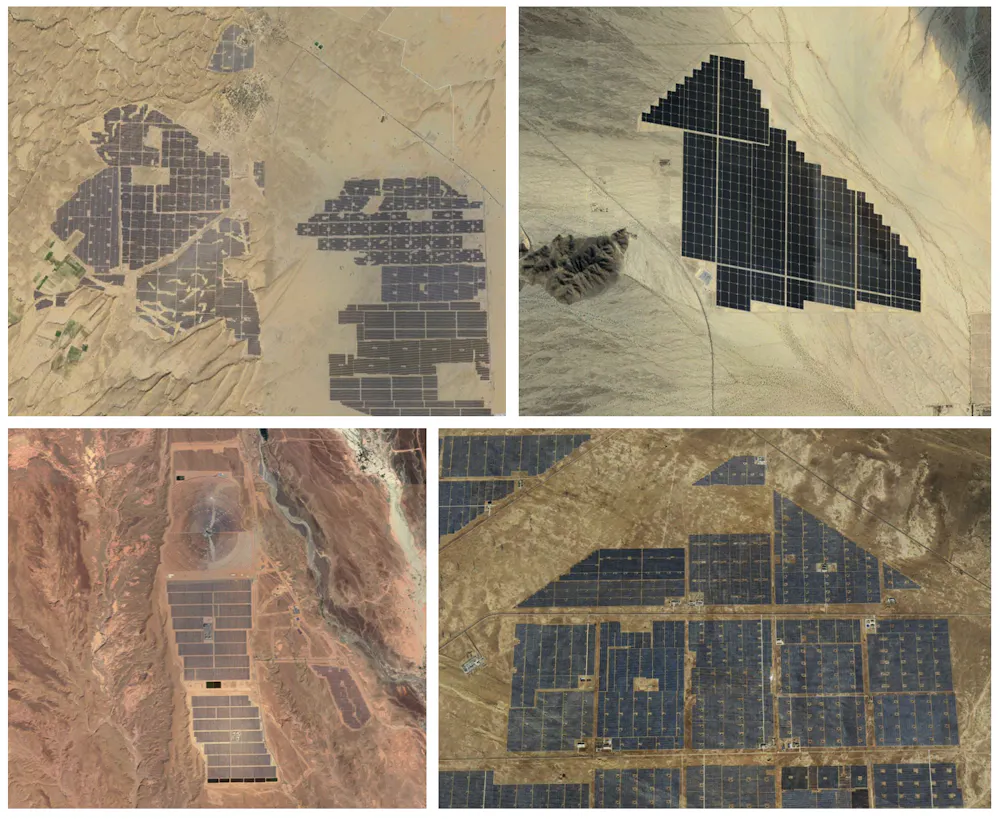
A satellite view of four different solar farms in deserts.
Clockwise from top left: Bhadla solar park, India; Desert Sublight solar farm, US; Hainanzhou solar park, China and Ouarzazate solar park, Morocco. Google Earth, Author provided

A greener Sahara

A 2018 study used a climate model to simulate the effects of lower albedo on the land surface of deserts caused by installing massive solar farms. Albedo is a measure of how well surfaces reflect sunlight. Sand, for example, is much more reflective than a solar panel and so has a higher albedo.

The model revealed that when the size of the solar farm reaches 20% of the total area of the Sahara, it triggers a feedback loop. Heat emitted by the darker solar panels (compared to the highly reflective desert soil) creates a steep temperature difference between the land and the surrounding oceans that ultimately lowers surface air pressure and causes moist air to rise and condense into raindrops. With more monsoon rainfall, plants grow and the desert reflects less of the sun’s energy, since vegetation absorbs light better than sand and soil. With more plants present, more water is evaporated, creating a more humid environment that causes vegetation to spread.


AlsoRead...

Ryan: Building real freedom through e-commerce

Ryan: Building real freedom through e-commerce

27 November 2025
Design Australia Group: Redefining Drafting as the engine of housing growth

Design Australia Group: Redefining Drafting as the engine of housing growth

26 November 2025

This scenario might seem fanciful, but studies suggest that a similar feedback loop kept much of the Sahara green during the African Humid Period, which only ended 5,000 years ago.

So, a giant solar farm could generate ample energy to meet global demand and simultaneously turn one of the most hostile environments on Earth into a habitable oasis. Sounds perfect, right?

Not quite. In a recent study, we used an advanced Earth system model to closely examine how Saharan solar farms interact with the climate. Our model takes into account the complex feedbacks between the interacting spheres of the world’s climate – the atmosphere, the ocean and the land and its ecosystems. It showed there could be unintended effects in remote parts of the land and ocean that offset any regional benefits over the Sahara itself.

Drought in the Amazon, cyclones in Vietnam

Covering 20% of the Sahara with solar farms raises local temperatures in the desert by 1.5°C according to our model. At 50% coverage, the temperature increase is 2.5°C. This warming is eventually spread around the globe by atmosphere and ocean movement, raising the world’s average temperature by 0.16°C for 20% coverage, and 0.39°C for 50% coverage. The global temperature shift is not uniform though – the polar regions would warm more than the tropics, increasing sea ice loss in the Arctic. This could further accelerate warming, as melting sea ice exposes dark water which absorbs much more solar energy.

This massive new heat source in the Sahara reorganises global air and ocean circulation, affecting precipitation patterns around the world. The narrow band of heavy rainfall in the tropics, which accounts for more than 30% of global precipitation and supports the rainforests of the Amazon and Congo Basin, shifts northward in our simulations. For the Amazon region, this causes droughts as less moisture arrives from the ocean. Roughly the same amount of additional rainfall that falls over the Sahara due to the surface-darkening effects of solar panels is lost from the Amazon. The model also predicts more frequent tropical cyclones hitting North American and East Asian coasts.
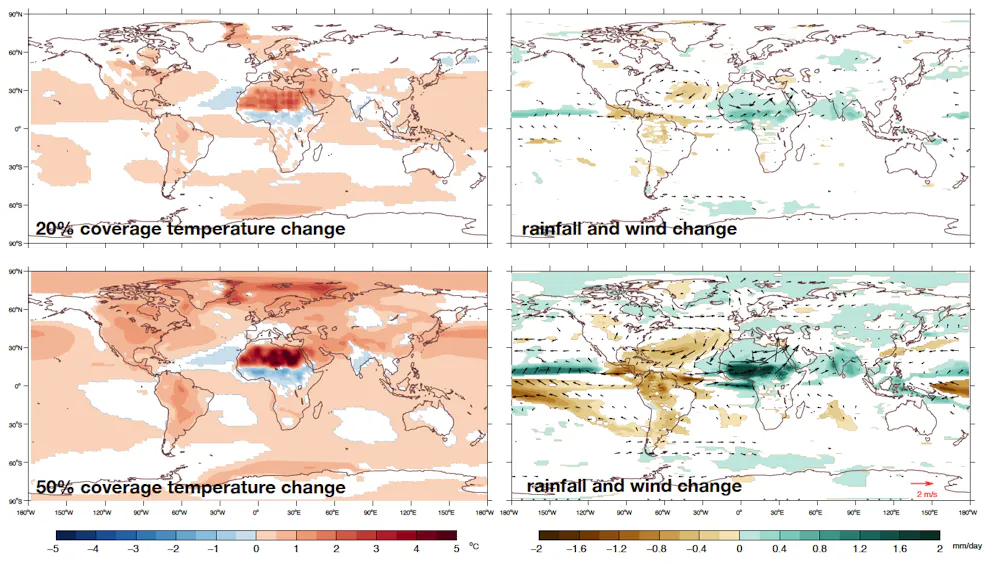
Four maps depicting regional climate changes under different Sahara solar farm scenarios.
Global temperature, rainfall and surface wind changes in simulations with 20% and 50% solar panel coverage of Sahara. Lu et al. (2021), Author provided

Some important processes are still missing from our model, such as dust blown from large deserts. Saharan dust, carried on the wind, is a vital source of nutrients for the Amazon and the Atlantic Ocean. So a greener Sahara could have an even bigger global effect than our simulations suggested.

We are only beginning to understand the potential consequences of establishing massive solar farms in the world’s deserts. Solutions like this may help society transition from fossil energy, but Earth system studies like ours underscore the importance of considering the numerous coupled responses of the atmosphere, oceans and land surface when examining their benefits and risks.

Zhengyao Lu, Researcher in Physical Geography, Lund University and Benjamin Smith, Director of Research, Hawkesbury Institute for the Environment, Western Sydney University

This article is republished from The Conversation under a Creative Commons license. Read the original article.


Tags: SB001
DMCA.com Protection Status

SUBSCRIBE to our NEWSLETTER

[mc4wp_form id=”2384248″]

Don't Miss

The evolution of Aesthetic Surgery through the lens of Dr Kourosh Tavakoli

by Pauline Torongo
4 December 2025
The evolution of Aesthetic Surgery through the lens of Dr. Kourosh Tavakoli
Health & Wellness

As global interest in Australian cosmetic surgery continues to grow, the combination of regulation, research and emerging digital tools is...

Read moreDetails

Ryan: Building real freedom through e-commerce

by Pauline Torongo
27 November 2025
Ryan: Building real freedom through e-commerce
Business & Finance

Ryan’s greatest achievement isn’t any single business or revenue milestone — it’s the ecosystem he’s built through the Change community.

Read moreDetails

Design Australia Group: Redefining Drafting as the engine of housing growth

by Pauline Torongo
26 November 2025
Design Australia Group: Redefining Drafting as the engine of housing growth
Business & Finance

Australia is under pressure to build homes faster, but design bottlenecks slow progress. Design Australia Group is fixing this by...

Read moreDetails

Louis Guy Detata builds Global Trading Empires through autonomous systems and disciplined leadership

by Pauline Torongo
25 November 2025
Louis Guy Detata builds Global Trading Empires through autonomous systems and disciplined leadership
Business & Finance

The path from investment banking to leading a global trading platform has taught Louis Detata that sustainable success requires more...

Read moreDetails

Burning Eucalyptus Wood: Tips, Advantages, Disadvantages & Alternatives

by Fazila Olla-Logday
20 November 2025
Image Supplied
Enviroment

Learn about burning eucalyptus wood for stoves and fireplaces. Discover benefits, drawbacks, harvesting tips, and better alternative firewood options for...

Read moreDetails

Everything Parents Need to Know About Baby Soft Play and Why It’s a Game Changer

by Fazila Olla-Logday
11 November 2025
Everything Parents Need to Know About Baby Soft Play
Health & Wellness

Baby soft play is a fun, safe, and educational way for little ones to explore and grow. Discover the benefits...

Read moreDetails

WOMAD Sets Up a New Camp in Wiltshire – Australian festival fans take note!

by Kris Griffiths
11 November 2025
Kumbia Boruka brought their reggae and dancehall flavour to the Taste the World Stage at WOMAD 2024 - Credit - Mike Massaro
Entertainment

With its 2026 edition moving to Neston Park in England, WOMAD offers Aussie music lovers a chance to reconnect with global...

Read moreDetails
Load More

Copyright © Blue Sky Publications Ltd. All Rights Reserved.
australiantimes.co.uk is a division of Blue Sky Publications Ltd. Reproduction without permission prohibited. DMCA.com Protection Status

  • About us
  • Write for Us
  • Advertise
  • Contact us
  • T&Cs, Privacy and GDPR
No Result
View All Result
  • News
    • Weather
    • Sport
    • Technology
    • Business & Finance
      • Currency Zone
    • Lotto Results
      • The Lott
  • Lifestyle
    • Entertainment
    • Horoscopes
    • Health & Wellness
    • Recipes
  • Travel
  • Expat Life
  • Move to Australia

Copyright © Blue Sky Publications Ltd. All Rights Reserved.
australiantimes.co.uk is a division of Blue Sky Publications Ltd. Reproduction without permission prohibited. DMCA.com Protection Status

No Result
View All Result
  • News
    • Weather
    • Sport
    • Technology
    • Business & Finance
      • Currency Zone
    • Lotto Results
      • The Lott
  • Lifestyle
    • Entertainment
    • Horoscopes
    • Health & Wellness
    • Recipes
  • Travel
  • Expat Life
  • Move to Australia

Copyright © Blue Sky Publications Ltd. All Rights Reserved.
australiantimes.co.uk is a division of Blue Sky Publications Ltd. Reproduction without permission prohibited. DMCA.com Protection Status





