• Advertise
  • About us
  • Terms and Conditions
  • Contact us
Sunday, December 7, 2025
Australian Times News
  • News
    • Weather
    • Sport
    • Technology
    • Business & Finance
      • Currency Zone
    • Lotto Results
      • The Lott
  • Lifestyle
    • Entertainment
    • Horoscopes
    • Health & Wellness
    • Recipes
  • Travel
  • Expat Life
  • Move to Australia
No Result
View All Result
  • News
    • Weather
    • Sport
    • Technology
    • Business & Finance
      • Currency Zone
    • Lotto Results
      • The Lott
  • Lifestyle
    • Entertainment
    • Horoscopes
    • Health & Wellness
    • Recipes
  • Travel
  • Expat Life
  • Move to Australia
No Result
View All Result
Australian Times News
No Result
View All Result
Home News

Sea levels are rising fastest in big cities – here’s why

Subsidence can threaten flooding in low-lying coastal areas, much more so than rising sea levels, yet scientists are only just realising the global implications of the threat with respect to coastal cities.

The Conversation by The Conversation
19-03-2021 06:29
in News
Photo by Leon Seibert on Unsplash

Photo by Leon Seibert on Unsplash

Sally Brown, Bournemouth University and Robert James Nicholls, University of East Anglia

It is well known that climate-induced sea level rise is a major threat. What is less well know is the threat of sinking land. And in many of the most populated coastal areas, the land is sinking even faster than the sea is rising.

Parts of Tokyo for instance sank by 4 metres during the 20th century, with 2 metres or more of sinking reported in Shanghai, Bangkok, and New Orleans. This process is known as subsidence. Slow subsidence happens naturally in river deltas, and it can be accelerated by the extraction of groundwater, oil or gas which causes the soil to consolidate and the surface to lose elevation.
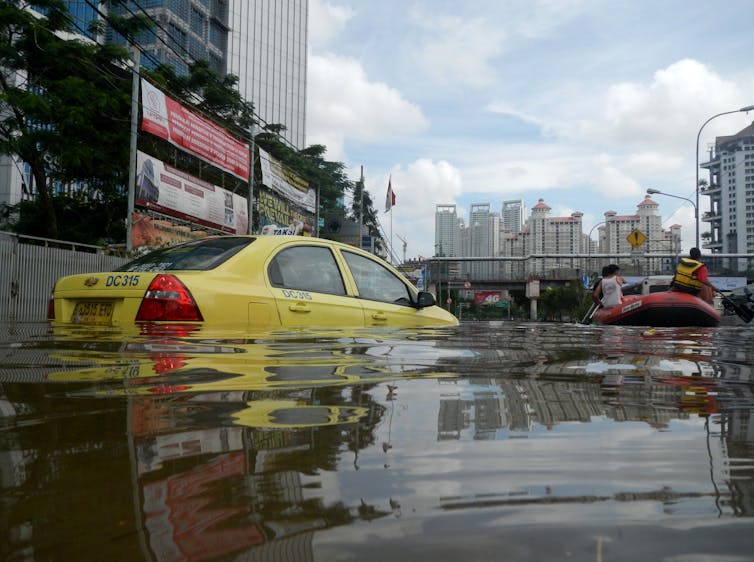
Jakarta is sinking while sea levels rise. dani daniar / shutterstock

Subsidence leads to relative sea level rise (sea level rise plus land sinking). It turns croplands salty, damages buildings, causes widespread flooding and can even mean the loss of entire coastal areas.

Subsidence can threaten flooding in low-lying coastal areas, much more so than rising sea levels, yet scientists are only just realising the global implications of the threat with respect to coastal cities.

In fact, while the average coastal area experiences relative sea level rise of less than 3mm per year, the average coastal resident experiences a rise of around 8mm to 10mm per year. This is because so many people live in deltas and especially cities on deltas that are subsiding. That’s the key finding of our new research, where we analysed how fast cities are sinking across the world and compared them with global subsidence data including less densely populated coastlines.
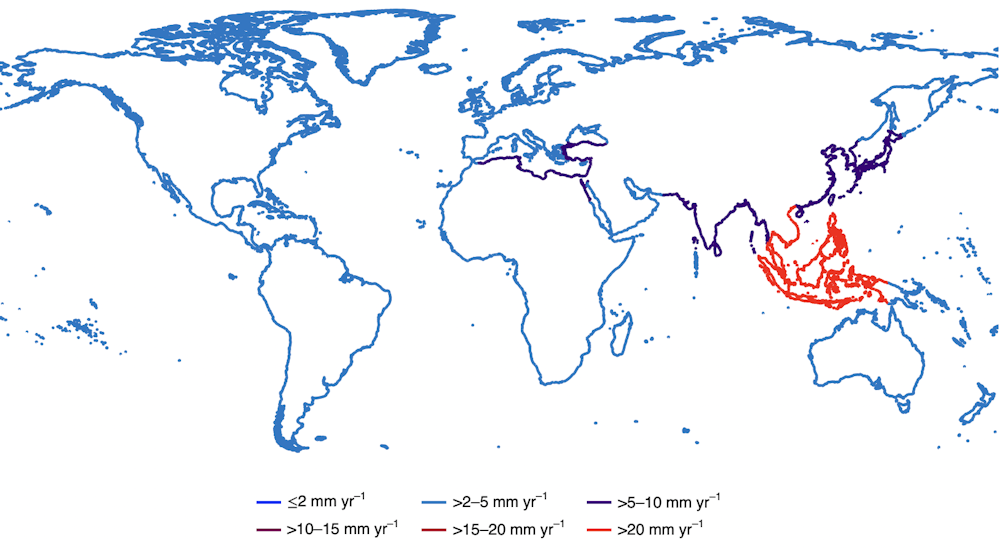
Map showing relative sea level rise in 23 coastal regions around the world.
When weighted by population, relative sea level rise is worst in south east Asia, followed by south and east Asia, and the southern Mediterranean. Nicholls et al, CC BY-SA

Our finding reflects that people often choose to live in river deltas, floodplains and other areas that were already prone to sinking, and in doing so will further enhance subsidence. In particular, subsiding cities contain more than 150 million people in the coastal zone – that’s roughly 20% of people in the world who live by the sea. This means relative sealevel rise will have a more sudden and more severe impact than scientists had originally thought.


AlsoRead...

Ryan: Building real freedom through e-commerce

Ryan: Building real freedom through e-commerce

27 November 2025
Design Australia Group: Redefining Drafting as the engine of housing growth

Design Australia Group: Redefining Drafting as the engine of housing growth

26 November 2025

Here are a few of the most affected cities:

Jakarta

The Indonesian capital Jakarta is home to 10 million people, and is built on low-lying land next to the sea. Groundwater extraction caused the city to sink more than three metres from 1947 to 2010 and much of the city is still sinking by 10cm or more each year.

Subsidence does not occur evenly, leading to uneven risks that make urban planning difficult. Buildings are now flooded, cracks are appearing in infrastructure which is being abandoned.

Jakarta has built higher sea walls to keep up with the subsidence. But since groundwater pumping continues, this patching-up policy can only last so long before the same problems occur again. And the city needs to keep pumping since groundwater is used for drinking water. Taking water, the very thing that humans need to survive, ultimately puts people at risk from inundation.

The battle against subsidence is slowly being lost, with the government proposing in 2019 to move the capital to a purpose-built city on the island of Borneo more than 1,000km away, with subsidence being one of many reasons.

Shanghai

Developing rapidly in the past few decades, and now with a population of 26 million, Shanghai is another sinker. The city has maximum subsidence rates of around 2.5cm a year. Again this is mostly caused by lowering groundwater levels, in this case thanks to drainage to construct skyscrapers, metro lines and roads (for instance Metro Line 1, built in the 1990s, caused rapid subsidence).
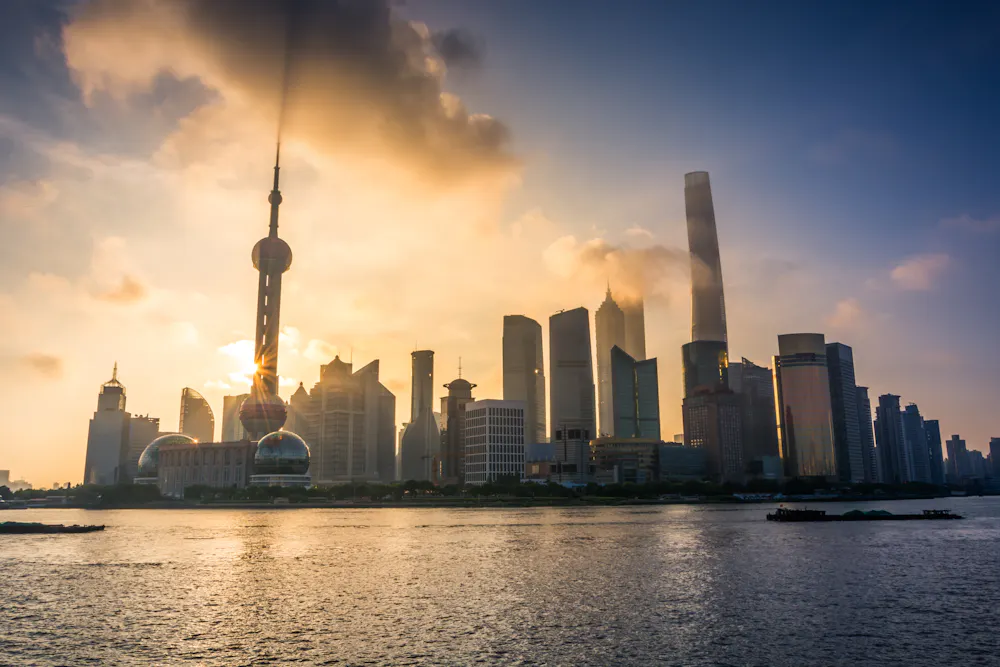
Body of water in front of lots of skyscrapers.
Shanghai is found where the river Yangtze meets the sea. John_T / shutterstock

If no additional protection is built, by 2100 this rate of subsidence and sea level rise mean that a storm surge could flood around 15% of the city.

New Orleans

In New Orleans, centuries of embankments and ditches had effectively drained the city and sunk it, leaving about half of it below sea level.
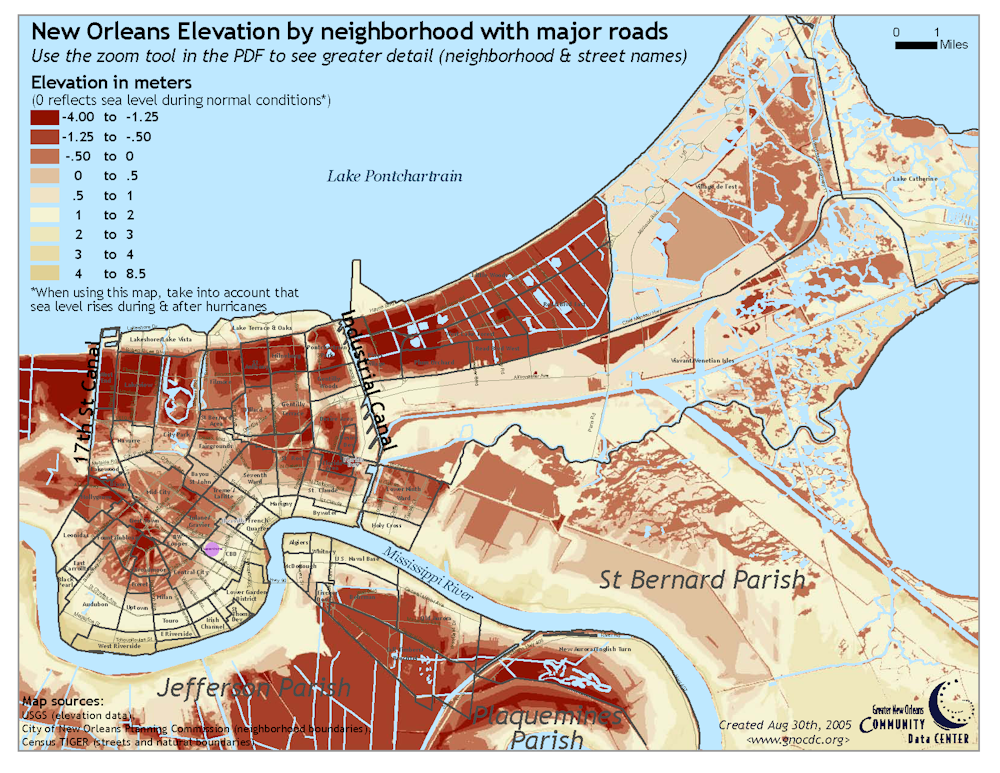
Map of New Orleans with shaded areas below sea level.
Much of New Orleans is below sea level (red) and relies on sea walls to stay dry. The Data Center, New Orleans, CC BY-SA

When Hurricane Katrina breached the levees in 2005, the city did not stand a chance. The hurricane caused at least US$40 billion (£29 billion) in damage and particularly took its toll on the city’s African American community. More than 1,570 people died across the state of Louisiana.

If the city had not subsided, damage would have been greatly reduced and lives would have been saved. Decisions that were made many decades or more ago set the path for the disasters that are seen today, and what we will see in the future.

There are no simple solutions

So what can be done? Building a sea wall or dike is one immediate solution. This of course stops the water coming in, but remember that the sea wall is sinking too, so it has to be extra large in order to be effective in the long-term. In urban areas, engineers cannot raise ground easily: that can take decades as buildings and infrastructure are renewed. There is no simple solution, and large-scale urban subsidence is largely irreversible.

Some cities have found “solutions”. Tokyo for instance managed to stop subsidence from about 1960 onwards thanks to stronger regulations on water pumping, but it cannot get rid of the overall risk as parts of city are below sea level and depend on dikes and pumps to be habitable. Indonesia’s bold proposal to move its capital city may be the ultimate solution.

Increased urbanisation especially in deltas areas and the demand for freshwater means subsidence will remain a pressing issue in the coming decades. Dealing with subsidence is complementary to dealing with climate-induced sea level rise and both need to be addressed. A combination of rising seas and sinking lands will increasingly leave coastal cities at risk.

Sally Brown, Scientist, Bournemouth University and Robert James Nicholls, Professor of Climate Adaptation, University of East Anglia

This article is republished from The Conversation under a Creative Commons license. Read the original article.


Tags: SB001
DMCA.com Protection Status

SUBSCRIBE to our NEWSLETTER

[mc4wp_form id=”2384248″]

Don't Miss

The evolution of Aesthetic Surgery through the lens of Dr Kourosh Tavakoli

by Pauline Torongo
4 December 2025
The evolution of Aesthetic Surgery through the lens of Dr. Kourosh Tavakoli
Health & Wellness

As global interest in Australian cosmetic surgery continues to grow, the combination of regulation, research and emerging digital tools is...

Read moreDetails

Ryan: Building real freedom through e-commerce

by Pauline Torongo
27 November 2025
Ryan: Building real freedom through e-commerce
Business & Finance

Ryan’s greatest achievement isn’t any single business or revenue milestone — it’s the ecosystem he’s built through the Change community.

Read moreDetails

Design Australia Group: Redefining Drafting as the engine of housing growth

by Pauline Torongo
26 November 2025
Design Australia Group: Redefining Drafting as the engine of housing growth
Business & Finance

Australia is under pressure to build homes faster, but design bottlenecks slow progress. Design Australia Group is fixing this by...

Read moreDetails

Louis Guy Detata builds Global Trading Empires through autonomous systems and disciplined leadership

by Pauline Torongo
25 November 2025
Louis Guy Detata builds Global Trading Empires through autonomous systems and disciplined leadership
Business & Finance

The path from investment banking to leading a global trading platform has taught Louis Detata that sustainable success requires more...

Read moreDetails

Burning Eucalyptus Wood: Tips, Advantages, Disadvantages & Alternatives

by Fazila Olla-Logday
20 November 2025
Image Supplied
Enviroment

Learn about burning eucalyptus wood for stoves and fireplaces. Discover benefits, drawbacks, harvesting tips, and better alternative firewood options for...

Read moreDetails

Everything Parents Need to Know About Baby Soft Play and Why It’s a Game Changer

by Fazila Olla-Logday
11 November 2025
Everything Parents Need to Know About Baby Soft Play
Health & Wellness

Baby soft play is a fun, safe, and educational way for little ones to explore and grow. Discover the benefits...

Read moreDetails

WOMAD Sets Up a New Camp in Wiltshire – Australian festival fans take note!

by Kris Griffiths
11 November 2025
Kumbia Boruka brought their reggae and dancehall flavour to the Taste the World Stage at WOMAD 2024 - Credit - Mike Massaro
Entertainment

With its 2026 edition moving to Neston Park in England, WOMAD offers Aussie music lovers a chance to reconnect with global...

Read moreDetails
Load More

Copyright © Blue Sky Publications Ltd. All Rights Reserved.
australiantimes.co.uk is a division of Blue Sky Publications Ltd. Reproduction without permission prohibited. DMCA.com Protection Status

  • About us
  • Write for Us
  • Advertise
  • Contact us
  • T&Cs, Privacy and GDPR
No Result
View All Result
  • News
    • Weather
    • Sport
    • Technology
    • Business & Finance
      • Currency Zone
    • Lotto Results
      • The Lott
  • Lifestyle
    • Entertainment
    • Horoscopes
    • Health & Wellness
    • Recipes
  • Travel
  • Expat Life
  • Move to Australia

Copyright © Blue Sky Publications Ltd. All Rights Reserved.
australiantimes.co.uk is a division of Blue Sky Publications Ltd. Reproduction without permission prohibited. DMCA.com Protection Status

No Result
View All Result
  • News
    • Weather
    • Sport
    • Technology
    • Business & Finance
      • Currency Zone
    • Lotto Results
      • The Lott
  • Lifestyle
    • Entertainment
    • Horoscopes
    • Health & Wellness
    • Recipes
  • Travel
  • Expat Life
  • Move to Australia

Copyright © Blue Sky Publications Ltd. All Rights Reserved.
australiantimes.co.uk is a division of Blue Sky Publications Ltd. Reproduction without permission prohibited. DMCA.com Protection Status