• Advertise
  • About us
  • Terms and Conditions
  • Contact us
Thursday, February 5, 2026
Australian Times News
  • News
    • Weather
    • Sport
    • Technology
    • Business & Finance
      • Currency Zone
    • Lotto Results
      • The Lott
  • Lifestyle
    • Entertainment
    • Horoscopes
    • Health & Wellness
    • Recipes
  • Travel
  • Expat Life
  • Move to Australia
No Result
View All Result
  • News
    • Weather
    • Sport
    • Technology
    • Business & Finance
      • Currency Zone
    • Lotto Results
      • The Lott
  • Lifestyle
    • Entertainment
    • Horoscopes
    • Health & Wellness
    • Recipes
  • Travel
  • Expat Life
  • Move to Australia
No Result
View All Result
Australian Times News
No Result
View All Result
Home News

One metre or two? The science behind social distancing

China, Denmark and France recommend social distancing of one metre; Australia, Germany and Italy recommend 1.5 metres, and the US recommends six feet.

The Conversation by The Conversation
19-06-2020 18:05
in News
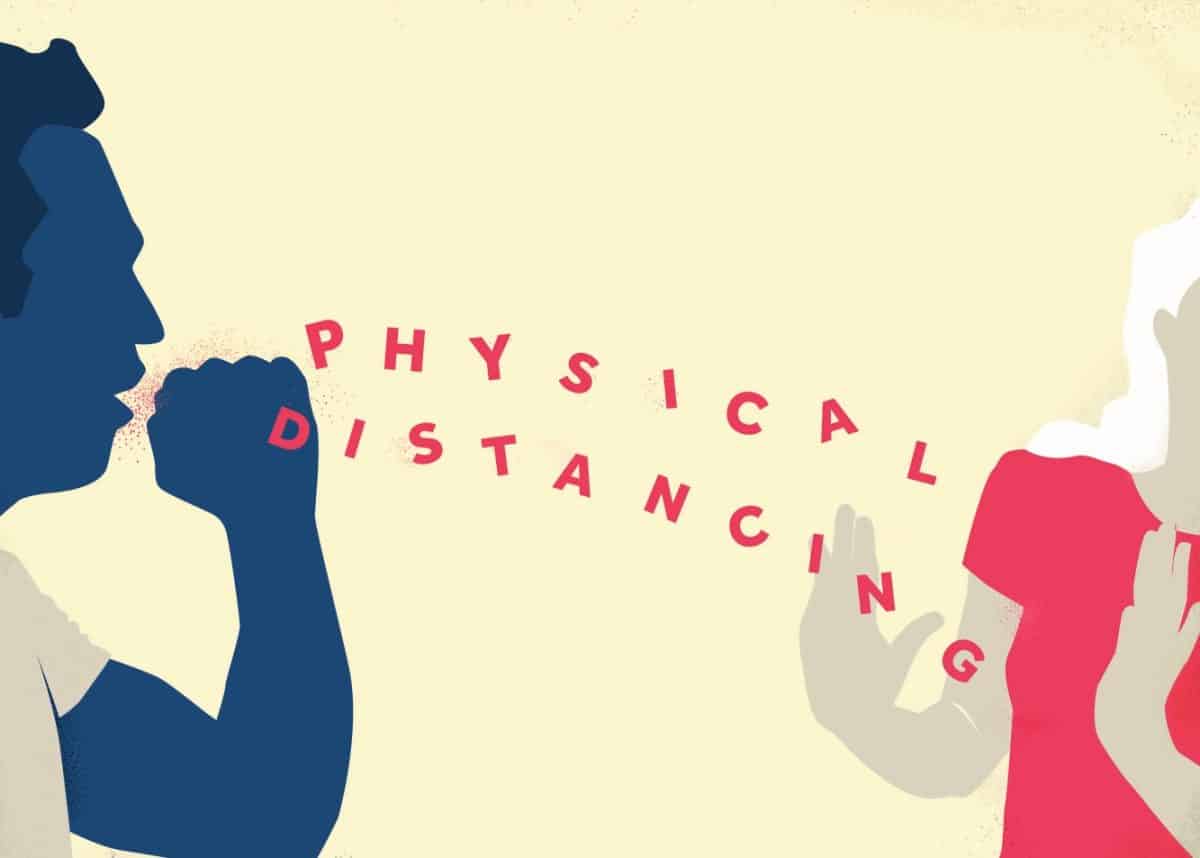
The science behind social distancing

The science behind social distancing Image created by Kyle Mueller. Submitted for United Nations

Lena Ciric, UCL

What constitutes a safe distance when it comes to the spread of COVID-19? The answer depends on where you live.

China, Denmark and France recommend social distancing of one metre; Australia, Germany and Italy recommend 1.5 metres, and the US recommends six feet, or 1.8 metres. The UK, meanwhile, is reconsidering its relatively large two-metre distancing rule, but has attracted criticism from top scientists for doing so.
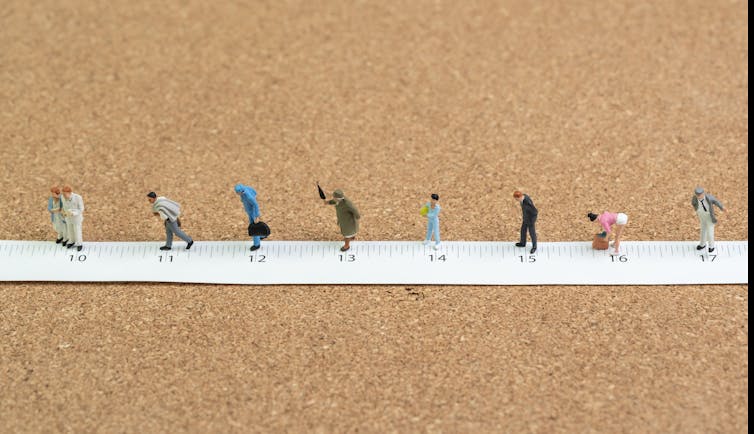
eamesBot/Shutterstock

The truth is, we don’t yet know how far is far enough when it comes to coronavirus. A recent study found the virus in air as far as four metres away from infected patients in a COVID-19 ward. But another study, touted by the WHO, concluded that the risk of transmission becomes significantly lower with a distance of one metre or more from an infected person, reducing further with increased distance.

Why such a range of “safe” distances? That’s because social distancing is a complex problem with many variable influencing factors. Here are four of the most important ones.

Respiratory droplets

When we breathe, talk, cough and sneeze, thousands of droplets are expelled from our mouth and nose. The size of these droplets varies – some may be millimetres in size and some might be many thousands of times smaller. The larger droplets, which carry more virus particles, settle more quickly due to gravity. The smaller droplets, carrying fewer particles, can remain suspended in the air for hours.

The number and size of droplets vary depending on the activity. A cough produces more droplets overall and a greater proportion of them are larger. Breathing produces fewer droplets overall and they are generally smaller. The speed with which the droplets leave your mouth and nose also influences how far they travel – sneeze droplets will travel furthest.


AlsoRead...

Brandon Willington: The Marketing Entrepreneur turning heads across Australia

Brandon Willington: The Marketing Entrepreneur Turning Heads Across Australia

8 January 2026
How Turnkey Building Group Is Restoring Trust In An Industry Known For Customer Disappointment

How Turnkey Building Group Is Restoring Trust In An Industry Known For Customer Disappointment

17 December 2025

Viral load

Viral load refers to the number of copies of the virus in a sample (for example, in the droplets that leave our mouth and nose). We know the number of virus copies in the respiratory samples of COVID-19 patients can vary from a few thousand to hundreds of billions per millilitre.

The viral load varies from one person to another, but also depends on what stage of the illness the patient is at. We also know that people without symptoms can shed the virus.

Knowing the viral load in respiratory droplets allows us to calculate how many virus particles people may be exposed to and whether this might be enough for them to become infected.

Infectious dose

The infectious dose is the number of copies of the virus that your body needs to be exposed to in order to develop an infection. When it comes to calculating a safe distance, the closer you are to an infected person, the more likely you are to be exposed to the infectious dose by breathing in virus-laden droplets.

The infectious dose for influenza strains varies from thousands to millions of copies. We do not yet know this number for SARS-CoV-2.

In time, further research on how the virus behaves in humans and other animals, and comparisons to other viruses will help to hone this number. In any case, we can be certain that the infectious dose will vary between different people.

The environment

Whether we are indoors or outdoors, in school, at work, on public transport or in the supermarket, the flow of air, ventilation, temperature and humidity will influence what happens to respiratory droplets.
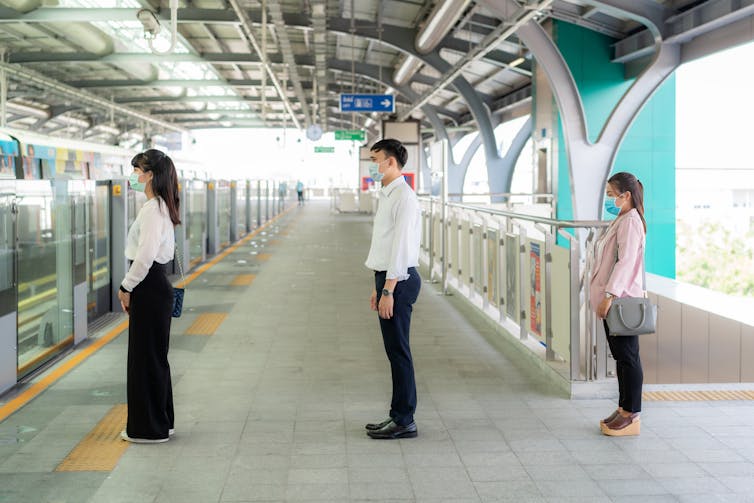
A lot depends on our environment when it comes to how water droplets spread. TravelerPix/Shutterstock

Air currents will blow droplets around in various directions. Good ventilation will dilute the number of droplets in the air. Temperature and humidity will affect the rate at which water evaporates from droplets. All this will affect our understanding of how much distance to keep in different types of space.

Complex scenarios

With these four elements, we can begin to put together what makes a safe distance.

Let’s start with this scenario: three people are in a room that is not ventilated. One of them is infected and two are not. One of the healthy people is standing closer to the infected person – for example, 80 centimetres away – and one is further away, say two metres.

The infected person coughs, producing a cloud of droplets. The larger droplets carrying more virus particles settle more quickly due to gravity. The smaller droplets carrying less virus travel further. So the person standing closer to the infected patient is at higher risk of being exposed to infectious droplets than the one standing further away.

Of course, the above scenario is overly simple. People move around. An open window may blow air in a particular direction. The infected person may cough repeatedly during a period of time. An air conditioner might recirculate air around a room. Room temperature and humidity may result in drying leading to smaller particles carrying higher concentrations of virus. Exposure to many smaller droplets over a longer period of time may be equivalent to exposure to a few larger ones in a short period.

There is an infinite number of scenarios and having one rule that applies to them all is impossible.

This means that different countries’ rules are, ultimately, best guesses made on the basis of some of the factors described above. They cannot apply in all contexts.

It is very unlikely that you would be exposed to infectious droplets outdoors because of rapid air flow and dilution, but enclosed crowded indoor spaces are much more of a risk. We all need to do our bit to stop the spread of coronavirus, so keep your distance, preferably as far as you can.

Lena Ciric, Associate Professor in Environmental Engineering, UCL

This article is republished from The Conversation under a Creative Commons license. Read the original article.


Tags: SB001
DMCA.com Protection Status

SUBSCRIBE to our NEWSLETTER

[mc4wp_form id=”2384248″]

Don't Miss

Lyca Mobile Australia’s Customer-First Overhaul Pays Off with Finder Award Win

by Fazila Olla-Logday
2 February 2026
Lyca Mobile Australia's Customer-First Overhaul Pays Off with Finder Award Win
Technology

Lyca Mobile Australia’s customer-first overhaul has earned a Finder Award, recognising its improved value, service, and stronger focus on Australian...

Read moreDetails

From Driveway to Dream Court: The Rise of High-Performance Hoops at Home in 2026

by Fazila Olla-Logday
20 January 2026
The Rise of High-Performance Hoops at Home in 2026
Sport

High-performance home basketball hoops are gaining momentum in 2026, as more homeowners invest in durable, professional-grade systems that combine advanced...

Read moreDetails

Brandon Willington: The Marketing Entrepreneur Turning Heads Across Australia

by Pauline Torongo
8 January 2026
Brandon Willington: The Marketing Entrepreneur turning heads across Australia
Business & Finance

Brandon Willington, founder of “Where U?” is changing the narrative for Australian businesses tired of inconsistent leads and empty promises.

Read moreDetails

How Turnkey Building Group Is Restoring Trust In An Industry Known For Customer Disappointment

by Fazila Olla-Logday
17 December 2025
How Turnkey Building Group Is Restoring Trust In An Industry Known For Customer Disappointment
Business & Finance

Turnkey Building Group is changing the narrative in an industry often associated with missed deadlines and broken promises. By prioritizing...

Read moreDetails

Risk Awareness for International Travellers – What Australians Should Know Before Entering Multi-State Regions

by Fazila Olla-Logday
10 December 2025
Schengen
Travel

This guide helps Australian travellers understand cross-border requirements, assess political and environmental risks, manage health and safety considerations, and prepare...

Read moreDetails

The evolution of Aesthetic Surgery through the lens of Dr Kourosh Tavakoli

by Pauline Torongo
4 December 2025
The evolution of Aesthetic Surgery through the lens of Dr. Kourosh Tavakoli
Health & Wellness

As global interest in Australian cosmetic surgery continues to grow, the combination of regulation, research and emerging digital tools is...

Read moreDetails

Ryan: Building real freedom through e-commerce

by Pauline Torongo
27 November 2025
Ryan: Building real freedom through e-commerce
Business & Finance

Ryan’s greatest achievement isn’t any single business or revenue milestone — it’s the ecosystem he’s built through the Change community.

Read moreDetails
Load More

Copyright © Blue Sky Publications Ltd. All Rights Reserved.
australiantimes.co.uk is a division of Blue Sky Publications Ltd. Reproduction without permission prohibited. DMCA.com Protection Status

  • About us
  • Write for Us
  • Advertise
  • Contact us
  • T&Cs, Privacy and GDPR
No Result
View All Result
  • News
    • Weather
    • Sport
    • Technology
    • Business & Finance
      • Currency Zone
    • Lotto Results
      • The Lott
  • Lifestyle
    • Entertainment
    • Horoscopes
    • Health & Wellness
    • Recipes
  • Travel
  • Expat Life
  • Move to Australia

Copyright © Blue Sky Publications Ltd. All Rights Reserved.
australiantimes.co.uk is a division of Blue Sky Publications Ltd. Reproduction without permission prohibited. DMCA.com Protection Status

No Result
View All Result
  • News
    • Weather
    • Sport
    • Technology
    • Business & Finance
      • Currency Zone
    • Lotto Results
      • The Lott
  • Lifestyle
    • Entertainment
    • Horoscopes
    • Health & Wellness
    • Recipes
  • Travel
  • Expat Life
  • Move to Australia

Copyright © Blue Sky Publications Ltd. All Rights Reserved.
australiantimes.co.uk is a division of Blue Sky Publications Ltd. Reproduction without permission prohibited. DMCA.com Protection Status